Telemann: 12 Fantasias for Solo Violin
Corelli’s solo sonatas were officially published in 1700, and Telemann came to publish a set of solo violin works in 1735 in the city of Hamburg. As far as we know, Telemann was a self-taught violinist.
These solo works aren’t given nearly the same kind of attention as Bach’s 3 sonatas and 3 partitas. I’ve found them to be interesting and like the mood that Telemann achieves in so many of the individual movements. Yet, compared to Bach, these are more melodic, less virtuosic. And while not as popular as Bach’s solo works for violin, there are a number of recordings available, both on modern and baroque violin.
In this survey I wanted to do a survey rather than review a single release. The recordings I’ve chosen to compare include all baroque specialists:
- Elfa Rún Kristinsdóttir (on her own label) (72 min)
- Andrew Manze (Harmonia Mundi) (71 min)
- Federico Guglielmo (Brilliant Classics) (72 min)
- Gunar Letzbor (Pan Classics) (72 min)
- Fabio Biondi (Glossa) (63 min)
It was Manze’s recording that I first became aware of these works. It was released in 1995 and I got it when it came out, so you can say I’ve lived with it for a long time.
There’s no bad recording in this bunch, I should point out. It can be very challenging to perform by yourself. Many of the artists listed above are known for leading ensembles. There’s a special intimacy with having just the conductor/director/leader alone in our living rooms through a recording.
You’ll notice that many of these recordings take up the same amount of time- between 71-72 minutes total. The odd-one out is Biondi at 63. I hope to provide some summary remarks about each recording below.
The Fantasias
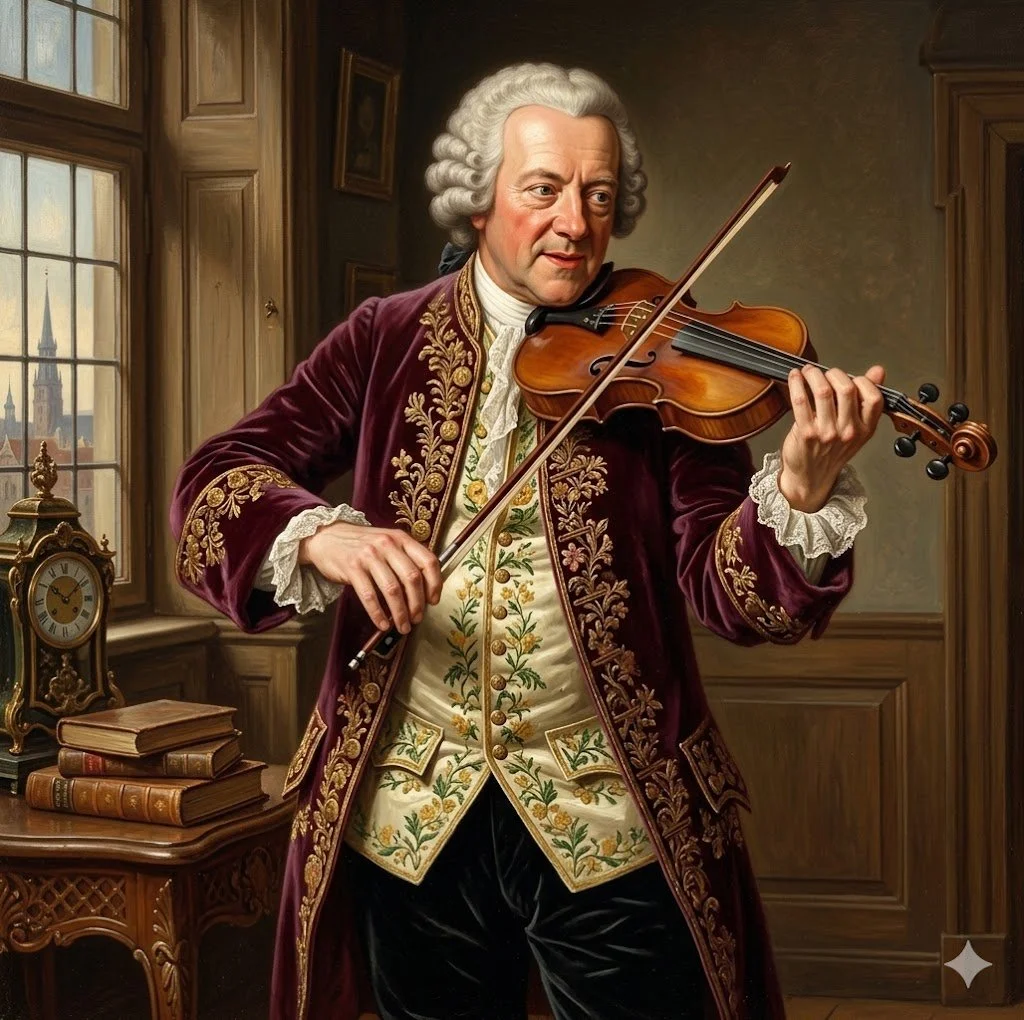
Telemann's twelve Fantasias for Solo Violin, TWV 40:14–25, published in Hamburg in 1735, occupy a peculiar and under-appreciated corner of the Baroque repertoire. The unaccompanied violin was not entirely novel territory — Bach's six sonatas and partitas, BWV 1001–1006, had circulated in manuscript since around 1720 — but where Bach's works press the instrument toward polyphonic density and architectural grandeur, Telemann's approach is characteristically different: lighter in texture, more cosmopolitan in idiom, and more overtly galant in their melodic orientation.
That Telemann published these works during his lifetime, in contrast to Bach's works which remained largely in manuscript, tells us something about his relationship to his audience — these were pieces intended to reach players and listeners directly, not to sit in a drawer. Written during his long tenure as Kantor in Hamburg, the fantasias reflect the city's mercantile cosmopolitanism: French dance gestures, Italian melodic lyricism, and German counterpoint all leave their marks, sometimes within the same piece. It should be noted he also published around the same time solo pieces for flute, viol da gamba and harpsichord.
Biondi
Biondi’s flashy recording, recorded in Nigoline di Corte Franca, at the church of Sant’Eufemia, is a particularly live recording with respect to the amount of reverb. We hear as much reflection as we do tone from his 1767 Gagliano violin.
His approach includes speed which aims, I think, to turn these pieces upon their head as virtuosic exemplars. Probably among the other performances, Biondi uses more vibrato. It’s not as if he’s lost his way in HIPP, but he uses it as an affective artifice.
I remember when this album came out, thinking “wow.” His interpretations felt like a breath of fresh air. The recording is made upon a borrowed historical violin.
Letzbor
There’s quite a bit of ink used to convey thoughts from the artist on the recording of this album. Using his long-owned Klotz violin, which he confesses to loving, the recording was made at the famous St. Florian monastery in Austria, but in the confines of a smaller room. I will admit that the acoustics captured in this recording are pretty special: we get a nearly 50/50 mix of reflection with sound coming directly from the instrument. The effect, I imagine, is like playing and watching yourself in the mirror.
Letzbor is an interesting interpreter; I’ve been on the record with not entirely embracing some of his interpretive decisions across some recordings. But I can confidently vouch for his interpretations here: there’s no pretension in his performances. He’s not trying to push the music toward its limits; instead, he’s pretty even in projecting what’s on the page while also clearly listening to the results.
If the use of vibrato in Biondi’s interpretation bothers, it’s absent here.
Guglielmo
This is an artist I’ve followed for years. Probably more than any other, it’s been easy to trace his development over time. His early recordings with L’Arte dell’Arco weren’t as confident as the man who set about to record his Vivaldi collection. Yes, he’s aged well over time—offering recordings with increasing value.
This recording, too, is made with significant reverb, offering what I’d wager is about a 70/30 split, with the majority of the recording made up of reflection. In some ways, his style aligns to that of Biondi, without the vibrato, at least in the quicker movements.
His violin has a good tone, which yes, in a solo recording, becomes a central issue. In listening to the 18th track, the Presto from the 6th fantasia, there’s a good strong authority from the violinist on the double stops. Every detail might not come into perfect focus given the album’s acoustic, but there’s a knack Guglielmo has in helping us feel the rhythmic energy in many of the pieces, the faster ones, especially.
Elfa Rún
This recording is the “dry” one in terms of acoustics; it’s not there’s no ambiance in the recording, but the mixture is something like 30/70, the lower number representing how much of the ambiance is presented.
I’m familiar with this artist through her recordings of baroque violin sonatas (2020) and the Bach violin concertos (2011).
There’s a great grit to her sound, in pieces like the B-flat major fantasia #1 (Track 1). Being so close to the bow on strings is a palpable, if not nerve-racking place to be. But confidence is and should be on her side. She’s a formidable player and that raw edge offered in this recording is a bonus.
As much as Biondi may revel in the special violin he was offered for his recording, or the love affair Letzbor has for his instrument, I have to say that the sound of Elfa Rún Kristinsdottir’s violin, for me, is among the most gorgeous. Give yourself some time with the final fantasia in A minor and enjoy the sonic texture. It’s pretty damn fine, right?
Manze
Andrew Manze is no longer a practicing violinist, having hung up his instrument and baroque repertoire to take on a second career as a conductor. His many recordings, however, introduced many of us to so much baroque and classical repertoire.
His recording’s sound, maybe the least attractive of the set I’ve assembled, is nearly 90/10, with us at home focused a lot of on the reflection.
Manze’s interpretations are, for me, highly personal. There’s much to admire in how he hears this music and how it’s projected to us through 1s and 0s.
He exudes comfort with the material. His own Gagliano violin is used here, which has a very particular sound. I like the application for Telemann, especially it’s clear high-end.
Conclusions
If one could only buy one album, which might it be? The recording by Kristinsdottir is probably my favorite, given both the strength of her playing and the sound of the album.
Despite my age with the Manze, the Letzbor comes to the front as another admirable contender. I appreciated too his essay on unease with the pieces until he had the time to explore them further during COVID.
These pieces—maybe more so than the ones by Bach—act as a mirror, revealing the personality of the artists. Flash and virtuosity come to the surface with Biondi; to some degree the same thing is at play with portions of Manze’s performances.
Guglielmo’s is honest, with good intonation at most every turn and a good amount of reverb for those who want that kind of sound.
The fantasias as a whole showcase who Telemann was: he was good at invention, which is coming up with musical material. I sometimes reduce this to “melodies,” but material is the more appropriate word, even if it sounds less precise. Telemann not only produced interesting melodic content, he couples it to rhythmic structures that help propel his ideas into the next. His treatment of harmony is never bizarre nor novel, but in alignment with customs of his day. He relied upon this talent more so than Bach, who in hindsight seemed nearly obsessed with counterpoint.
For those who want their music to move them, Telemann tries here. Despite his popularity in his day, it’s also remarkable that across these twelve fantasias he has moved us, maybe less, than in just one of Bach’s Sonatas and Partitas.
These collections all together are probably not all needed in one’s collection, but pick two, maybe three, and take delight in how these artists each choose to forge this music into sound. The lightness is something charming about the pieces, wherein with Bach, I find depth and profundity.
See also: Review of Sato on Telemann's Fantasias. I'd forgotten about his recording when I penned this survey.