Bach: Goldberg Variations at the Thomaskirche • Zhu
Background
Born in 1949 into an artistic, bourgeois Shanghai family, Zhu Xiao-Mei was performing on Peking radio and television by age eight and entered the Beijing Conservatory at ten. When the Cultural Revolution came, her family was split up and the seventeen-year-old was dispatched to a labor camp in Inner Mongolia. A spinet piano smuggled inside a pile of blankets and hidden in a cowshed became her lifeline — she practiced nightly after working in the fields, and it was here, initially just to warm her hands in the cold, that she turned to Bach's fugues.
She returned to Beijing in 1975, emigrated to the United States, then settled permanently in Paris in 1984, where her career — begun late and without media coverage — gradually took flight. She served on the faculty of the Conservatoire National Supérieur de Musique and sits on the juries of major international competitions including the Clara Haskil and Bach Leipzig.
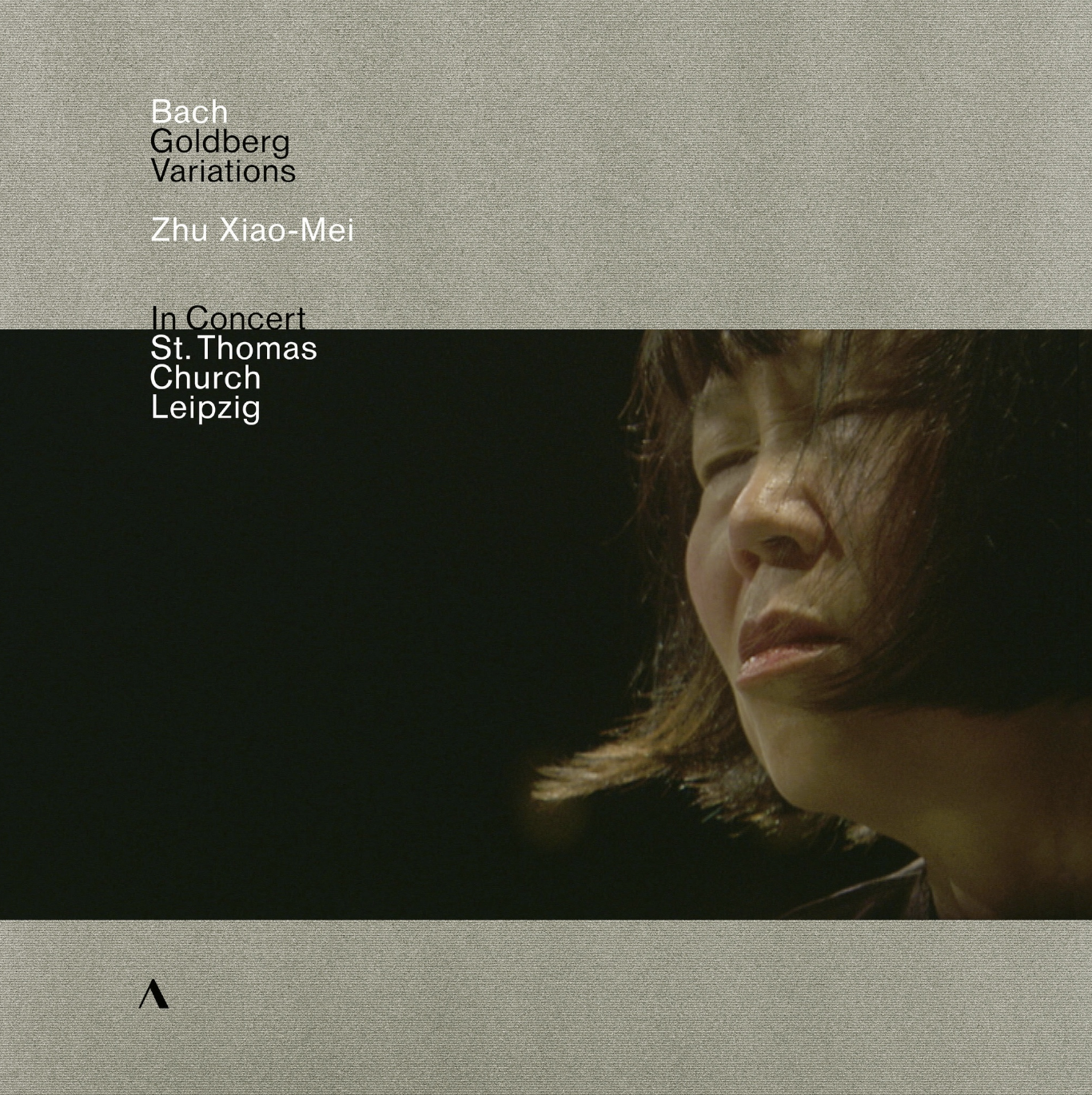
Her first recording of the Goldberg Variations appeared on Mandala in 1999 and was later reissued by Mirare. In 2014, at the Leipzig Bach Festival, she performed the Goldbergs at St. Thomas Church — the first pianist ever to do so — in a concert released on DVD with an accompanying documentary in which she reflects on Taoism, the cyclic nature of Bach's music, and her own biography. The release received a Special Achievement Award at the International Classical Music Awards, and that same year she returned to China for the first time in 35 years.
Her autobiography, The Secret Piano: From Mao's Labor Camps to Bach's Goldberg Variations, published by Robert Laffont in 2007, won the 2008 Grand Prix des Muses and has been translated into multiple languages.
The 2014 Performance in Leipzig
This April, Accentus released the live performance captured on video in 2014. I've seen portions of it, and likewise, watched a documentary about the artist. There is indeed something remarkable about her place in the greater classical music world, as is with being invited to perform at St. Thomas'. For those that don't know, it's believed to be the final resting place of Bach (as far as we know it's his bones that were moved). Each year, the Bachfest Leipzig uses Bach's church as a central location for concerts. Despite a close association with the Bach Archiv, with its association with musicologists, the festival doesn't exclusively embrace HIPP musicians.
Zhu performs without music upon a Steinway in front of a live audience. She uses pedal. With changes in dynamics and articulation. Yes, she plays the repeats. Her playing doesn't always have the crisp sound that we get on a harpsichord, but given the recording location, the sound on this release is clear and is not marred by the church's natural reverb.
It's not lost on me that Zhu's age at the time of this recording was the same as Bach's at his death, from complications from eye surgery.
I can't speak with much authority around the pianist's formal training or what she was asked to emphasize in her playing, but it only takes a few variations to recognize a strong consistency in her playing. There's a strong independence between her hands. I wouldn't call her performances romantic. They are far from the very dry touch used by Gould. There's a considerable weight to her touch upon the keys, unless she's making the notes purposely short. The use of pedal at times would annoy András Schiff. She puts the melody out in front consistently. She wants us to hear the music the way she hears it, maybe? It's almost as if it's no secret about the parts she finds interesting.
Let's take the 13th variation as an example: this recording captures far more detail around her touch than I got from the DVD recording from Arte. I can't say what kind of mastering was done on this release, but there's a far more palpable sense of dynamic range and lyrical treatment that's audible in this high-res release. This tends to be one of the more introspective variations, and here it lives that way, but without the pianist retreating into the shadows. Is every possible articulation possibility explored? No. She's detail oriented but not to the point of wanting us to only pay attention to details. And yes, I think this is deliberate.
The next variation (no. fourteen) showcases a similar way she brings variety in articulation to amplify the music. Is it ultimately polished? No, at the end of the first half, we can hear it both times, she slows just a bit, to allow the puzzle pieces held onto by both hands to interlock and stick together. Yes, the tempo slows a bit in the repeat of the second half. But do we ever lose the momentum of this movement's stream of notes? No, I'm happy to report we do not.
Yes, in fact, her 1999 recording (released in 2007 on Mirare) of the same variation comes off a lot differently. No, the sound isn't as good. The tempo is quicker, the overall pace, more controlled and without any feeling of hesitation. In 1999 the artist would have been just starting her recording career at 40 or so.
I know more about Zhu's life, her journey, her exile, her return to China, and her personality too than I know about many artists whose music I listen to. The earlier recording is tighter, technique-wise, with a far drier sound. Knowing what she's shared and put out into the world about her own musical journey? It makes this performance sit with me differently.
Take the French-ified sixteenth variation? How many times have we heard this? How many times has she played it? I get the feeling she wants us to hear it differently. I nearly see the dancer in her mind directing the melodic jumps. I can't say what her intent may be, but this performance had me experiencing this movement in a different way. She draws me in, I want to hear what she's doing or trying to do, however successful it may play compared to other performances I have heard, lingering in my own mind.
This woman has nothing to prove. She came to Leipzig, her power and experience in tow. Any artist that gets me to hear familiar music again in new and different ways has my respect.
Being invited to perform in "Bach's House," as we might be willing to call St. Thomas' (no offense intended to God), is a supreme honor.
Of course, Lang Lang's recording was made in this same space. I'm willing to offer that he has a superior piano technique, given his current age of 43.
And while I admit I was impressed with that technique, I'd choose this recording over his, any day. I can't say precisely why it appeals to me, but Bach's brilliance here seems more palpable in her hands. The twentieth variation? Those strong hammer attacks on particular notes get noticed. There's a bit of the bull in the China shop thing going on. I like it so much. Never before have I been able to hear the different lines between left and right hands so separated.
Conclusions
The recent release by Yunchan Lim is, for me, a recording that, while not loved by everyone, is pretty special to me, showcasing a young but supremely powerful talent. Those who get into piano sound and technique — specifically control of touch — may find nirvana in this recording, if not surpassed by the earlier DG release by Víkingur Ólafsson, which has even more of that control on display.
I'm also quite partial to the recording by the Korean pianist Ji. If I could only have one piano rendition, it would be his. He's willing to dig in and give nearly every variation its voice. While others may excel at technique, his balance of technique, power, and how he helps us feel Bach for me just pushes the experience ahead. And no — I haven't listened to all of the recordings of Bach's Goldberg Variations. I hope in my life to discover more, maybe some already recorded, some yet to be? It's a piece that we can squeeze over and over and learn and feel new things.
Even if Zhu's recording isn't as technically tight as some I've just mentioned, I don't think we should discount this performance. There's a real labor in the performance of the 26th variation. You can hear it, not only with fingers at the keyboard, but in the breathing of the pianist. Yet, there's a charm at play too, no? How the melodic, chordal component is articulated against the endless running? The separation is purposeful. The performance, careful, plotting, the voices, while played together, audibly separate.
The opening variation carries with it more energy and promise. There's nothing clever being tried. It's, I don't know, honest? Yeah, that's a good descriptor for me. And that honesty comes through track after track, variation after variation.
I've heard a few live performances of this work. I remember watching a doctoral student at his recital at Eastman go for this work at a period piano. He was a great talent, but man, did he crash and burn. Lesson learned for me: even if you've memorized it, don't leave your music backstage.
Watching Zhu Xiao-Mei perform this — and yes, going back to the video on YouTube — I'm struck by how she plays, for most of it with eyes closed. I know what it's like to feel music in your fingers. There are spots where something doesn't always come out just so, maybe as clearly articulated, or with the hands ultimately in sync? It's her recovery from these moments that I find so satisfying. Not mistakes, just little self-corrections.
I applaud Accentus and Zhu for giving us this audio recording from her live concert in Leipzig over a decade ago. She shares in the liner notes that playing this music affords her pleasure, finding that this music is the "expression of life itself." And that with age, she's explored being more spontaneous in her interpretations.
More profoundly, she states that, in the presence of Bach's remains, she felt she was speaking directly to Bach.