J.S. Bach: Transformations • Nepomnyashchaya
This recital of Bach centers on his transformation of concertos by others into keyboard works. That brings us the Italian Concerto (BWV 971) in addition to the two concertos (BWV 972a and 974, after Vivaldi and after Marcello). The other transformational angle explored here is the presentation of works he may have intended for lute, the prelude, fugue, and allegro BWV 998 and the D minor sonata, after BWV 1003, BWV 964.
The artist performs upon a Katzman instrument I assume belonged originally to her husband, who also pens the liner notes.
For those wondering, I did confirm that her husband Richard Egarr recorded BWV 971 for an EMI release from 1997. The sound on this recording I feel is superior, although both performances are strong; in the case of this recording, she squeezes seven seconds off Egarr in the concerto's Presto. The speed almost feels rushed at times—only because I'm not used to hearing it this fast. Yet she shows no sign of perspiration at this tempo. It's brilliant.
Going backwards on the album, the opening Adagio from BWV 964 is, for me, more convincing than what most violinists manage. It's a difficult piece for a single violin to realize, and the two-handed version simply lands better. The tempo of the fugue is brisker than what most violinists (and lutenists) aim for, and here, it may be more appropriate, given the instrument.
Listeners may already know there are some excellent interpretations of this work done on the harpsichord: the one by the late Wolfgang Glüxam (2017) is among my favorites, for the way he reproduces the echo effects in the finale (Allegro). It's a very different interpretation from the one by Rinaldo Alessandrini (2018). For those who keep up with my Bach, this piece also appeared on Cristiano Gaudio's excellent recording (2026). Finally, a different arrangement is presented on Jean Rondeau's Imagine album from 2015. Nepomnyashchaya's rendition is technically a tour-de-force. As musically satisfying? For the last movement, I'm leaning heavily toward Glüxam as my favorite. With Nepomnyashchaya, that "rushed" feeling returns, though her ornaments are nothing short of ravishing.
Another performer tackling this work was Guillaume Rebinguet-Sudre (2022). His Andante clocks at 5:33 versus Nepomnyashchaya's 4:31. Her tempo for me wins, although the Frenchman's instrument possesses an uncannily rich timbre. Bach takes on a similar construction with the left hand part in the Adagio BWV 968 recorded here, which Nepomnyashchaya pushes on tempo too. Under some interpreters I find these movements can lag a bit. I'm with Nepomnyashchaya on the tempo for this track (#7) too. I'm less impressed with the tempo and pacing treatment of the prelude, BWV 999 in C minor.
I once watched a friend play the Marcello concerto, BWV 974, for me. The theme sounds simple enough, but I saw firsthand the challenge of Bach's two-handed version—two voices carried in the right hand alone. The technique from Nepomnyashchaya is strong. When the texture thickens, I think her response to slow just a bit is not only wise but affective.
The slow movement—like the BWV 968 with repetition—might have lagged, but again, I applaud her tempo choice here. The trick is having that regular pulse in the left hand while the right has a freer feeling. Some of that does come across, especially as she nears cadences. The finale, marked Presto, is indeed performed Presto. I think there were some rhetorical moments missed by the adopted tempo; the runs she inserts, though, are flashy and as such, should impress the listener. They impressed me.
The opening of the Vivaldi concerto (BWV 972a) does address the rhetorical option. After this introductory moment, the tempo becomes more regular and Nepomnyashchaya's technique takes center stage. So many notes! The repeated figures in the third movement Allegro impress. This wouldn't work on an organ, but on the harpsichord I'm digging it—and the right-hand arpeggiation. Just… wow. The final cadence is like a warm hug.
Conclusions
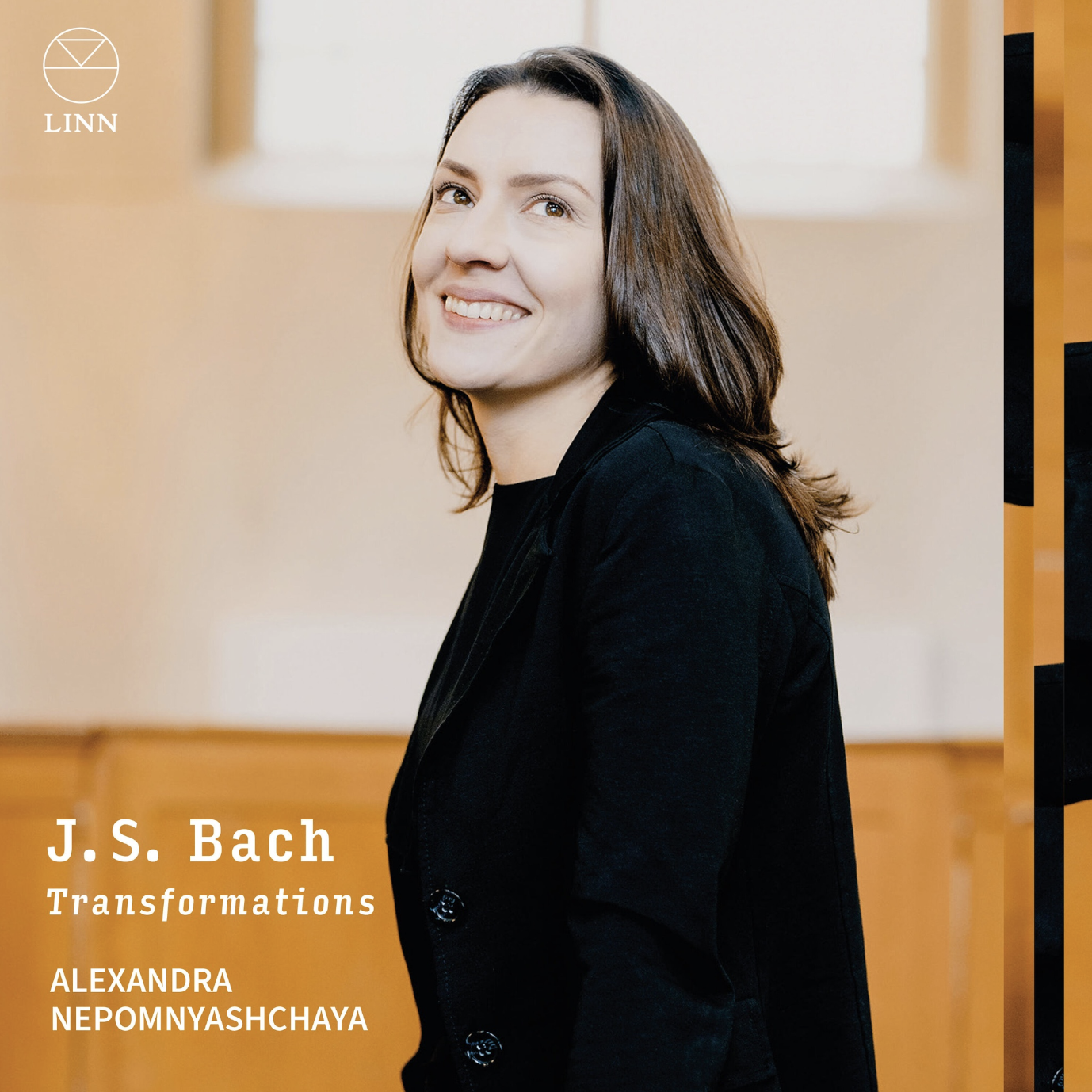
The artist is seen smiling on the cover of this Linn release. She has a reason to smile: she's an accomplished player whose technique is on display in this recording. Maybe more so than many others who have tackled this same material.
I say that because, while many pros possess a strong technique, technique alone doesn't equate to a strong interpretation. One that moves the listener. And let's be clear, one way to move the listener is to dazzle them. And this album has moments of razzle and dazzle.
What I miss here are attempts to showcase the music's rhetorical opportunities. They aren't entirely ignored, but they are also not the hallmark of her interpretations. As a case in point, cue the 16th track for the opening of the Italian concerto. There are some small rubato moments, slowings, if you will, but for me this piece is full of conversation. And it doesn't come across that way in this interpretation. And that's very much my own bias with the work. In the return to the theme around 3:28? Just give me a little pause, please? We're off to the races again.
Some may not appreciate the briskness which dominates this recording. For the slow movements, I find Nepomnyashchaya's chosen tempos to be smart. In some of the faster movements, I worried she might run out of breath. Which is okay, the harpsichord does not require breath, right, but then again, maybe that's the way I've internalized my own performance as a brass player, through breathing.
This album joins Nepomnyashchaya's solo release of Muffat from 2024 and her collaborations with violinist Igor Ruhadze on albums of Geminiani and Boccherini. This marks her first recording devoted to Bach. The point of view I take from these performances is one of a composer who was not only the ultimate virtuoso of the fingers, but one who could set the humble harpsichord ablaze through composition and arrangement—another kind of virtuosity altogether.