Duphly: Éclats et derniers feux • Barrucand
Jacques Duphly's life traces the long twilight of the French harpsichord school. Born in Rouen in 1715, he trained with François D'Agincour and began his career as an organist at seventeen before leaving Normandy for Paris in 1742, where he entered the aristocratic salon world and became one of the capital's most sought-after harpsichord and pianoforte teachers. His four books of Pièces de clavecin, published between 1744 and 1768, brought him considerable renown, even abroad, yet he seems to have cultivated a striking personal reticence: unlike Rameau, Rousseau, or Diderot, he left behind no substantial writings on music. By the time of his death on July 15, 1789, Duphly had nearly vanished from public view, leaving music that seems poised between grace and boldness, French inheritance and cosmopolitan experiment, the brilliance of the harpsichord's high age and its eventual decline.
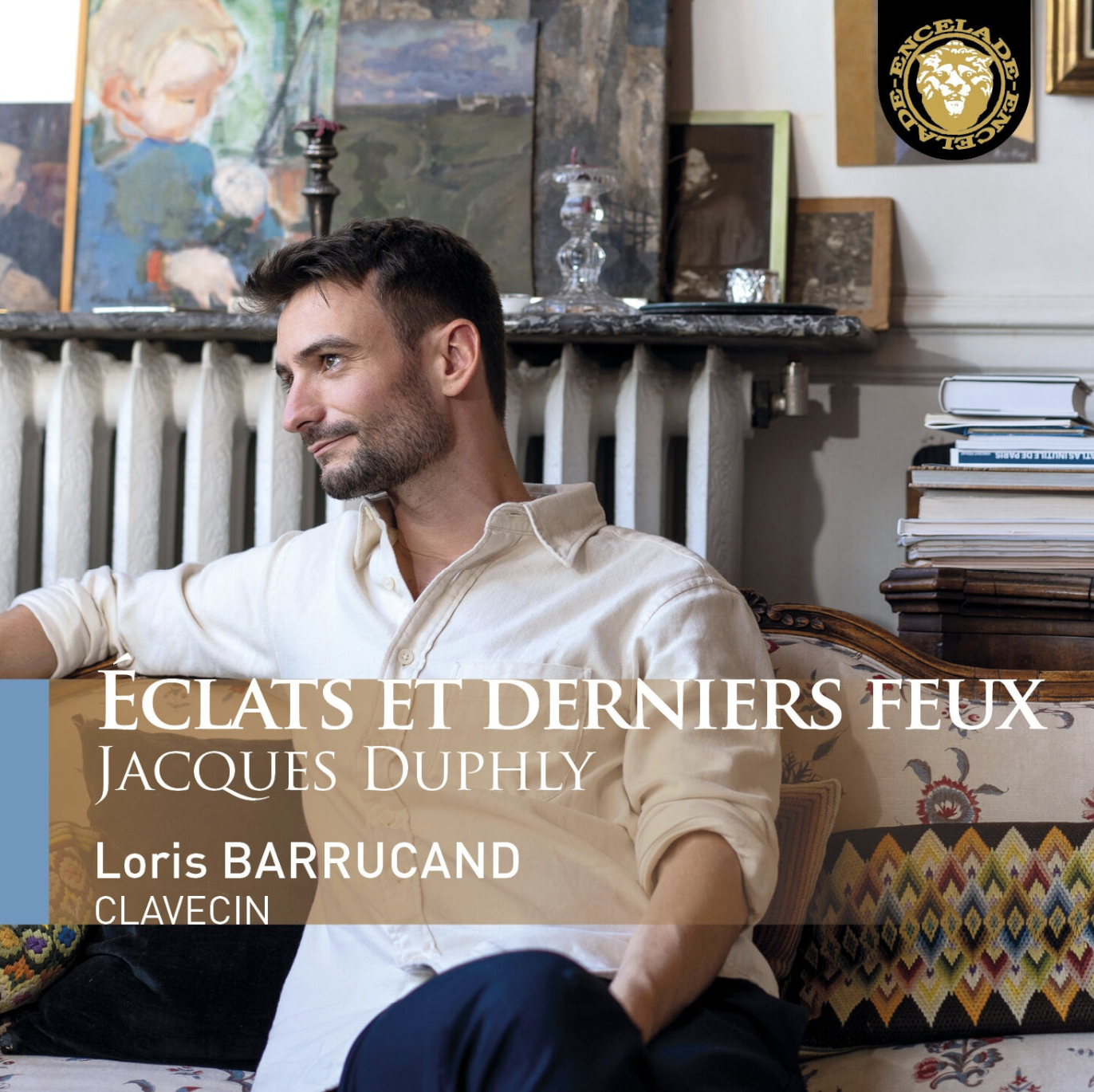
Barrucand makes this recording at the church of Saint-François-de-Sales de Valezan upon a Sidey instrument after Hemsch. The sound for me is ideal: the instrument is captured in good detail, without excess of reverb. The lower register commands respect in my listening room, which speaks not only to the fine recording, but to the quality of the instrument used.
As a recital, Barrucand takes from all four of Duphly's books, offering us a type of retrospective of the composer's art. Such a cross-section offers a lot of variety, perhaps intentional to provide us a portrait of this late-period claveciniste.
I started with the second book's La Félix not only because I'm familiar with it, but because I love the name. The piece sits a bit low on the keyboard, and some of those chords? They warm the soul in their richness. Barrucand offers some rubato in his interpretation; it's not overly done, but just enough to let us know he feels that same richness.
It's during Barrucand's performance of the next track, La de Latour, that you're well aware that this is harpsichord music and not music composed for the piano: the sharp articulation required in the right hand, repeated notes, and arpeggiation all speak to the harpsichord's strengths. The piece sparkles under Barrucand's touch.
Whomever the second book's La Lanza was named for must have been a jovial character. The piece takes an interesting form in how the two hands interact in the opening, suggesting a piece for an orchestra. The two voices in the right hand are, I'm guessing, a challenge for the player? It is expertly rendered, as is the scalar section that must have been created to dazzle the audience with the player's technique. The departures to a softer, minor-moded section are a dramatic touch.
A mechanical apparatus seems channeled in the fourth book's La Pothoüin. Yet Barrucand breaks the illusion by adding in some pauses. I'm impressed by the composer's traversal down to the lower portion of the keyboard. The writing is clever. The biographical note earlier about Duphly falling into obscurity may not be too surprising, when we consider the very baroque nature of this piece, coming late in his published works. It very much ignores the shift in musical style that by this time had come to Paris. The last section, taking us through a solid harmonic progression is all about texture, perhaps a nod to Couperin's mysterious barricades? While it's not a quotation, the style is close enough to show us the composer looking backward rather than forward.
The album ends with a Chaconne from the third book; the tuning used adds spice to the work, which starts out more complex than I would have expected. The composer has built a small world into this piece, with frequent mood shifts and use of the full compass of the keyboard(s).
Conclusions
Astute readers may recognize Loris Barrucand's name from my earlier review of his duet with Clément Geoffroy. I revisited that album this weekend and found it to be just as enjoyable as my first listen.
This album is a great introduction to Duphly's music. For those interested in an even fuller introduction, Christophe Rousset's 2012 recording is a longer recital covering two discs. His instrument, too, sounds great, although I think the engineering on this album is a step ahead. As ever, Rousset likes to keep things in time. Barrucand's style isn't quite as indulgent as that exercised by Skip Sempé, but it is more pronounced than Rousset.
What stays with me is how Barrucand handles Duphly's harmonic turns—the way he lets a suspension hang, or allows a shift to the minor to register before resolving it. That patience is what makes the case for this music. Duphly was, by his own century's standards, already glancing over his shoulder, and Barrucand plays as though he understands that the backward glance is the point: this is the harpsichord at its late, declining light, in the hands of someone who plainly loves it. A persuasive introduction to a minor master—and, in its quiet way, a moving one.