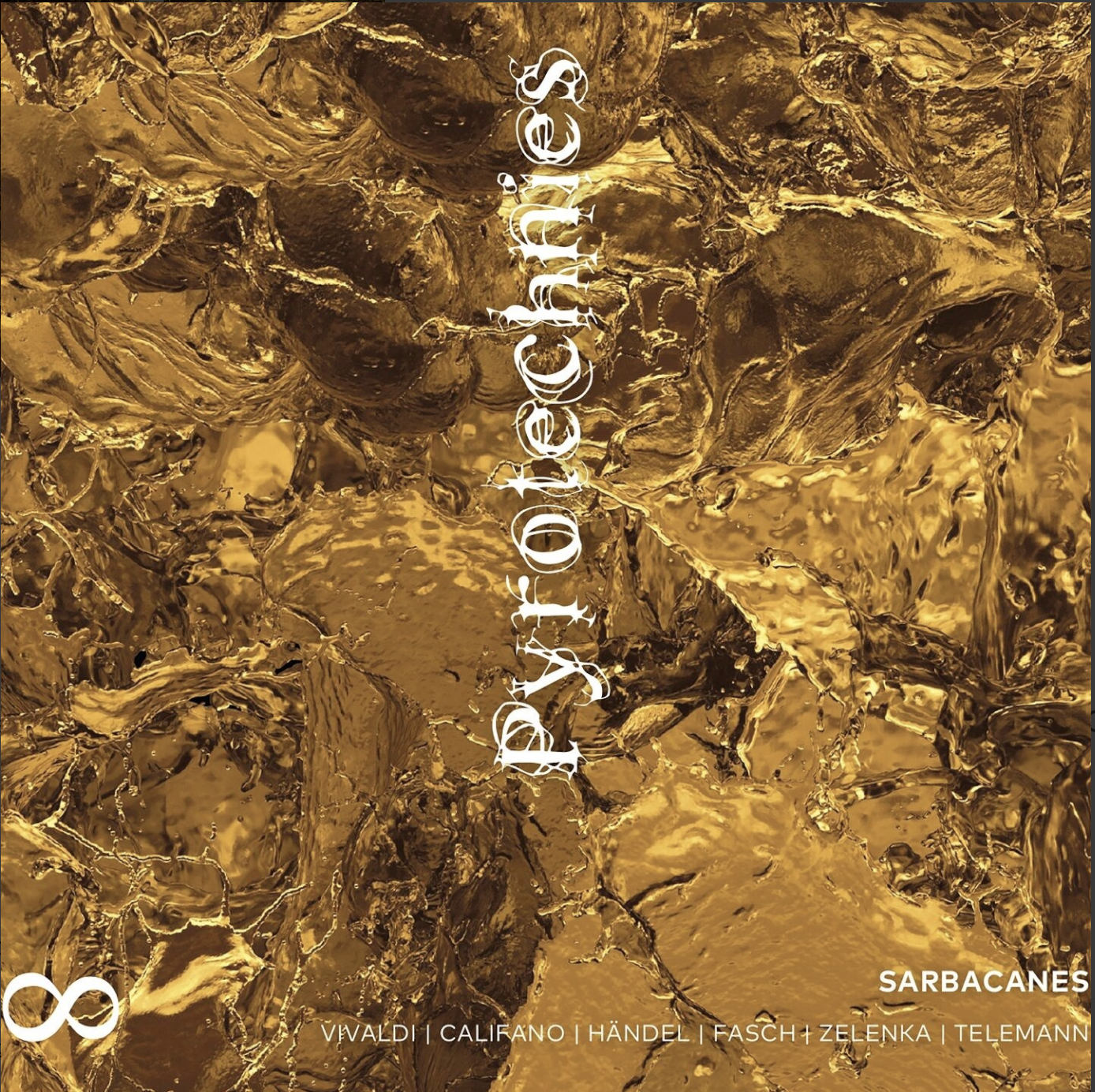
Pyrotechnies • Sarbacanes
This hour-long recital features music for winds—the ensemble's specialty—from Vivaldi, Handel, Califano, Fasch, Zelenka, and Telemann. The French ensemble's recording appeared on Oktav Records in September 2024. A booklet was not provided, but some sleuthing found a copy here. The chamber group is composed of two oboes, bassoon, violone, and keyboard.
The recording captures a close-up image of the winds with plenty of detail; the reverb after cadences is significant, signaling to me a high ceiling, likely a church. (The booklet confirms it!) I auditioned the album at CD quality via Qobuz nearfield in my main listening room and found the sonic effects luxuriously supple, so far as sound can possess suppleness. For what it's worth, I detest the word supple, but I had difficulty finding a better one.
The first piece, a trio sonata for two oboes with bassoon in the continuo, brings back memories. RV 81 appeared on an early CD of Vivaldi's "wind music" that I remember enjoying from the public library.
The only composer I'm unfamiliar with is Arcangelo Califano. He was active in Dresden as a cellist in the 1730s. The album is predominantly just oboes (left and right), with a delicious-sounding bassoon in the center. Again, the sonic image is of sitting right in front of the musicians, bathed in their sweet timbres. The organ really blends into the texture; it's difficult to hear on its own, but it's set back in the deep soundstage.
The piece by Handel is an arrangement of his trio sonata for two violins and continuo, HWV 388; here it takes the album's standard scoring: two oboes, violone, organ, and bassoon. The booklet for some reason lists violins, but clearly they are not. That's as good a cue as any to discuss the booklet: it's unusual in its layout, with big, graphic pages for each work and the commentary (in French) opposite. I love the artistic and pragmatic treatment.
The pieces by Zelenka (ZWV 181) and Fasch (FaWV N:d2) switch to harpsichord. The Telemann (TWV 42:D3) returns to the organ. It's not often that I come across a piece by Telemann I'm not at least somewhat familiar with, but this one didn't easily register with me: the group may have fooled me. The quick third movement was giving me some strong Zelenkan vibes. It's positioned last on the album, and the technically challenging passages for the oboes are a treat. I know I might not want to play anymore after this track. But they don't show any fatigue. It's not often you hear two players, spaced apart, in strong lockstep. Bravo!
Conclusions
This album was a delight. My only regret is that they didn't choose my favorite G minor Zelenka trio sonata! The blending of the keyboard and violone is so well done; in the middle movement of the Vivaldi we get the violone alone and the sound is just perfect.
Sound is a big part of this album's charm, once we've granted due praise to the choice of repertoire and the composers' art. And of course the musicians themselves are sensitive interpreters, with a balanced approach to supporting one another. Their rubato treatment is a hallmark of their interpretations, and the opening movement of the Zelenka is a perfect exemplar of all these qualities.
Virtuoso baroque trio sonatas built around a pair of oboes. Few ensembles possess this much polish; the bonus is a recording made in a sympathetic environment with an expert engineer.