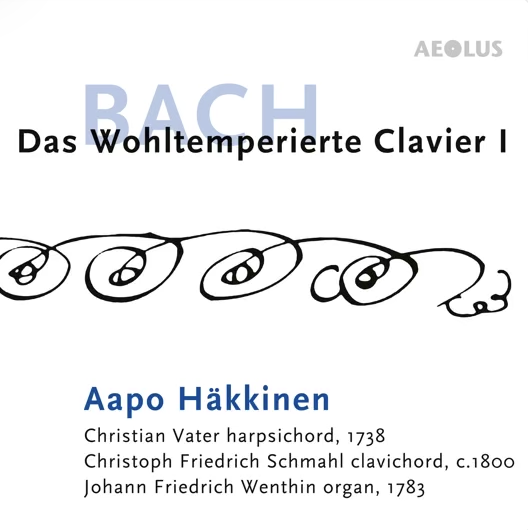
J.S. Bach: The Well-tempered clavier, book 1 • Häkkinen
The question of what Bach meant by clavier is one that rewards revisiting. He could have written cembalo — that is how most HIPP performers approach this work — but he didn’t. He wrote keyboard, and Aapo Häkkinen has taken that at face value, giving us the first book of the Well-Tempered Clavier on three instruments: a harpsichord from 1738, a clavichord from 1800, and a handful of bonus tracks on organ, one tuned to the system hinted at by the scribbles on the score’s cover. (This has been covered at some length in liner notes and in academic research, but we know “well-tempered” means that the keyboard is tuned in such a way that all keys can be used without re-tuning, and there has been a hypothesis that Bach’s coverpage scribbles describe such a well-tempered system, separate from what we use today for pianos, which is equal-tempered.)
Häkkinen’s case for the multi-keyboard approach is easy enough to follow. The liner notes explain the Vater harpsichord — unusual for having two 8’ courses — and the clavichord in detail, and there is a certain pragmatic appeal to the argument: clavichords were the affordable domestic instrument, the keyboard that amateurs would have had at home, and presenting the WTC in that light casts them as domestic but also pedagogical. I’d also point out that this isn’t the first time I’ve encountered the clavier-as-any-keyboard argument. The artist makes mention of organs without pedals and those pairs presented on the restored organ continue the exploration. In my recent review of the Esfahani concertos by Bach, it’s interesting to note that he treats them as harpsichord pieces rather than “keyboard pieces,” despite the labeling Hyperion uses in that release. And he may be right to label them as harpsichord pieces since the word cembalo is used — but I cannot speak to how strict Bach was with his own nomenclature.
Where things get complicated is in the listening. The challenge any producer faces with an album like this is balancing instruments of wildly different dynamic profiles. The clavichord, an intimate instrument by nature, comes across surprisingly loud here in relation to the harpsichord, and the recording space has a liveness to it — a quality I associate more with a small concert hall than someone’s front room. The effect is most pronounced in the C minor prelude BWV 847, where the frantic opening passages played on harpsichord carry enough ambient bloom that the texture turns muddy, the articulation half-swallowed by the acoustic. There’s bite enough in the instrument that you can follow what’s happening, but the prelude didn’t pull me in. The fugue fared better, the subject coming through with more clarity, but I kept wishing for a drier room. The organ, by contrast, came off best of the three on record: the microphones capture both the direct pipe sound and its reflection in the space, and there’s a sense of scale that suits the instrument. I’d have been happy to hear the whole album on that organ.
Then there is the Vater harpsichord’s timbre that disappointed me; it may well be the combination of the instrument and the acoustic, but it didn’t excite me. I felt the sound faired better through speakers than headphones. Timbre is a very personal choice. Some may have little issue with the sonic signature from this instrument.
What saves the album is Häkkinen himself, and the tempos in particular. His approach is straightforward without being dull — his tempos are moderate to more quick and he follows strict time without letting things turn mechanical, adjusting his touch and phrasing to the character of each piece. In the A minor prelude BWV 865, that discipline is its own reward: the music moves cleanly, no rubato indulgences, nothing that calls attention to itself. The C major fugue BWV 846 is a good early example of his articulation at work — the subject is clean throughout and the momentum never drops. The E major fugue BWV 854 is played with authority, a strong effect, and works as a satisfying foil to the somewhat relaxed feel of its paired prelude.
The clavichord moments are, for me, the most interesting on the album. The G-sharp minor fugue BWV 863 benefits from the instrument’s character in a way the harpsichord pairs do not quite manage: the phrasing opens up, the articulation of the fugue subject becomes more pointed, and the music breathes differently. The D minor prelude BWV 851 on clavichord is also well-judged — a nice tempo, good articulation in the upper register, that particular delicacy the instrument has in its high range. And the F-sharp minor fugue BWV 859 is the highlight of the recording for me, its pace lovingly drawn out, the clavichord’s sustaining quality used to real effect. There’s more rubato here than anywhere else on the album — not a lot, but enough to make this reading feel genuinely considered.
The switch between instruments across the album is a conceptually clever move, but in practice the jump in timbre from clavichord to harpsichord and then to organ is atypical for those who enjoy inserting a disc of the WTC and letting it play through. Again, the alternative options using only organ or only clavichord might have changed my perceptions, especially so if the clavichord was seated in a more domestic-sounding environment.
Conclusions
Häkkinen is a solid and consistent performer. His tempos are well-considered, his articulation in the fugues is a genuine strength, and he is clearly sensitive to the individual character of each piece. The problem is that, across a work of this scope and with so many competing recordings to measure against, consistency can read as a kind of anonymity. I would have liked to hear him take a stronger interpretive stand first — some ornamentation, a more individual touch, something that makes you feel this is unmistakably his WTC — and let the multi-keyboard concept serve as a bonus dimension rather than the primary statement. As it stands, the performances are the best thing here, but they are not quite distinctive enough to make this essential, and the recording itself — the acoustic, the particular character of the Vater harpsichord — works against the album more than it works for it.
There is real pleasure to be had here for listeners who want the WTC in something other than the standard harpsichord-only format, and the clavichord pairings in particular make a compelling case for a different way of hearing this music. The F-sharp minor fugue alone is a reason to listen. But I keep coming back to the idea that the concept should have sharpened the interpretations rather than substituted for them. This is a creative recording I am glad exists, and one I will return to selectively, but not the version I would reach for first.