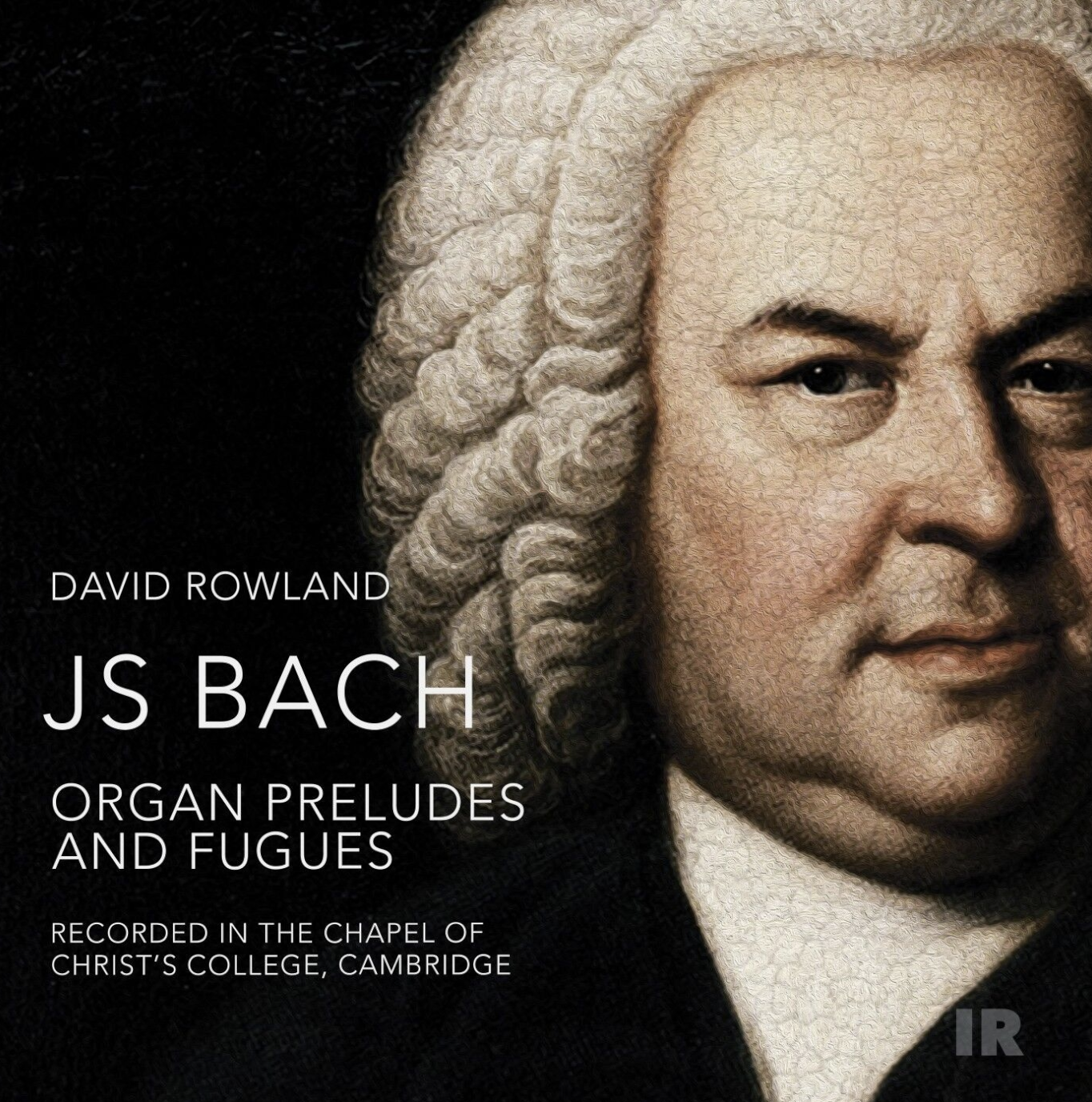
J.S. Bach: Organ Preludes & Fugues • David Rowland
This album is as much about Bach's music as it is about the performer and his workspace — Rowland has spent some forty years at Christ's College Cambridge as organist, choir leader, and early piano specialist, and the chapel's modest dimensions yield a notably transparent sound.
I'd start with the Prelude and Fugue in B minor BWV 544. The nearly twelve-minute work from Bach’s tenure in Leipzig has a magnificent opening. The concept of the piece to me sounds like it could very well have been worked into an orchestral piece — say the opening section from a passion or dramatic work. The fugue takes about half the time, constructed from a meandering subject that rises, something outlandish in comparison to the fugue subjects in Bach's WTC. It's also a great piece to acclimate one's ears to the resident organ. The organ has been reconstructed several times but retains a number of its original 1705 pipes. It was likely constructed by a Dutch maker of the time who was famous in England for his organ building.
In addition to several prelude/fugue pairs, Rowland offers us some chorale preludes plus the organ concerto BWV 522, for a 73-minute recital. Readers will recognize my affinity for BWV 659 (track 8). Rowland's performance is nicely voiced, but his treatment of the melody is not highly decorated, as I have heard elsewhere. This prelude, alongside another famous one, Liebster Jesu, Wir Sind Hier BWV 731, has a noticeable hiss in the sound. I can't speak as to whether it's an artifact of the wind production or something else, but it was appreciably noticeable in my audition via headphones, and persisted on my office system, though with less severity.
For those that want even more drama than what we get in the famous Toccata and Fugue in D minor BWV 565 (which is not included here), the opening pair in C minor should suffice (BWV 546). The scope of this organ allows a very transparent view into each part: the pedal itself enjoys a nice independence from the manuals. There is much debate about which organ to use in the performance of choral works (in many recordings today the one used is a small portable unit, which can play alongside an ensemble such as a harpsichord does). I imagine this instrument out of the context of these works serves well to accompany the Christ's College Choir.
This piece is followed by the first of two chorale preludes based upon Dies Sind Die Heil'gen Zehn Gebot. Here the independence between the two hands is again a highpoint. The pedal doesn't dominate, but it's nicely present on my system. Compare this to a recording made in a large church and it's immediately audible how much that separation helps us hear Bach's writing with clarity.
Rowland does not come across with a strong personality, which is how I might describe one of my favorite organists, Ton Koopman. However his playing has virtuosic flourishes. A great place to witness these is in the famous "wedge" pair, the Prelude and Fugue in E minor BWV 548. Christoph Wolff believes that this piece, alongside the B minor pair, was written for the University Church in Leipzig. It survives in a copy in the hand of Bach himself and his pupil Johann Peter Kellner. The fugue's runs never slow Rowland down. Rowland's performance here had me grinning nearly throughout.
Conclusions
This recording is, of course, a celebration of David Rowland's tenure at Christ's Chapel Cambridge. It spoke to me in an interesting way since I visited Cambridge last year, having stepped into this chapel. It's a great Bach recital, but more than that, it's a testament to the instrument that occupies this space.
The team from Immersive Recordings might have applied some filtering to reduce the hiss I mentioned, which is most audible during the chorale preludes. If it's an artifact of the wind production on the instrument, I could see why they may have wanted it present as a type of authentic representation of the instrument.
For both those who study Bach's organ music and those who tire of the "wash of sound" that some recordings provide, the transparency brought about through Rowland's performances on this recording is something special.