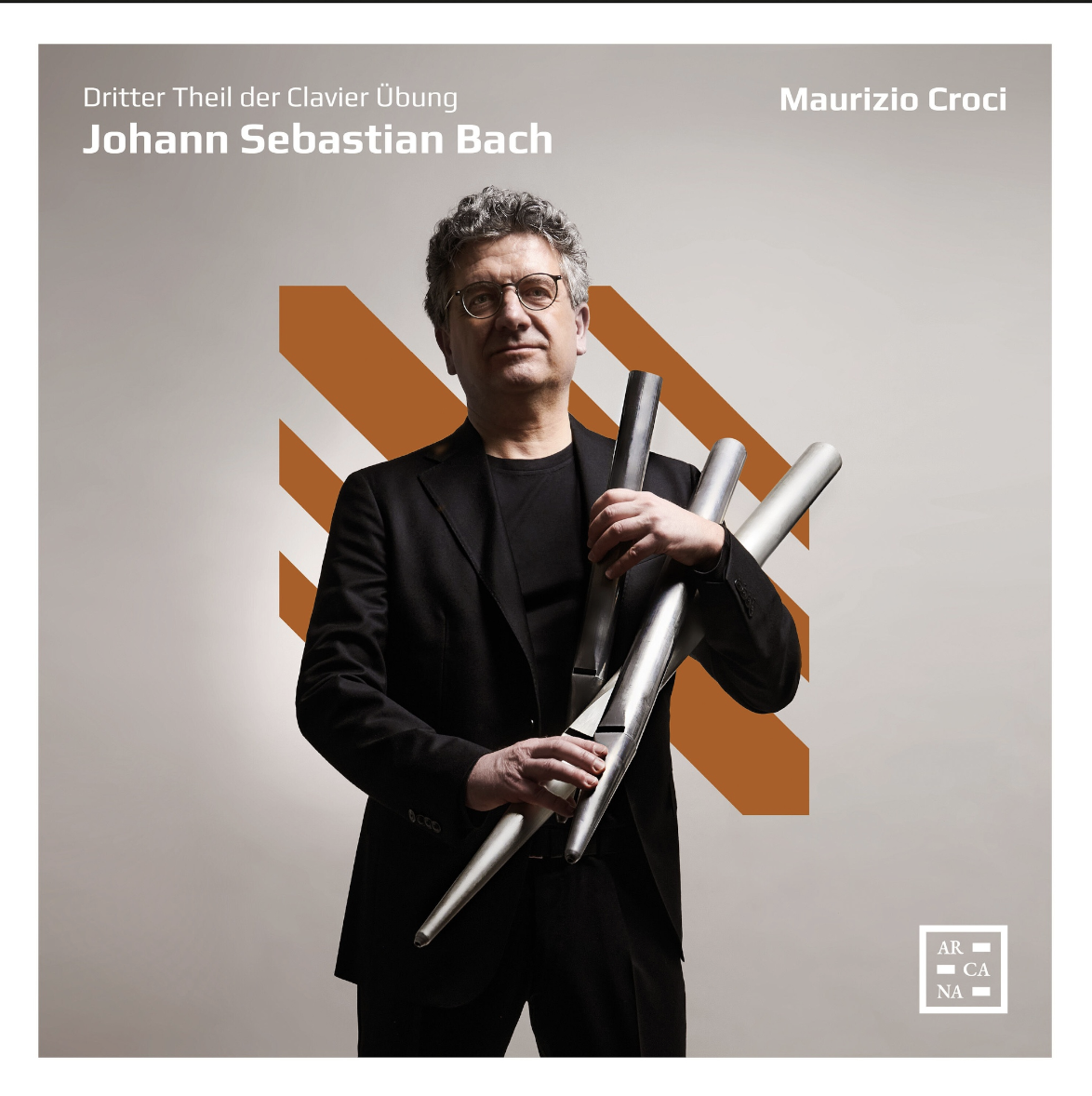
J.S. Bach: Dritter Theil der Clavier Übung • Croci
Bach's third set of keyboard works was published for organ in 1739, after some delay. Bach had real renown as an organist among those who had heard him play outside his ordinary Leipzig duties, and it is easy to read the publication as a document of what he could do at the instrument.
Some have referred to this collection as an organ mass. It opens with the prelude of the so-called St. Anne prelude-fugue pair; then Bach gives us a sequence of chorale preludes, a set of four Duetti, and closes with the fugue, creating a musical sandwich. Croci performs on an instrument built at almost exactly the moment the collection went to press, using registrations drawn from Georg Friedrich Kauffmann's Harmonische Seelenlust. Kauffmann, court and cathedral organist at Merseburg, was another candidate for the job Bach landed in Leipzig; the liner notes call him
a well-known figure in central German musical circles.
The notes themselves — Croci writing on Kauffmann, Peter Wollny on the collection — are excellent.
There are multiple people to credit for what we finally get at home: Rainer Arndt for a beautiful recording made inside the Stiftskirche Grauhof of the Treutmann organ; Kauffmann and the researchers who mapped his indications onto this instrument; Bach, of course; and Croci, willing to try some interesting solutions out with his trust in Kauffmann.
The dynamic range here is wide, capturing the organ in its quietest moments as well as its loudest. I'll add that I recently added a sub-bass speaker to my principal setup, which helps with organ music, and it was a great pleasure to audition this recording with an extension that is otherwise difficult to appreciate in a home environment.
I should say up front that I have shied away from this collection over the years because I don't find it nearly as accessible as the other Clavier-Übung volumes, including the fourth, which we know as the Goldberg Variations. Much of it depends on a familiarity with the Lutheran hymn repertory that most of us simply don't have, and appreciating these pieces asks more work of the listener than Bach's other published keyboard music does. That reservation runs underneath everything below.
Prelude and Fugue in E-flat, BWV 552
We should keep in mind that this collection was likely not conceived as concert material, and that the prelude and fugue would have been performed together. I don't mind that Croci (like others) places them first and last; we can easily program our tracks. The piece borrows musical ideas from France and Italy — overture and concerto — and these multi-national styles were likely seen as a nod to the composer's worldliness as much as a bid for the tastes of the day.
This is the piece I've heard many times, and it sounds great here, commanded by Croci's fingers and feet. The fugue sounds different to me with 16' registration at the keyboard, a feature of Kauffmann's preference; balance is achieved with 32' stops in the pedal. Another great showpiece for this instrument.
The Duetti
The Duetti are Bach's demonstration of what he could do contrapuntally with two voices. They are odd pieces, to be honest, and given the Belder recording of Die Kunst der Fuga I reviewed recently, they are not always heard as organ pieces. The performances here don't disappoint, and each is rendered in an interesting set of colors. Each stays its course, but collectively they reveal an instrument capable of considerable range.
The chorale preludes
Bach offers twenty-one chorale preludes. These works have a liturgical function, introducing a Lutheran hymn before it would be sung by the congregation — a musical appetizer — and they would have been heard one after the other in that context. In his recording of Bach's organ works, Ton Koopman uses his Amsterdam-based choir to record the four-part hymns so that one can hear the preludes in context. The same is done in the recording by Jeremy Filsell, using a men and boy’s choir (Signum Classics, 2022).
You may well be familiar with Bach's Orgelbüchlein, which covers the liturgical year; that publication was, I believe, meant as a pragmatic resource. Here the preludes are far more drawn out and complex.
The construction of these preludes relies on a melodic component — the cantus firmus — which is the recognizable contribution from the chorale. The result is a freely composed piece that uses the melody as a recurring element, typically in longer, drawn-out notes so that it stays audible. The art is in fitting that element into something else, much like the process used in a fugue, though the format is different. What we mostly won't get, and what Bach's listeners had, is the luxury of familiarity. They knew these tunes cold. The closest analogue I can think of is how we appreciate a jazz cover of a popular song; one of my favorites is Brad Mehldau's Wonderwall (Brad Mehldau Trio Live, Nonesuch 2008).
Do you need to hear the hymns? I'm not sure it's necessary, and if it were, I'd side with the approach employed by Suzuki, Koopman, and Filsell do, using choirs. For me, repeated listening does more to unpack the dense texture and notice what's happening. I'd also recommend following the score, if you read music.
One of the most impactful preludes is Kyrie, Gott heiliger Geist, BWV 671, written in five parts (!), with the melody in the bass. The pedal registration here is gnarly, in a good way, and the weight is sonically satisfying. Putting the Holy Spirit in the bass sets it as the foundation of the music, where in BWV 670 the melody sits in the tenor, representing Jesus, and in BWV 669 in the soprano, representing God the Father.
BWV 684 is one of the more familiar preludes to me, and it benefits here from registrations that keep each voice distinctly colored. Another is BWV 680, a contrapuntal solution built on a rising subject that is hard to ignore. There's an edgy sound to the stops used, which contrasts sharply with what we hear in BWV 675. In both cases the strong articulation works against the acoustic, which isn't overly large.
I looked at other recordings, and to my taste the organ and the registrations here are the strong components that aid Croci's interpretations. McVinnie's recording, released in January of this year, can't compete on the instrument. Nor can Masaaki Suzuki's, recorded for BIS in 2000; Suzuki's style lacks the stronger articulation Croci employs, and the same can be said of Filsell's recording on Signum Classics. There is simply a better instrument here, matched with a great recording; the separation of notes gives us something to hold onto instead of hearing everything mushed together in reverb.
BWV 686, Aus tiefer Not schrei ich zu dir, was originally set by Luther, paraphrasing Psalm 130. Bach sets it twice, also as BWV 687. The 686 is dense, composed in six voices (!!), with both feet carrying two voices in the pedals. That density makes for an unusual sound, one I found challenging. I can't say whether the muddiness of texture is emblematic of the authentic experience in the church, or partly a symptom of trying to reproduce those low frequencies with fidelity at home. Of all the tracks, this is the one I found most difficult on Croci's release. The contrast with 687 is shocking — perhaps on purpose. The psalm's own two-part shape may be the source: the first verses speak of sorrow out of the depths, the later ones of trust in God. Two pedals indeed. I'll suggest that Kauffmann's registration recommendations in 686 must have sounded superb in person, but again, that isn't the experience I had. Filsell's 686, for me, is far more satisfying for his instrument's clarity.
Conclusions
This collection benefits here from an amazing instrument, one where the performer has employed unusual combinations of sound following the writing of one of Bach's contemporaries, in an effort to approach the sounds Bach himself was known to create at the organ.
The accessibility problem I named at the top doesn't go away. But I'd encourage you to spend the time. We live in an amazing period where all of this music is available to us if we want it, and for those who read music, seeing the complexity Bach applied to these chorale preludes only illuminates the colorful solutions he captured in ink.
What's more impressive is the realization that at least some of these pieces were born out of Bach's ability to create at the keyboard, not necessarily sitting at a desk with pen and paper — that they are the result of many hours of experimenting and improvising.
Maurizio Croci has made many records, though this is the first I've listened to critically. Anyone willing to invest time in Bach's third book should seek out alternatives; I made a few comparative remarks, but there are excellent recordings already out there. This one is special to me not only for the character of the instrument, but for the unusual registrations that emanate from research into the writings of Georg Friedrich Kauffmann.