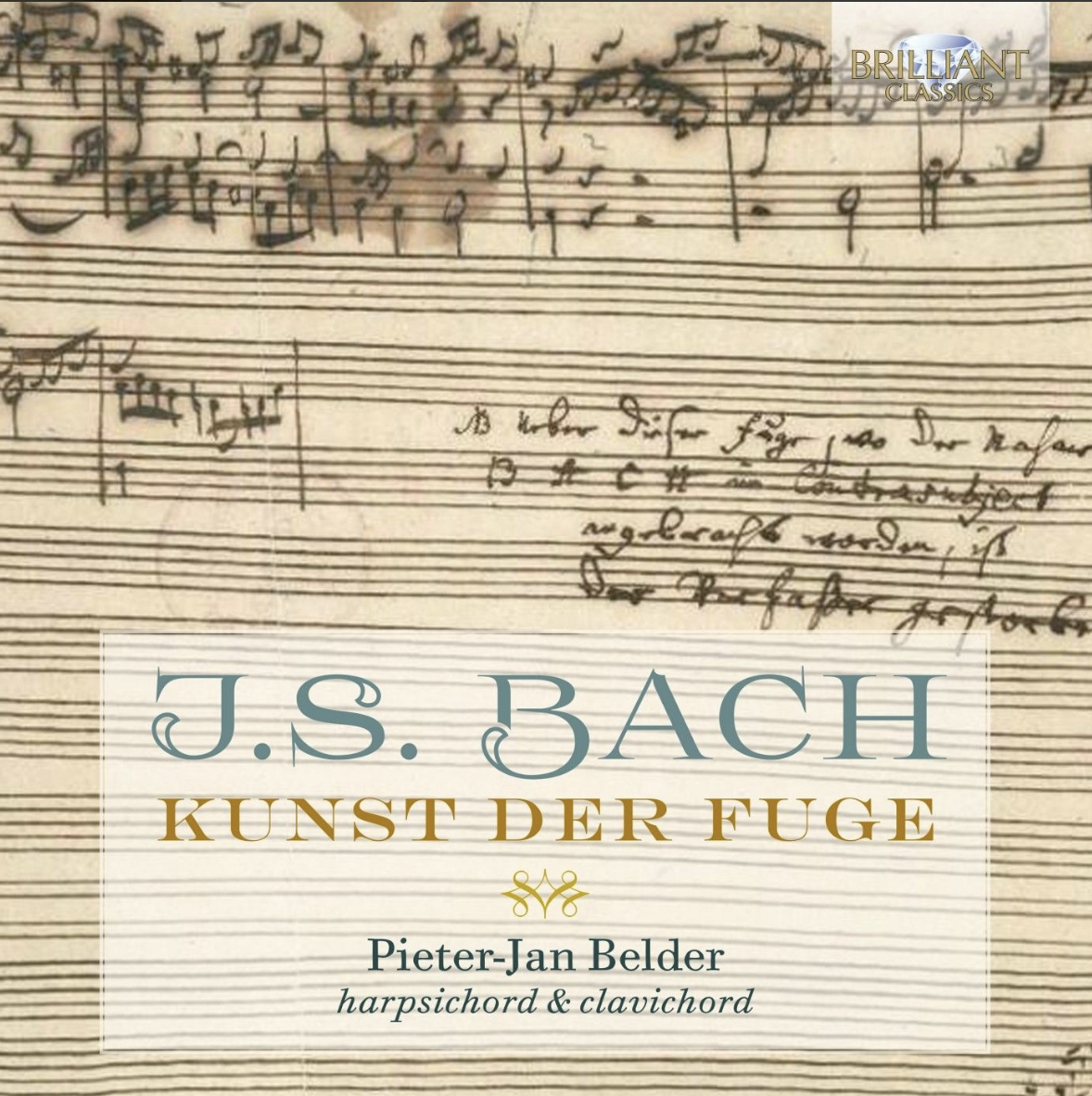
Die Kunst der Fuga • Pieter-Jan Belder
Among the most prolific recording artists, in addition to his roles as a teacher, Pieter-Jan Belder has recorded several large collections of music, including Domenico Scarlatti's sonatas for keyboard, the Fitzwilliam Virginal Book, and the complete keyboard music of William Byrd. The music by Bach figures large in his work as well, and this recording appeared in 2019 of Bach's Kunst der Fugue on his usual label, Brilliant Classics.
The instrument(s) used for BWV 1080 is the harpsichord (he's joined by Gerard de Wit for two tracks requiring two keyboards); both players use instruments made by Titus Crijnen (Belder's is after Blanchet, de Wit's is after Ruckers). However, in addition to 1080, Belder includes the four duetti, BWV 802-805, and performs these upon a clavichord by Geert Karman after Friederici. Finally, the two ricercars from BWV 1079 are also included, performed on harpsichord.
The instrument appears on the right side of the stereo image with some small reverb going left, positioning us, I think, with the performer in a hard-surfaced room. The sound is bright and immediate.
Jon Baxendale provides good liner notes, although the size of font used and the width of the columns makes for difficult on-screen reading. No rationale is given for the use of the harpsichord, although the use of that instrument isn't really something anyone would question, as it was the keyboard available to Bach. Readers will already know the work's intended instrumentarium is sometimes questioned because of Bach's use of open score, but readers may also know that this may well have been because Bach intended the work to work as a treatise on counterpoint, with open score making the art of composing fugues all the more accessible to the reader.
One thing I'll say off the bat: I like how Belder ends his pieces. In terms of personality, he's typically a very clean player without any strong affectations to his style. However, in the final cadences, he sure knows how to relish the ends; nothing is overdone, but there are those arpeggiated final chords, and in the six-part ricercar, a nice ornament to let us know we've reached the end.
Belder studied with Bob van Asperen, who also recorded this on harpsichord, but this recording, for me, provides a nicer contrast to the one made by Ton Koopman with help from his wife, Tini Mathot. Also a Dutchman, Koopman distinguishes himself with a strong personality, brought out through heavy ornamentation. I know some absolutely can't stand Koopman's extravagances, but I find them charming — which is not to say I found these performances lacking without them.
Take Contrapunctus 6 in stylo francese: Belder takes the movement slower than some, but what we get is some drawn-out trills and a strong pulse in relation to the dotted rhythms. His touch and the way he sustains work beautifully together. It's the time he spends with the keys down that, to me, shows off a strong technique and, ultimately, a satisfying interpretation.
Belder uses different registration in Contrapunctus 8 to highlight the changes in the fugue's overall structure. The change in dynamics, from louder to softer, is subtle, but it feels like a natural way to utilize the capacity of a double-manual instrument. The final cadence to this bear of a fugue is simple and again highlights how I imagine he relishes the endings of the pieces.
Another point of comparison for me is the virtuosic performance on harpsichord by Christian Rieger. There's something infectious about the faster tempo Rieger uses, say, for his Contrapunctus 9, which also comes off a bit clearer, thanks to the timbre of his instrument. I think Belder's performance is strong — the slower tempo makes it easier to hear the independence of the voices. Belder's instrument, for sure, has a bit more color to its sound, and when used with two courses, that color comes off to us as "richness."
I felt the tempo chosen for the pair that makes up Contrapunctus 12 should have been faster; the trills used are exaggerated, and I like the way they speed up, but it comes off a bit comical in their length given the speed. I found the tempo for Contrapunctus 13 to be nearly perfect for my taste. It's offered twice; the second time is in concert with de Wit upon a second instrument. The thickness of texture and the ornamentation gave me Koopman-esque flashbacks. I liked their collaboration a lot.
The track I always spend the most time with is the unfinished fugue, known as the Fuga à 3 soggeti, or Contrapunctus 14. The ordering Belder uses here doesn't place this track last, but I think the way he's organized the album's music works well. Without getting into the details, the ordering of the work is not definitive, given the different versions of what Bach left us.
There's likely to be a debate among Bach's fans as to his most affecting piece of music, but I'd argue hard for it being the fourteenth contrapunctus. That said, I am not confident the harpsichord is the best medium for that potential to be shown. There are multiple points throughout where I know I get goosebumps. In my mind, I'm hearing the lines independently and as they come together to form the harmonic foundation through which Bach often reveals the affections in music — it's those spots that pull you in. Again, it's Belder's touch and his willingness to sustain that, for me, rewards us in this movement. There are also some spots for ornaments, and they land just right.
Throughout, he again changes keyboards, which offers some dynamic color to the work; the ending, though? It didn't work as strongly for me as others have. It's the one spot where a bit of rubato might have been warranted.
Bonus Music
The four duetti BWV 802-805 were published as part of Bach's third set of keyboard works, or Clavierübung, which was for the organ. I can't say why the clavichord is more appropriate here than a harpsichord, although I will say that the instrument used here gives us such a palpable feel for Belder's fingers. Again, his touch is something worth beholding. The dynamic variation he infuses, while subtle, brings these pieces to life for me. It's no wonder that we're left to believe Bach so enjoyed the clavichord. It's a personal instrument, often a challenging one to perform in public given its diminutive sound.
Where I might have liked a few of the 1080 numbers to go a tad faster, the tempos for these pieces, for me, were ideal. Most go quickly; 805 is presented a bit slower, which I think is in strong alignment with its character.
The ricercars from the Musical Offering are the two most complex pieces from his collection made for Frederick the Great. If I could have anything, I'd have liked to have heard one of them on the fortepiano. Given the engaging performances on clavichord, the piano might have offered us some further delight in the performer's touch.
These pieces, each built upon the same royal theme handed to Bach, are obvious showpieces. Bach likely had already started his work on the Kunst der Fuga when he prepared the collection for his son's employer. It's an odd collection, with a compendium of different contrapuntal devices and puzzles, alongside a wonderful trio sonata. The term Ricercar, like Contrapunctus, speaks to the past and Bach's admiration for the work of great past composers alongside his own connection in that lineage. It's one of the reasons — for his use of keyboard, violin, and flute across the collection — that I have often wondered if he might have proposed himself such solutions for realizing the Kunst der Fuga with different combinations of instruments.
That question is not answered here. Belder's performances of both ricercars are assured and played cleanly. They lack a strong personality, which some will like. I went back to my Koopman recording (Challenge Classics, 2009) and he clocks the six-part reading at 5:53 versus Belder's 8:39. Both performances are rewarding, but it's the strong personality of Koopman's, not necessarily his tempo, that I end up preferring.
Those who already are familiar with Belder won't encounter surprises with his performance of the six-part ricercar: as he's done throughout the recording, he is not out to call attention to himself as much as the music. The trill at the end is a small gesture, but it captures the essence of his approach, which I think is well-aligned to his performances across many of his recordings.
Conclusions
Despite how Bach may have envisioned the performance of his contrapuncti, I'm a fan of hearing at least some of these fugues on stringed instruments. But for those who want a version made on keyboard — and the harpsichord exclusively — this is a strong contender. In addition, the inclusion of the 4 duetti and the two ricercars offer value.