Still Life: Early Baroque Fantasy • Música d’Outrora
This album, directed by Pablo Devigo, puts on offer mostly Italian music from the earlier half of the baroque period. The recording is made in a very reverberant space—St. Alban's Church in Birmingham, England. Christi Park leads on violin; Devigo leads from the harpsichord and chamber organ; the continuo team includes Timothy Lin on gamba and cello, Asako Ueda on theorbo and archlute, Louis Moisan on guitar, Dávid Budai on violone, and Claas Harders on lirone.
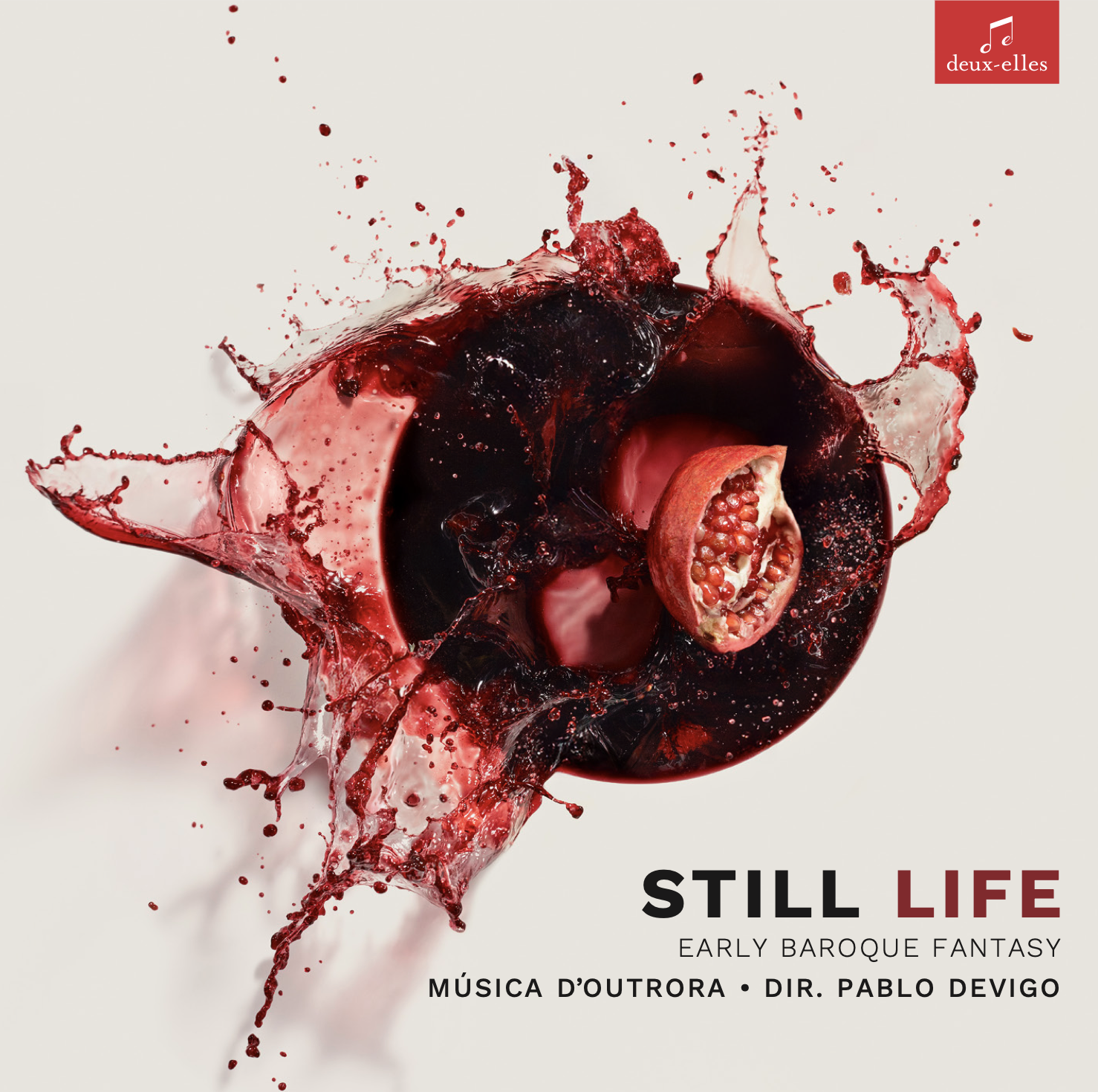
At the outset: no one records music like this—not for the material, but for the actual acoustic character captured by the microphones. It dares to nearly eschew every best practice in music recording. Yet, the result is masterful. This production from Deux-Elles has an interesting cover but includes a lot of baroque artwork alongside the liner notes. The booklet, with a lot of color photography too, is only in English, but for me that wasn't an issue.
Composers represented include Buxtehude, Albertini, Castello, G. Strozzi, and Stradella. Above all else, these musicians get the style of these works, offering interpretations that are meant not only to dazzle us, the audience, but to convey the full affekt of the compositions. This sentiment came through strongly in the two performances of music by Castello. Park's violin playing reveals her ability to play to the acoustic with dazzling virtuosity.
The Sinfonia in D minor, no. 2 by Stradella opens with a solo on lute. The microphone captures the instruments' details closely, but the recording also captures all the reflections in the church. The effect is nearly Dolby Atmos-esque in stereo. The intimate opening gives way to Lin and Park with a dramatic back-and-forth that ultimately satisfies.
Gregorio Strozzi's Ancidetemi pur is performed upon what I can only imagine is an Italian harpsichord. The piece comes from his collection of Capricci for keyboard published in Naples, 1687. It's the only track dedicated to solo keyboard, but it's also the album's longest, at over 11 minutes. The piece is an elaboration on an original vocal composition by Arcadelt, showcasing the baroque period's obsession with replacing the power of the voice with instruments. Devigo is an effective interpreter.
The Lübeck composer Buxtehude is represented here with his sonata à 3 in D minor, BuxWV 257, from his opus 1 collection. Fans of the composer will recognize it as a trio sonata for violin and gamba with continuo. The ensemble's protagonists don't disappoint. The dramatic potential of the piece is amplified in the acoustic space they occupy. Park, Lin, and Devigo are each in top form.
Conclusions
This London-based group, founded in 2022, offers here its first recording of a mix of both familiar and likely unfamiliar music for today's audiences. That approach is smart, as is the choice of venue and the participation of Ignasi Cambra as recording engineer.
The ensemble is always technically tight, and in many cases it makes dramatic use of the performance space, with pauses before coming back into focus. The playing by Park is especially strong, offering great tone and control, sweetening things when needed. Her command in the Albertini on track 6 is outstanding in every manner.
The ideas of rhetorical presentation and an imitation of the voice were nearly always on my mind as I listened to this recording.
This album receives my highest endorsement. These musicians aimed to give us fantasy, and the cover art of a splashed goblet of sangria nearly captures their impact on me.