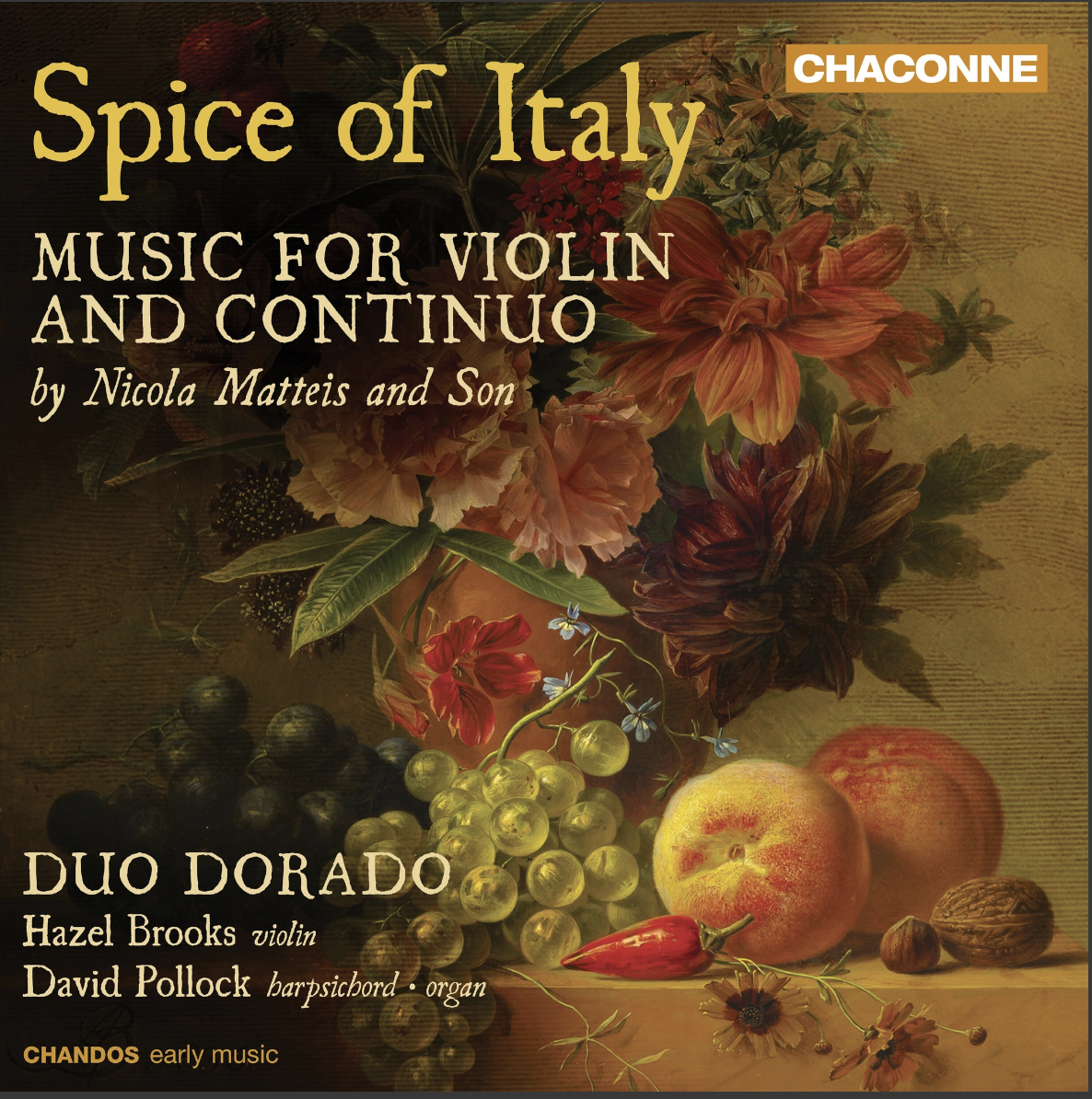
Spice of Italy - Music by Nicola Matteis Sr. and Nicola Matteis Jr. • Duo Dorado
The Nicola Matteis we often celebrate today through recordings is the one born around 1645, who would later arrive in London an established violin virtuoso. His son was born around 1670, likely in London, and likewise took up the violin. In this recital by the duo made up of Hazel Brooks and David Pollock, we get selections from both men. Brooks uses two violins—the older George Miller from 1670 for the father's music and a Viennese Thir from the eighteenth century for the son's. Pollock performs on both a harpsichord and a chamber organ; the former a 1999 copy, by Anne and Ian Tucker, of a Ruckers-Hemsch instrument.
The music here is repertoire I enjoy. The recording was made at St. Martin's Church, East Woodhay; the balance favors the violin, and the room itself sounds controlled but reverberant. The violin's sound is a bit more reflective than a direct imprint of the instrument — not the most ideal capture, but not one that distracts from the music either. The acoustic, even so, leans dry.
In the pieces from Book IV (tracks 5-7), I noticed a few fleeting intonation issues from Brooks. The Preludio à due corde poses the particular challenge of sustaining two strings continuously; I don't think what I'm hearing traces to the instrument itself so much as to the meantone tuning used on the keyboards. The Fuga a due corde is a fun piece and I enjoyed its vivacious character. The Aria armorosa is likely the most recognizable piece to me by Matteis; this was a performance I felt just came off a bit too flat. Both the lack of attempting to provide some shape to the long notes and to phrases, and the use of rubato gave me this impression. Because of the way the violin captured, I'm not sure the effect I'm hearing is as much the intention of the violinist as how the instrument was recorded. In track 8, some real variation in dynamics is practiced, but the resulting effect in my room is stymied I think by the way the instrument was captured. The Allegro from Book 1, track 10, is very well-done; the recording maybe doesn't showcase as clearly as I'd like, but the violin playing is technically assured and the use of dyanmic contrast works for this piece, another well-known contribution from Matteis, the father.
Two pieces by the son appear on this album: the Sonata in C minor (no. 18) and the Sonata in A major (no. 21). The first (track 14) opens with an Adagio that's expressive in performance but not as written—the simple melody wants improvisatory content Brooks doesn't supply. The Allegro that follows is largely a non-stop chase of notes that fails to impress; pushing the tempo might have let the younger Nicola show off the technique the writing implies. Brooks shapes the violin line well, but not well enough to rescue the movement, and the closing cadence wants the trillo or tremolo flourishes the Italian tradition calls for. It's this absence that recurs through the disc—intonation is mostly secure, articulation is strong, but the ornament a period audience would have expected is largely withheld.
The second sonata's opening Adagio includes some expressive touches this time. The Allegro is a finer piece of writing, even if its style and content resemble the earlier minor-key sonata. The closing Grave is dramatic, opening with a rhetorical flourish and building through an interesting harmonic progression; Pollock's handling of the continuo here is well done. It's an interesting piece, but I'm not convinced this performance brings out its full potential with dynamic shading and contrasts.
The longest track on the disc is the elder Matteis's variations on La Folia (track 21), at eleven and a half minutes. Next to the familiar Corelli version, this one takes some different and no less interesting harmonic paths through the same repeating progression — but the performance leaves a lot of the piece's potential behind, some of it down to a tempo choice that lets sections sag.
Brooks' articulation is strong throughout. My one reservation is a habit at cadences: on the final note, she nearly always adds a mild vibrato I'd have preferred without.
The closing "suite" is assembled by the performers from pieces in the 1676 Ayres collection, centered on G. Matteis's inventiveness here is remarkable. The Giga might have taken a faster tempo — its trill effects show off his skill as a composer — and the preceding Ostinatione wanted a bit more shape in the phrasing.
Conclusions
This is a generous program (78:20 total) of Matteis, and the two sonatas by his son — by design or not — end up showcasing the father's superior command of writing for his audience. I appreciate that the duo keeps the continuo to one keyboard instrument at a time rather than layering on extra continuo players; alternating harpsichord and organ still gives the ear some variety.
Brooks' interpretations were, on balance, somewhat underwhelming to me — sometimes too slow and without the flexibiity of some rubato, occasionally insecure in pitch, and short on the unwritten elaboration some slow movements seem, to me, to ask for. Both artists didn’t offer enough contrast for music that is built upon a foundation of contrasts and in many cases the interpretations leaned on safe rather than exciting.
I admired the sound of both violins on their own terms, but the recording projects them a bit brightly and loudly against the keyboards. Despite Chandos's high-resolution recording technology, this wasn't the most ideal balance — the shrillness in the violin sound had me taking breaks from listening. I'll note I only heard this album on my main system with a new set of cables in place, and I can't rule out that the change contributed to my impression.
I went back briefly to the duo's earlier Finger release (Chandos Chaconne, 2019) and heard the same tendencies — vibrato on long notes, a steady pulse held without much rubato. The balance between Pollock and Brooks, though, is better there than here. The album was new to me and I look forward to digging in.
Ultimately, this isn't an album I expect to return to often.