Erbarme dich! • Ayres Extemporæ
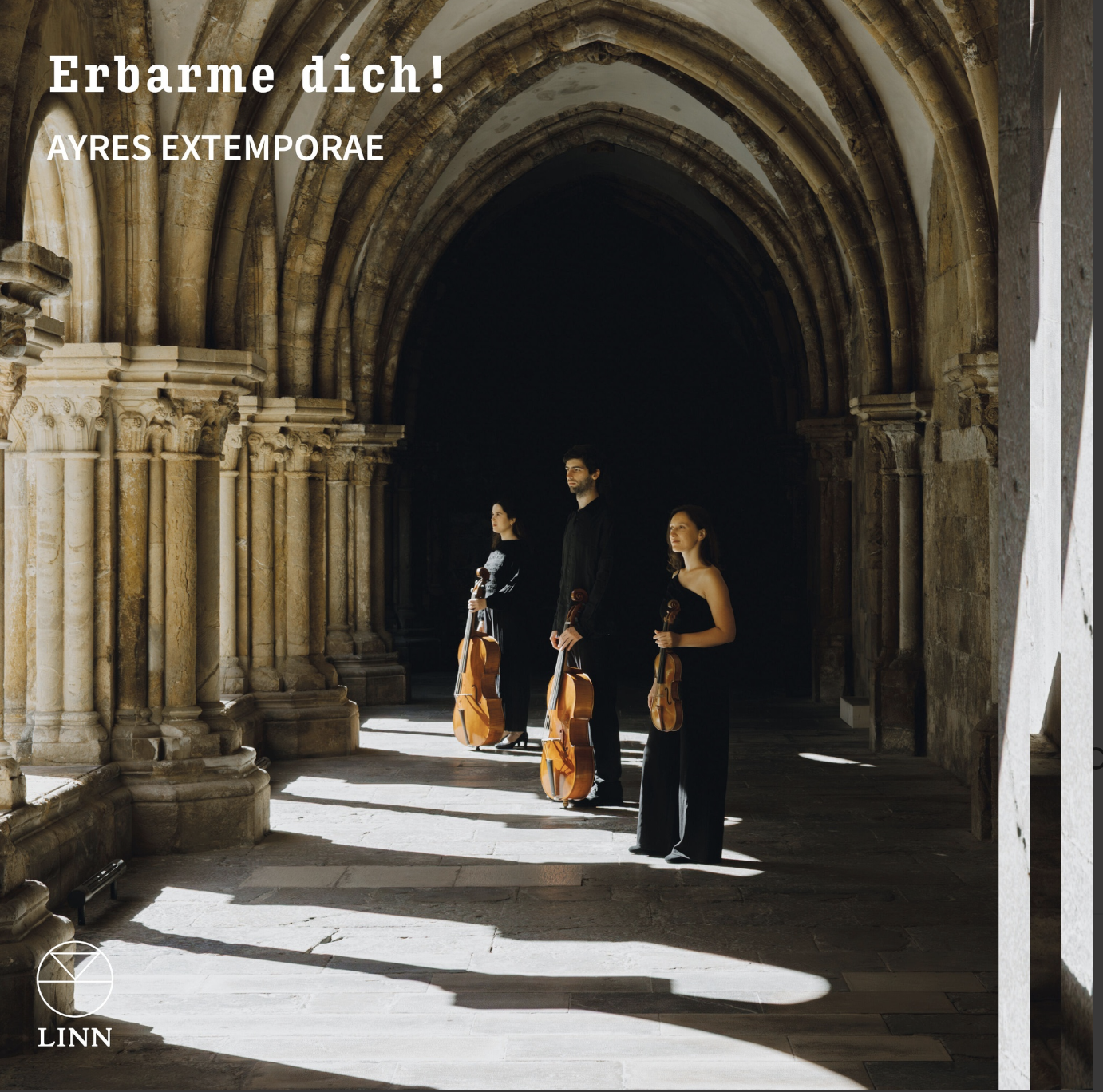
This album "Have Mercy" includes an interesting combination of instruments: violin, five-string cello, and (4 string) cello. The liner notes explain the concept of the album this way:
Erbarme dich! represents a spiritual journey from torment to redemption built around the instrumental transcriptions of arias and sonatas by J. S. Bach, interwoven with the expressive depth of works by Biber and Locke. It is a profound reflection on these universal themes, tracing the full spectrum of human emotion from anger, guilt or remorse to acceptance and, ultimately, peace. The aria from the cantata BWV55 lends its name to this programme: a plea for mercy of touching vulnerability, signalling the beginning of the journey towards absolution.
They also explain that the 5-string cello takes on a chordal support role, while the larger cello serves to realize the bass lines. The group has been awarded several prizes for their performances after meeting at the Collegium Vocale Gent Academy in 2020.
After an introductory Pavane from Matthew Locke, the group gives us an especially fun rendition of Biber's E-minor sonata (1681, C. 142). The connection between players is especially solid, offering something truly affective without the support of a keyboard or lute. The instruments used offer us, I'd say, a richer experience, even if the textures are similar, but pizzicato helps raise the texture component. The violin playing is excellent, and the support, it's locked in, from two players who match Xenia Gogu's drive and style. Before the piece's end, we're treated with quite a climax, the two cellos locked in together, offering ample support for the violin part's drama.
The group gives us a few pieces by Bach that come from his gamba suites: the middle movements of BWV 1028 and BWV 1029, then the full suite BWV 1027. Also from Bach is the Andante un poco from BWV 1015, scored originally for violin and keyboard. There's a sensual lean to these pieces, achieved somewhat by the phrasing and articulation from the violin. The opening of 1027 especially sounds to me quite plausible as an arrangement, each instrument offering us the right articulation, and while they blend together well as an ensemble, we're still treated with good transparency between the parts.
When we get to the faster movement in 1027 we lose a bit of the bite in articulation that is normally heard in this piece; but while the lack of the keyboard is partly to blame, there's a real smoothness to the violin part that I think is satisfying. The tight integration of the parts, too again, is a hallmark.
As the title may signal, they also include two pieces by Bach originally intended for voice. The second is an aria from cantata 97: Ich traue seiner Gnaden. The violin part has a lot to do, leading the introduction, then supporting the 5-stringed cello part with chordal support. What the instruments do feels a bit unidiomatic as far as string writing goes, but the result is nevertheless an affective experience. This could easily turn strange if the parts were played "romantically" with vibrato and long phrasing, but these HIPP musicians do it right by keeping to shorter phrase lengths and only applying vibrato for ornamental support.
The first vocal piece is from cantata 55, Ich armer Mensch, ich Sündenknecht, the titular Erbarme dich!. Here the trio texture gives melodic material to both the 5-string cello and violin. Here I was reminded how Gogu is very good at leaning into the dissonant lines offering us special release as the harmonies shift and the dissonance resolves. I think this makes for good rhetorical playing. While I feel she may lead in this kind of playing, we get the same from Víctor García García on the 5-string cello.
The penultimate track is a Ciaccona from Andreas Oswald's sixth violin sonata (d. 1665). He was born in Weimar and served as organist there before Bach's tenure. He was known as a virtuoso on the violin, too. The piece is interesting, presenting itself as a nice simple melody, but it expands somewhat with nice dramatic complexity for the violin part before winding down gently.
By far the most exciting piece on this album is the aforementioned violin sonata by Biber. It's where I felt all three players played with exquisite drama. The two faster movements from BWV 1027 were also welcome, as the other pieces all lean toward the more tender and slow side.
On the recording front, Linn gives us good balance among the players, with support for them ducking in and out of the limelight. The presence of atmosphere is reduced, offering a pretty clear presentation of just the three players. It's a warm recording, just about as ideal as one might desire.
Ayres Extemporæ have found something real here — not a novelty of instrumentation, but a genuine argument for this particular combination of voices. The drama of the Biber sonata alone earns the disc.