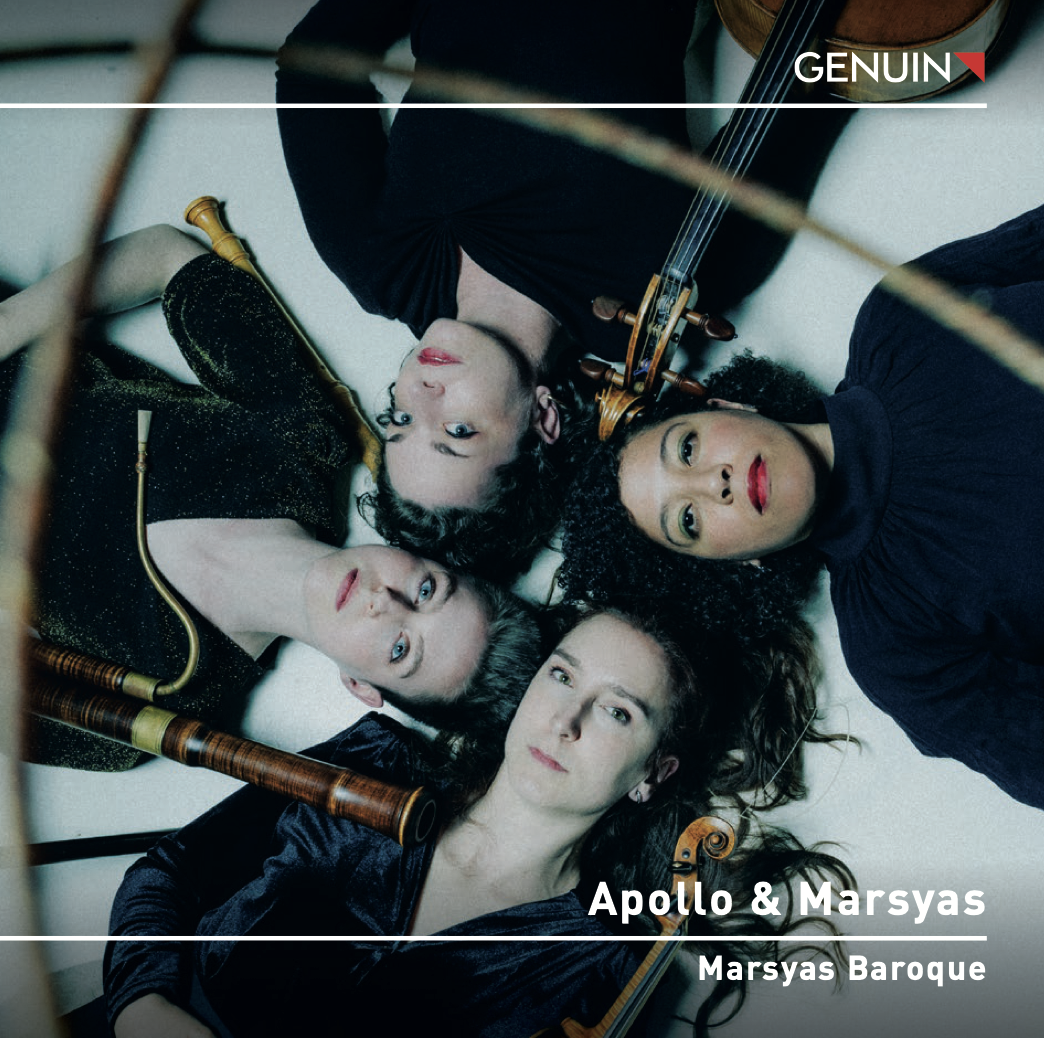
Apollo & Marsyas • Marsyas Baroque
Presented across six "acts," Marsyas Baroque (Paula Pinn, recorder and bassoon; María Carrasco Gil, violin; Konstanze Waidosch, cello, violoncello piccolo, and gamba; and Sara Johnson Huidobro, harpsichord and organ), not to be confused with the similarly named Marsyas Ensemble, presents works by all manner of Baroque composers: Castello, Locatelli, Quantz, Vivaldi, and Telemann, alongside Gesualdo, Reichenauer, Supriani, Blavet, and others in programmatic support. The program retells the myth of Marsyas, the satyr (half human, half beast) who finds Athena's discarded aulos and challenges Apollo to a musical contest. The old story helps explain the pairing of recorder and violin pieces.
Spoken tracks in German, read by Timur Işık, advance the story. After an opening "overture" in Castello's Sonata Quarta from his second book, two solos let the characters establish their identities: Quantz's Vivace alla Francese for recorder, then the first of Locatelli's Capricci from L'arte del violino, op. 3. Johnson Huidobro gets a solo as well, with the Toccata from J.C.F. Fischer's Uranie suite. In the solos and ensemble pieces alike, the recording is close, with a nice acoustic backdrop in support of the chamber ensemble. The album is blessed with good sound.
Because the concept pairs storytelling with music, the pieces tend to be short. Vivaldi's concerto RV 92 is presented complete, as is Reichenauer's sonata à 4 in G minor, Rk 18. The longest single tracks, each under seven minutes, bookend the album: Castello at the start, and at the close Bach's Schmücke dich, o liebe Seele, BWV 654. The organ chorale is arranged here for recorder, violin, and violoncello piccolo with chamber organ, the added strings perhaps suggesting that Apollo has won the contest, although the booklet notes Marsyas’ echo with the inclusion of recorder. The two bookends, Castello vs. Bach, also chart a Baroque musical journey, highlighting the ensemble’s abilities with changing styles.
One of the standout qualities of this recording is the very texture of the harpsichord. A great example is Marin Marais's Plainte from his Pièces en trio. (The booklet places it in the second suite; the ensemble's online track list, in the third.) It's both a function of the recording and the keyboardist's interpretive style in continuo, and it comes off as luxuriously enjoyable.
The aforementioned quartet by Antonín Reichenauer features Pinn on bassoon, perhaps another stand-in for the double-reed aulos. The piece was new to me and carries the scent of both Vivaldi and something a bit more rococo in style. It was a great introduction to both this composer and this ensemble's tight style. Clearly these are musicians who are comfortable with one another, their active parts on all fronts falling together like precisely cut Japanese wood joinery. The use of organ in this quartet is a sonic bonus.
There's one departure from early music: the group performs Alessandra Bellino's (b. 1970) Marsýas, commissioned for the program. The piece captures the satyr's non-human wildness with ease, and it fits the program thematically, but it's a creative flower with a prickly stem, and I can imagine skipping it on repeated listening.
For my part, I'd also program out Işık's German readings; I don't understand them, and frankly, I just want to hear the music. The booklet offers a link to access English translations. Across the board there's no superior player here: solos for each member (including Supriani's Toccata X for cello) give everyone a moment to shine. Each performer is a virtuoso, and that doesn't always make for successful ensemble playing. Here it does: the arrangement of Telemann's Die Glut des Zorns and the Vivaldi chamber concerto reveal just how well they play together.
Props to these musicians for finding a creative way to introduce themselves through the Apollo and Marsyas story. I think the concept might work better in concert than on a recording, but as I've noted elsewhere, it's trivial to skip whatever doesn't reward repeated listening.
My most enthusiastic recommendation goes to the musicianship on display across this album. While I tend to prefer recordings that focus on a body of published material, this one aims to show the ensemble's range across diverse repertoire, and in that aim it succeeds. This album will be released on Genuin next week.