Monteverdi: Vespro della beata Vergine • InALTO
When you study Baroque music history with a Monteverdi specialist, you can imagine you get a proper education in the composer and his musical legacy. At the time of my introduction to his 1610 Vespro della beata Vergine (SV 206), the recording everyone reached for was the Monteverdi Choir's, made live in Venice. I was careful to have that very recording in my ears when I walked through St. Mark's, looking up at the ornate golden mosaics. By 1610, Monteverdi had already published five books of madrigals and written two operas, L'Orfeo and L'Arianna, the second now lost, save for its famous lament. He was looking for a new start, one he would find in Venice three years later. But many indications suggest this collection was written in Mantua.
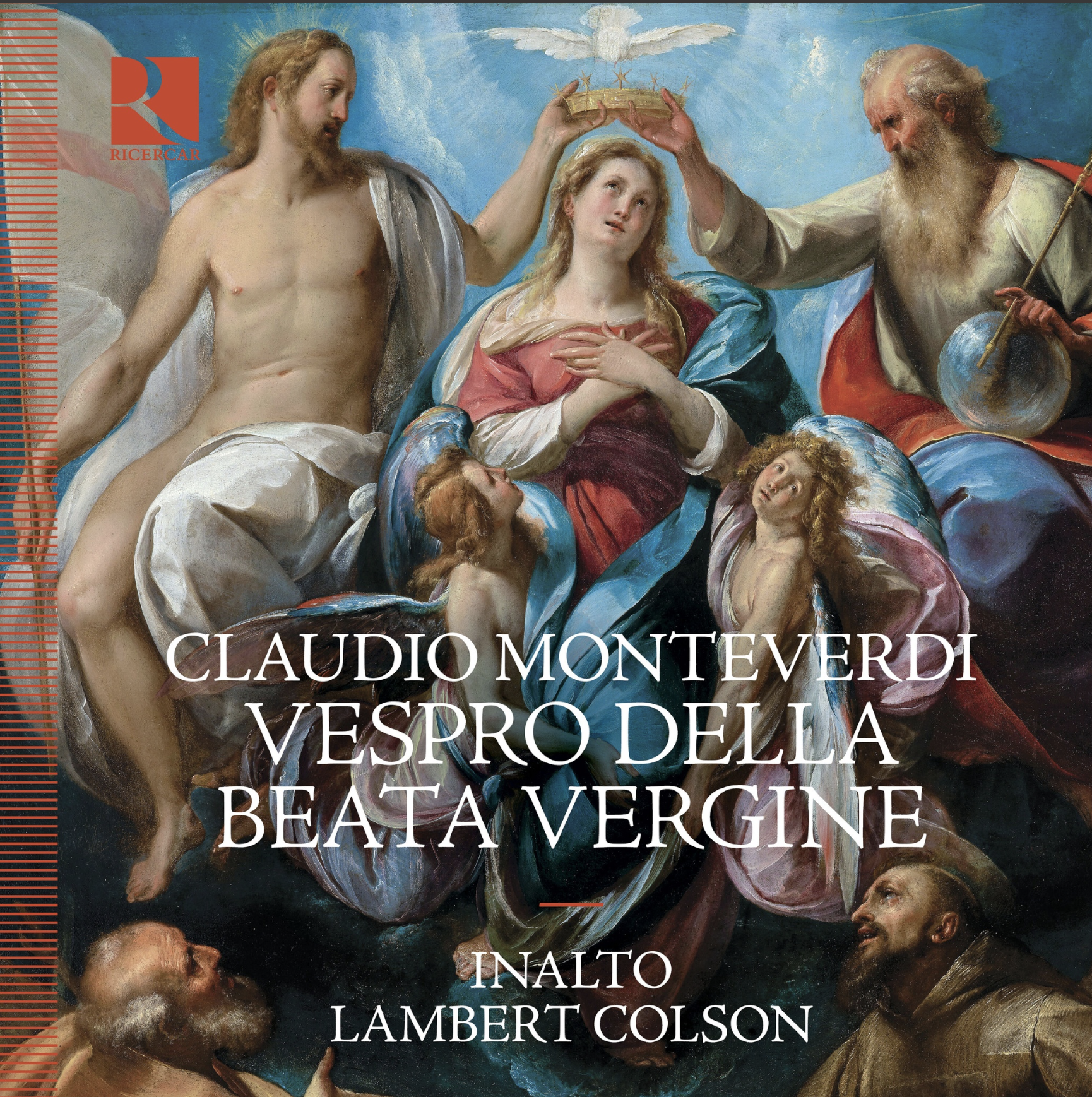
This new album from InALTO aims to bring some of the latest research and understanding to light, including that of Jeffrey Kurtzman, who contributes one of the booklet essays. The booklet notes are an extreme delight for those who have heard this collection many times. The ensemble went to Mantua to record in the Basilica of Santa Barbara, where the performance rightly opens with an organ toccata by Claudio Merulo, and where the basilica's restored 1565 Antegnati organ is a presence throughout. The musicians go so far as to reconstruct the liturgical material that would have surrounded Monteverdi's own pieces, enlisting the Cappella di San Petronio di Bologna to sing chants with Mantuan provenance.
I appreciate the booklet's discussion of historical authenticity and of the adjustments made so the recording rewards the listener at the other end of the microphones. What is easy to appreciate is the supremely clear sound, well balanced among voices and instruments. Without reservation, I believe this album should become the reference for this work. (Some years ago, a friend came across Marco Mencoboni's recording with Cantar Lontano on SACD, made in this same basilica, and sent it to me. I really liked it, but the amount of reverb came at the expense of clarity. For anyone interested in clarity of text, and perhaps in the environment for which this work was conceived, this new recording fits the bill.)
Among the research applied to this performance is the proportional relationship of tempo between sections. I found some of the tempi swifter as a result, which would not work in a space such as St. Mark's. The tempi not only seem well suited to the smaller Gonzaga basilica; having a rationale for the relationships between pieces also speaks to the composer's conception of the collection as a unified work, an idea the booklet argues persuasively.
Track 2 of the second disc, the Ave maris stella, shows a tight, balanced integration of voices and instruments. It's easy to imagine all the musicians of InALTO breathing in tandem. The instrumental interjections are played in the same style as the singing (the director, Lambert Colson, is the lead cornettist). The hymn's fourth verse is sung by Bart Uvyn, with a voice I very much admired. Massimo Altieri is even more expressive with his tenor in the sixth.
That cohesion of instruments and voices starts at the work's beginning, the Deus, in adiutorium, which borrows the toccata from the composer's first opera. Some may miss the grander presentations of other productions, but this one favors balance, with one singer per part and forces scaled to Santa Barbara. While I'm up for hearing that opening with trumpets and cornetts blasting, the clarity achieved here is something special. The balance continues into the Dixit Dominus, the first opportunity to highlight solo voices, each expressively rendered.
Altieri returns for Nigra sum, offering, for me, just the right amount of expressive color and dynamics. In a similar way, Maïlys de Villoutreys and Alice Foccroulle shine in Pulchra es. The next concerted number is Duo Seraphim, and I can't say I've ever enjoyed it more. The blend and matching of voices is supremely satisfying, and the vocal style, vibrato included, is outstandingly rendered. The next concerted piece, Audi coelum, includes the echo effect, sensitively handled by Riccardo Pisani and Luca Cervoni.
A favorite of many, I'm sure, is the Sonata sopra Sancta Maria. The instrumental opening is so nicely rendered, and the agility and connectedness between the two violins is perfect. The purity and blend of the soprani is the ideal addition, again in great balance with the instruments. The team's ability to capture the instrumental forces with clarity is what sets this production apart, giving listeners at home a front-row seat.
The opening of the Magnificat (disc 2, track 4) brings that clarity back, and having the organ's texture and sound so nicely integrated is a treat. The recorders that come in to accompany Pisani in Quia respexit, with the texture of that organ still clearly audible? Chef's kiss. The organ has a strong presence in Deposuit potentes too, supporting cornett and unison voices, and the way its tone blends with the violins is magical. Pisani opens the Gloria Patri in echo with Cervoni to great effect, again supported by this colorful organ. If ever a piece in this collection takes us somewhere otherworldly, it's this one (track 14).
A canzona by Giovanni Gabrieli and a Palestrina Salve Regina round out the production. Of course, I can't speak to the ultimate authenticity of all the material added to Monteverdi's score, but I found its inclusion musically satisfying. Bringing this work into a tighter liturgical light may not matter to the non-religious, but on purely historical grounds it gives us a newly enlightened understanding of this music's function. It also puts on record a reconstruction the ensemble first presented live, closing the 2023 MA Festival in Bruges.
This album deepened my appreciation for this work. The tight integration of all the assembled forces may be unparalleled, and the extreme clarity of voices and instrumental timbres and textures makes this one of the most palpable performances I've experienced on record.