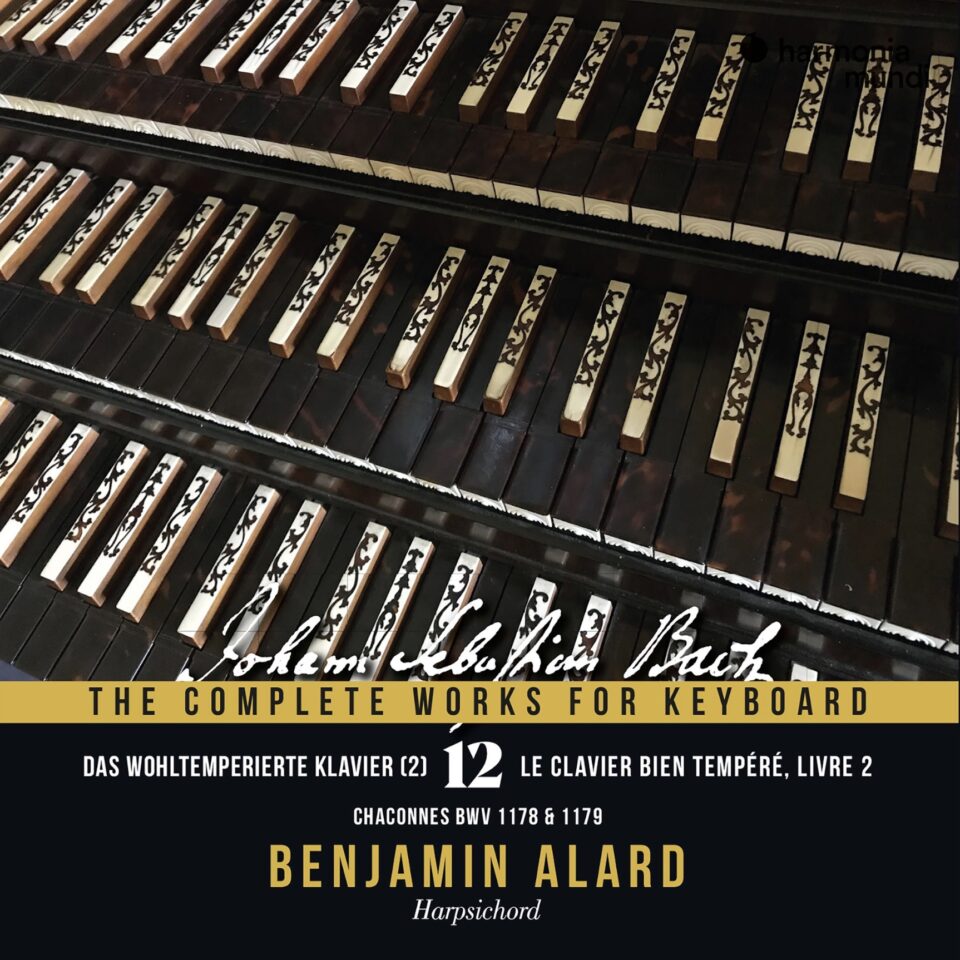
This is volume 12 of Benjamin Alard’s recording of Bach’s complete keyboard works for Harmonia Mundi. As in Book I, Alard plays a three-manual Hass harpsichord (1740). In addition to the WTC II, the CD release includes the two newly identified chaconnes: the Chaconne & Fugue in D minor, BWV 1178, and the Chaconne in G minor, BWV 1179. I’d already found these on Qobuz, released separately by Alard; they are not included in the streaming version of this volume, although its track list includes them.
The instrument may be of special interest to many because of its year of construction, its many registration options, and its third keyboard. Andreas Staier has recorded on a copy of an earlier instrument by the same maker: his WTC II (Harmonia Mundi, 2021) was played on a two-manual copy of a 1734 Hass, built by Anthony Sidey and Frédéric Bal in 2004. I found the creativity Staier applied across the set a bit distracting, especially when the registration used in a prelude did not carry over to its fugue. There’s no rule that it should; organists routinely change registration between a Bach prelude and fugue. I can’t say whether my reaction comes from years of training my ears to hear each pair in a single color. There’s also the element of taste.
In Alard’s new recording, I found the changes in registration less jarring to, well, my taste. Exploring the instrument’s full capabilities seems natural, given that the historical instrument gives us something a piano cannot. Pianists may well argue that their instrument can produce different colors through pedaling and touch, and I’m not here to argue that point; but the instrument used here offers something, in a mechanical sense, that the piano does not.
What listeners may find controversial is Alard’s ordering of the preludes and fugues. For one, many of us know from memory what comes next, and Alard breaks that expectation. (Yes, we can program the tracks in whatever order we choose.) The second is familiarity: track numbers that align across recordings.
I won’t recount his complete ordering here, but he starts with the C major pair, then moves to F minor, B-flat major, D-sharp minor, and A-flat major. The logic is the circle of fifths, walked backward: each pair sits a fourth above the last, with major and minor alternating almost throughout, so each disc completes a full twelve-key circuit. The second disc retraces the circle from C-sharp major with the modes largely reversed, and each disc closes with one of the chaconnes. The result is the ultimate test of the applied tuning and how it holds up across the set.
I’d argue that no one expected anyone to perform this set as a concert, and ultimately, ordering for me is up for debate. It may matter only if you like to pop in a CD and let it spin through. In this case, Alard gives us a new journey.
The liner notes provide good context for the WTC II and the two chaconnes, plus background on the Hass instrument from the Musée instrumental de Provins. They do not, however, explain Alard’s ordering of the pieces. As with Staier’s recording, the main essay is by Peter Wollny. And as with the previous releases in this series, Harmonia Mundi still insists on the smallest possible font for the booklet.
Performances
The G major pair (BWV 884) appears as tracks 23–24 on disc 1. The prelude is fast and exciting, with added sparkle from the registration. Alard drops in the lowest register in spots, a smooth and satisfying effect. His tempo is well chosen, and the ornaments are crisp and tidy. The shift into the fugue is smooth, with no jarring change of registration. With the courses he applies, the fugue’s texture takes on an orchestral feel. Alard’s execution of the upward run before the close is virtuosic and satisfying.
The C-sharp major pair (BWV 872) appears as tracks 1–2 on disc 2. It’s one of those preludes that demands consistency of touch and articulation to give it an even, steady feel. Mechanical perfection isn’t really called for, but Alard is a technical player: he delivers the consistency and adds just a few touches of rubato to make the performance feel human. He drops in the 16′ for the fugue, which gives it an unusual weight for those used to the 8′ sound. He’s smart not to use it throughout, but rather as an organist would, given the luxury of an extra keyboard or the foundation of the pedals. Nicely done.
Another well-known pair is the C minor (BWV 871), tracks 15–16 on disc 2. Again, Bach tests the right hand. Alard’s tempo is well judged. The space between notes in the prelude may feel awkward to those used to hearing it on piano, where legato is often applied, but I think Alard’s approach works well. The fugue continues in the same timbre. The tempo is a bit swift for my taste, but careful attention to timing, with a bit of rubato, again makes the performance feel human. The addition of the 16′ at the end seems warranted and is not jarring. Oddly, there’s a noise at the end of the track, either Alard getting off the bench or a mechanical thud from the instrument. I’m surprised it wasn’t edited out.
The D-sharp minor pair (BWV 877) appears as tracks 7–8 on disc 1. There are some nice moments in the prelude where Bach’s figuration gets fancified; Alard shows no sign of strain in delivering them in time and with light grace. He employs some interesting colors in the prelude, given the instrument’s kaleidoscope of options. The fugue sits a bit stale for me in the rhetorical department, and an annoying page turn is audible at the start, which should have been cut or replaced with a second take. I’m used to hearing this fugue with a bit more energy (not always tempo, but energy). Alard’s performance is in line with many others across the set, with agility and well-applied rubato, but I think a kick in the tempo might have made it more rewarding.
Finally, the F minor pair (BWV 881) sit at tracks 3–4 on disc 1. This one may be less satisfying for some, because Alard applies a very nasal register, the Cornet 8′. What’s interesting (or, some may say, annoying) is his use of separate keyboards, with the nasal registration applied to only one of them, in the left hand. Things get spicy in how Bach constructs his patterns across both hands: the contrast in texture makes that construction very clear. My honest first reaction was “oh, God, no…” but by the end of my first listen, Alard had convinced me that this registration illuminates Bach’s writing in a way we listeners might not otherwise appreciate. The Cornet registration continues into the fugue, though not throughout. I’m less satisfied when that voice disappears, although he does bring it back.
Conclusions
It’s interesting that Harmonia Mundi has published, within five years, two WTC II sets on harpsichords with similar sonic signatures, given that both trace back to the same Hamburg maker. Alard and Staier are both accomplished musicians, and maybe the point is that yes, both are fine, but they differ in style. I did not want to make this review a comparison between the two, but at this point I did want to re-sample Staier’s recording and refresh my memory.
In Staier’s recording we sit further from the musician and instrument, so the presentation is different. I much prefer the closeness of Alard’s new recording, at least through headphones. However, some of the preludes and fugues, the E minor fugue (BWV 879) especially, simply bask in the sun under Staier’s command. He has the energy I spoke of earlier. That is of course style, but style also reaches us as listeners as personality. In a fugue like the E minor, the speed and articulation Staier brings are very satisfying.
Which is ultimately to say, I don’t think I want a definitive collection of the WTC II. With Benjamin Alard we get a very consistent approach across all the preludes and fugues. His instrument offers plenty of timbre and color, and I think he applies those colors intelligently and with care. We all hear music differently, I’m guessing, and while I wouldn’t pin every one of Alard’s performances as a clear favorite, he offers quite a bit to admire across this set.
If you own the Staier recording, I don’t think it’s a question of one versus the other. If you love Bach on the harpsichord, both recordings deserve your time. To my ears this new recording has the better sound, although the few background noises that needed editing should have been dealt with.
All told, I hope Mr. Alard receives special recognition for this volume of his project. The performances are at a consistently high level, and I have little doubt the press will notice, as it has with some of his earlier recordings.