Introduction
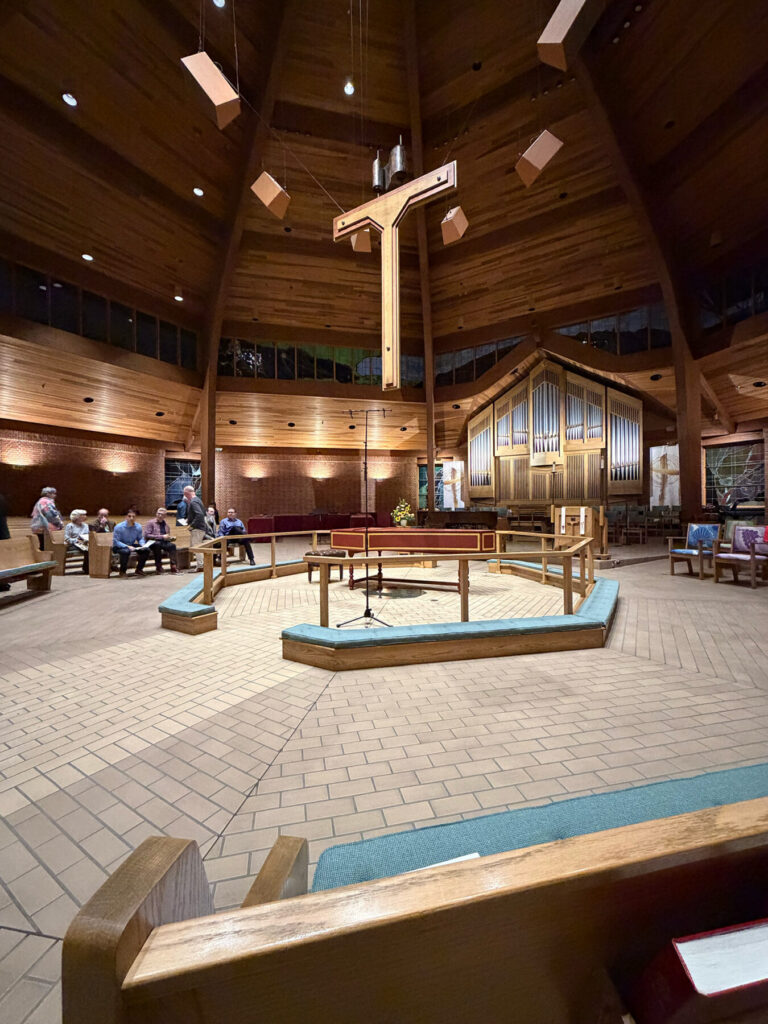
Jean Rondeau’s program for Chamber Music Maryland at First Lutheran Church in Ellicott City, Maryland, on November 21 was all French: Louis Couperin, Jean-Philippe Rameau, François Couperin, and a technicolor closer, La Marche des Scythes by Joseph-Nicolas-Pancrace Royer. I’ve seen him play that last piece on YouTube, and of course I spent significant time with his Louis Couperin. It was the Rameau I found most pleasant, likely because of its strong familiarity.
The concert was followed by a question-and-answer session moderated by WBJC’s Jonathan Palevsky. Some of the questions reflected the diversity of the audience: one asked about his favorite piece; another wanted to know why the keys on the second keyboard moved when he played the other. Rondeau said he has no favorite pieces, and that he doesn’t want to spend too much time with any one piece, there are so many one can enjoy. He alluded to the idea that doing so sucks the love out of performance, and that no performer should become obsessed with a single piece. The comparison to lovers revealed how he thinks about music—or maybe it says more about how he thinks about lovers. Either way, the audience got more than one chuckle out of the conversation.
I asked Rondeau whether either of two musicians had influenced or inspired him. The two I named, both of whom came to mind as I watched him play, were the late Scott Ross and the jazz pianist Keith Jarrett. I didn’t tell Rondeau why these musicians came to mind, but I can do so here.
Rondeau did point out that he and Ross both played the original instrument at the Château d’Assas: Ross for his Scarlatti sojourn, Rondeau for his album Vertigo. But that, he admitted, was pretty much alone where their paths crossed. He reminded the audience that Ross died before he was born—but of course, I was wondering whether he’d listened to Ross’ recordings. Evidently not.
Ross was an important figure for attempting to de-institutionalize the role of the performer. He played in casual clothes, he smoked cigarettes, and I’m guessing he didn’t much care for an establishment that expected a “classical” musician to show up on stage in a tux.
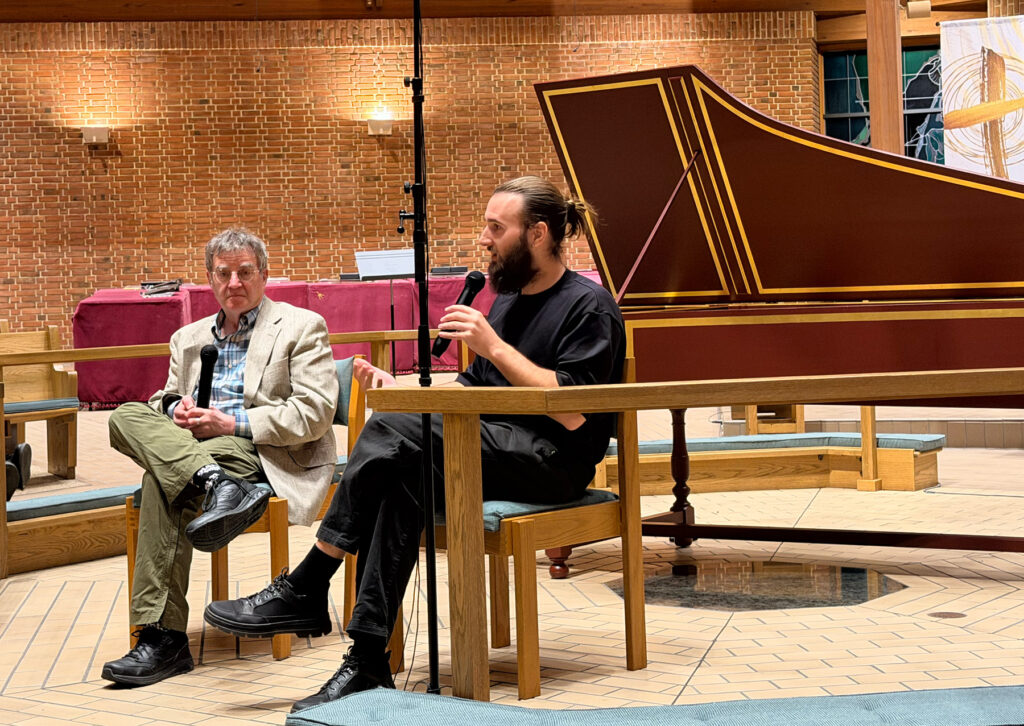
Rondeau wore a dark shirt and pants, his hair pulled back. He was sporting a beard, which was nothing new. No bracelets. He looked like a representative of an anti-fashion movement. I couldn’t care less, but I found it hard not to see a connection back to Ross.
I’d also suggest that Ross’ approach to playing isn’t terribly foreign to Rondeau’s. Rondeau spoke to the audience about feelings and emotions, and about expecting every performance to sound different, given changes in venue, audience, instrument, and one’s own disposition.
He warmed more to the association with Jarrett. At one point Rondeau nearly lifted himself off the bench, and I thought he was going to stand while playing—something we can see Jarrett do on many occasions with his Standards Trio. Rondeau admitted that Jarrett was important to him in his teens, and that yes, their repertoires share something in terms of improvisation. He was humble about it, saying he doesn’t consider himself a musician on Jarrett’s level.
The funny thing, of course, is that Jarrett has played baroque music on the harpsichord (J.S. Bach, to be exact), and I was never a big fan of the results. The other connection is Rondeau’s own jazz playing on piano. But neither of these secondary overlaps came up.
The Performance
Rondeau played a locally-sourced instrument placed in the center of the church, whose hard surfaces made for a great musical venue. He came up to the instrument, sat down, paused, then played continuously for around seventy minutes. Those unfamiliar with the music may not have realized where one piece ended and the next began. It was different for me: I’d never seen a historically informed player connect the music like that, from one composer to the next. He performed everything without a score. He shared later that some of what he played was improvised, and that other music, even though it may have sounded improvised, was not.
He did something I’m a fan of: he internalized the music. He didn’t use that term, but I’ve experienced it myself. I’ve played something so many times that it’s in my fingers and I no longer need the score. It opens your mind a bit, offering new interpretive options. It’s music; it’s no longer notes on a page. I find that approach refreshing as a performer, and I think it worked wonderfully for Rondeau in this repertoire.
Although I’m sure he wouldn’t say this, there were a few moments where he leaned into speed as a technique. There’s a virtuosic component to playing fast, and a few times it caught up with him. But set those aside and consider what he was after: having us feel the music the way he was feeling it, and revealing the potential in what has been handed down to us through the centuries. On that score, he delivered.
I enjoyed looking around the sanctuary. At people’s faces. The intense focus shared by nearly everyone in the audience. Rondeau had them locked in, whether they knew the pieces or not. The repertoire’s rich harmonies, woven through complex passagework? Rondeau was in his element. In that way he’s a master communicator. I got goosebumps more than once, and by the time he started his single encore, François Couperin’s Les Barricades mystérieuses, I’d resigned myself to acknowledging that this was one of the best concerts I’ve ever attended.
Rondeau comes across as someone who thinks deeply about music, but not in a scholarly sense. That’s not a statement about his intellect or talent, just his approach. He clearly spoke from a grounding in historically informed performance practice (HIPP), but without getting academic about it. I thought that framing served this music well.
And now I’m hoping Rondeau will play more Rameau—and commit it to a recording beyond what he’s already given us on Vertigo.
Program
Louis Couperin: Suite en ré — Prélude G. 1, Allemande G. 35, Courante G. 42, Sarabande G. 51, Canaries G. 52, Chaconne la Complaignante G. 57
Jean-Philippe Rameau: Prélude; Suite en la from the Nouvelles suites de pièces de clavecin — Allemande, Courante, Sarabande, Les Trois Mains, Gavotte avec six doubles (with Rondeau adding his own seventh double)
François Couperin: Premier prélude en do majeur from L’Art de toucher le clavecin; La Ténébreuse (Allemande); La Favorite (Chaconne à deux tems – Rondeau)
Pancrace Royer: La Marche des Scythes
Encore — François Couperin: Les Barricades mystérieuses