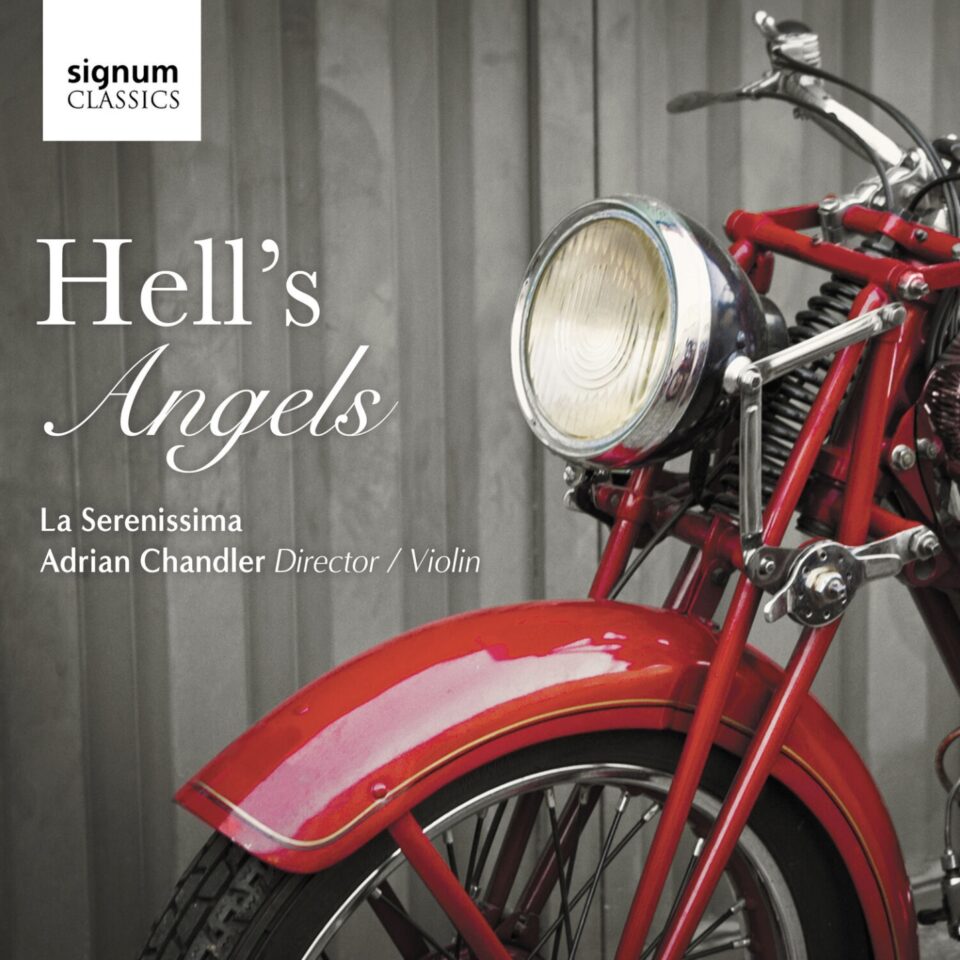
This is a generous set of sonatas crossing Italian and French borders, exploring the impact Vivaldi had on other composers and musicians. From the liner notes:
On account of the juxtaposition of French and Italian repertoire, it was decided to give the album a title inspired by the legendary meeting between violinists Pietro Locatelli and Jean-Marie Leclair in Germany on 22 December 1728 at the court of Kassel. The meeting was witnessed by Jacob Wilhelm Lustig, who afterwards wrote that Leclair played like an angel, while Locatelli played like a devil. This description has often since been used to describe the differences in national playing styles of France and Italy.
Eight musicians in all made the recording in December 2022, during rolling pandemic aftershocks. The sonatas cover various orchestrations (violin and cello, two violins, two cellos, two violins alone, and keyboard and violin), so there’s definite variety on offer.
The recording was made in a school, and while that may not suggest top-rate acoustics, it sounds good, with very clear and detailed imaging. The distance to the musicians shifts a bit from one work to another, but I’ll take it, given the quality.
I’m glad to find Mascitti and Guillemain here, two composers whose music I’ve found delightful on other recordings. The Guillemain sonata for harpsichord and violin in G is very galant in style, more so than the Mascitti. The violin writing sounds simple, but I don’t think the music is easy to play, given the high range and the double stopping. I have to imagine it’s not much fun to play, actually, which belies the style of the opening Allegro. I’m not a violinist, though, so that’s only conjecture. The piece is meant to focus on the violinist over the keyboard, although the harpsichord part has its own important role and is more than continuo support. The finale, marked Presto, is clever, even jocular in spots. I didn’t know this piece, but enjoyed getting to know it in Adrian Chandler’s capable hands.
The Mascitti G minor sonata for cello and violin is in five movements. Both players have technical tightness in the faster movements; the middle Largo brings the two soloists together with continuo, and I wonder whether some improvisatory decoration might have been called for.
Leclair wrote several sonatas for two fiddlers, and here we get the G minor one, op. 12, no. 5, played by Chandler and Oliver Cave. They offer challenge, but I think they’d be a lot of fun to play. There I go speculating again, but it’s the sense I get from these two. Love the stereo imaging on this one, too.
The Vivaldi trio sonata in G, RV 820, was not new to me; I remember discovering it through Modo Antiquo’s 2015 album The Young Vivaldi, which was its premier performance. Their performance was a tad spicier, though the sound wasn’t ideal, nor was the timbre of their cellist. The band here plays well enough, with clean passagework in the violin and good tempos, but there is perhaps more potential in this piece, stylistically that got explored on that album that appeared on DHM.
Better in my view was the second Vivaldi, RV 68, without continuo. The booklet says the continuo is optional, and I enjoyed it this way; it makes a nice companion piece to the aforementioned Leclair.
Benedetto Marcello has not been my favorite composer, but his B-flat sonata for two cellos (S.F. 758), in four movements, is well served by its two cellists. Three cellists are listed in the booklet, and I assume one is Samuel Ng, but I can’t say who the other is. The piece lets them imitate one another in counterpoint, and they do an excellent job. Their first Allegro isn’t taken too fast, which I think is true to the character of the piece. The theorbo in the continuo, played here by Lynda Sayce, was a great choice. There’s room for a little more drama through dynamics; both players are a bit reserved. The finale, Presto, is reminiscent of Bach’s sixth Brandenburg Concerto, and it too, I think, sounds like a fun one to play.
Conclusions
This program combines some pieces we may already know; that’s not a problem. I’m always open to new interpretations. But for me some of these works were unknown, and that is a bonus, for sure. Some of the pieces are served by excellent sound, others maybe one notch below (where more players are involved), but overall this is a clean and satisfying listen.
In the Italian pieces especially, La Serenissima aren’t on quite the same stylistic plane as some Italian ensembles in the HIP world. Those ensembles purportedly derive their tempos, effects, and strong dynamics from historical writings, but I can’t say whether that edgy style is more authentic.
What’s on offer here, however, is not academic or pedestrian, words that have been used to describe some early HIP recordings. For those who regularly hear or collect recordings by Chandler and his band, I think the rewards are likely high when spinning or streaming this one. I’ll be sure to return to it!