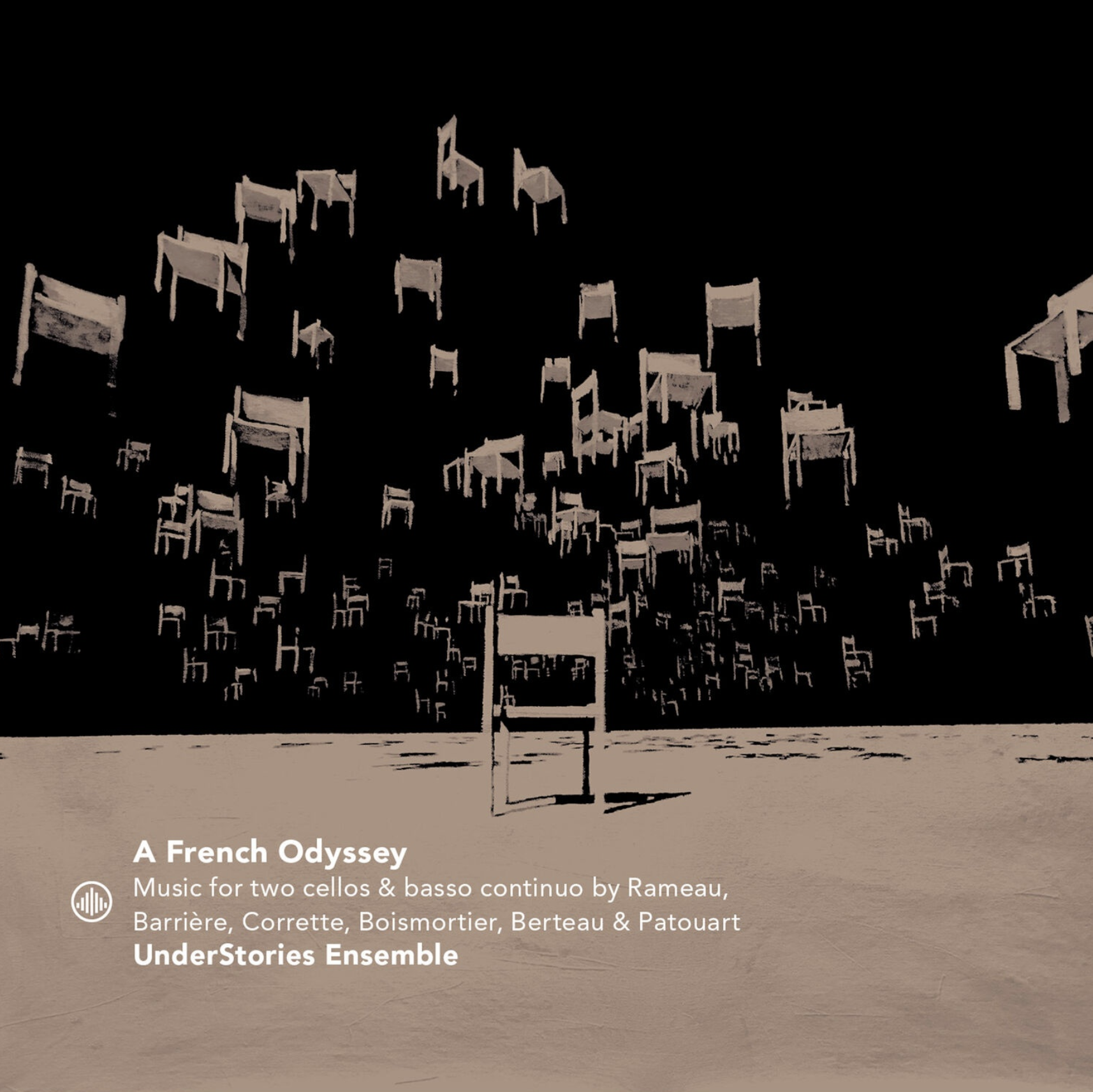
A French Odyssey • UnderStories Ensemble
Founded in 2018, UnderStories focuses on exploring the rise of the cello as a solo instrument, and especially the repertoire for two concertante cellos in the 18th century. Another major element of the ensemble’s activity is to treat Baroque music as liberally as it was done within the period itself, where arranging and changing instrumentations in order to shed a different light on seemingly familiar repertoire was the order of the day. Therefore, the use of two piccolo cellos is our example. The sound and tuning of the instrument make the transcription of violin music especially idiomatic and will hopefully allow the public to discover a repertoire that they might have not known in another context.
This recording features music by Barrière, Boismortier, Rameau, Corrette, and Berteau; it also includes a work by Patouart who was born in 1719. As the description about this album from the liner notes dictate, this album is an attempt to re-imagine works from the French baroque featuring two cellos in the lead. Furthermore, percussion is used to help enliven the pieces by Rameau, bringing the dance element into focus.
The three-movement trio sonata by Patouart is interesting as it was written for two cellos. The older material, I thought, may have been more appropriate performed on gambas, but the sound achieved by the ensemble left me satisfied, even if in the context of a few of these pieces the cello may not have been as prominent an instrument as the viole da gamba.
Boismortier’s piece was originally scored for flute and bassoon (!), but comes off well in this guise with two cellos. UnderStories sell it as a really engaging piece, and it was among my favorites, not to leave out the arrangement of Rameau’s harpsichord piece, L’Égyptienne.
Corrette, a composer I often think had a very happy disposition, leaves us with a concerto entitled Le Phénix, scored for four bass instruments. Among the ensemble they bring four to the stage. Corette’s music ends up sounding the most “modern” among the pieces, outpacing for me Patouart’s style. There’s an Italian approach to Corrette’s writing. The tempos are well-chosen, the coordination between instruments tight.
The selections from Rameau’s Indes Galantes are recognizable, given the popularity of the work; here is where the group includes percussion. I know I’m a generation early in bringing Lully to the conversation, who is not represented on this album, but his famous demise, keeping time with a stick that he impales upon his foot is apt here; the percussion helps us a listeners hear the importance of the underlying rhythm. I am glad they added this element to these arrangements.
As for the genesis of this album, we can easily recognize that music in the baroque was typically a pragmatic art, it’s not unusual to see pieces, like some here, scored with “options” rather than with the requirement of one specific instrument. I can’t say how these composers would have reacted to the arrangement featuring cellos, but I can safely say that nothing seems compromised in the music presented. The performances by this ensemble align nicely with their arrangements, which is only confirmed as perfectly viable by the pieces where the use of cellos is already prescribed.
This is my first of hearing UnderStories, named for the vegetation under the canopy of a rainforest, hence the focus on the cellos. This was an engaging compilation of music, much of it rich in French baroque flair.