Opus 109 “Green Album” • Ólafsson
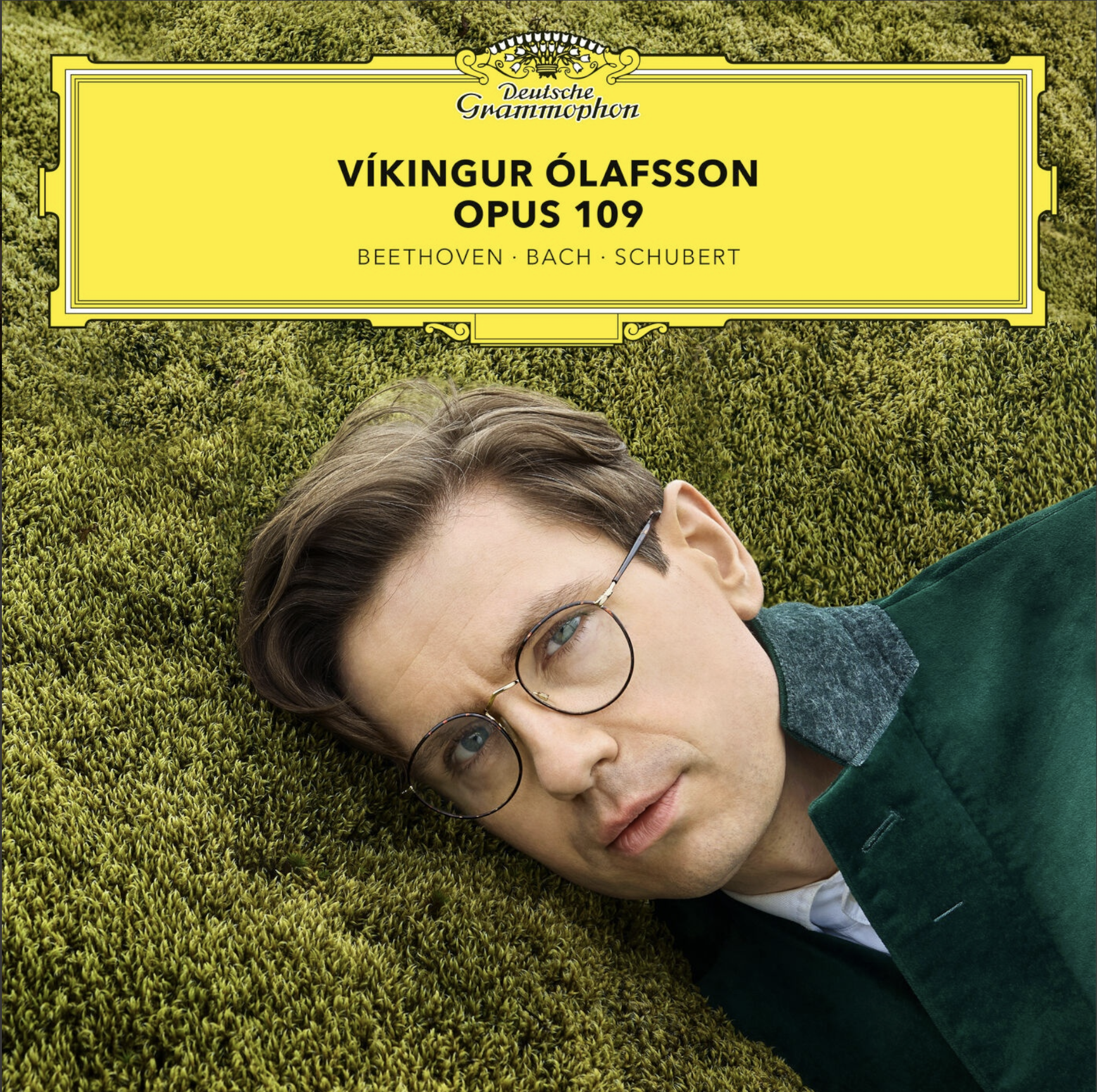
One of the first things I noticed about this program is its centering on the keys of E major and E minor. The liner notes reveal that the pianist experiences synesthesia—not the first musician to associate musical keys with color. Hence the visual presentation: Ólafsson robed in green, set deliberately against green vegetation.
The program includes works by J.S. Bach, Schubert, and, of course, Beethoven. The sound of the piano has always been an important component of an Ólafsson recording, and this one is no different. It is a dry sound, as if the tone were pushing through fabric toward the listener. It’s pleasant, but drier than most. The effect is not so much that of a concert hall as of listening across the room in a high-ceilinged home or château.
His touch is the other defining component—one you either come to love (or perhaps detest). The accuracy and extreme control of his fingers remain, to my ears, among the most fascinating aspects of his pianism.
Schubert
While this album is the first installment in a project devoted to Beethoven’s late sonatas, Schubert appears here as something of a palate cleanser—a cool, light course within a longer, multi-movement meal. What we’re given is not merely something calm or transitional, but Schubert’s Sonata No. 6 (D. 566).
Ólafsson’s control in the first movement is extraordinary, offering a wide dynamic range from its opening through the central climax. It also serves as an effective bridge toward Beethoven’s style.
In the second movement, the care with which Ólafsson balances dynamics between melody and left hand is especially striking. It is this precision that makes his performances so compelling, aided here by engineering that captures his technique at close range. With my current speaker setup, listening closer rather than farther away amplifies this effect far beyond what one might experience in a concert setting.
Bach
Bach is clearly an important composer for Ólafsson. Included here are the Prelude BWV 854, the Sixth Partita BWV 830, and—closing the album—the Sarabande from French Suite No. 6. There is something both intriguing and slightly disorienting about his realization of trills in the opening and closing selections. While these choices work pianistically, they can feel foreign if one is accustomed to historically informed approaches. The Sarabande, in particular, pulls us furthest from Bach’s time, though its style ultimately meshes well with the music that precedes it.
I was especially eager to hear his take on the Sixth Partita after recently reviewing Gordis’s recording. Ólafsson typically plays with great steadiness of pulse, though he allows himself notable rubato in the opening Toccata. More compelling than his treatment of time, however, is his use of articulation. His control of dynamics takes center stage in the Fugue, where he brings unexpected clarity to Bach’s contrapuntal lines, highlighting portions of the countersubject through subtle dynamic shaping. As much as I often close my eyes to admire Bach’s architecture in this work, here I found myself equally absorbed in Ólafsson’s pianism itself.
That said, there is little here that would spark real controversy in terms of tempo or pianistic style. Still, it takes only a quick comparison with another piano recording to appreciate just how distinctive his abilities are.
The Corrente is taken at a brisk pace, in sharp contrast to Gordis’s more restrained approach. That distinctive touch lends the performance an added sense of virtuosity, and the piano itself proves well suited to the demands of speed, lightness, and dynamic contrast. One suspects Ólafsson is playing an instrument close to ideal for his aesthetic.
The movement most likely to provoke debate is the Gigue. At just two and a half minutes, the tempo is exhilarating—but it nearly pokes fun at what I’ve always found one of Bach’s more curious dances. The theme’s wandering relationship to key is largely erased at this speed. Perhaps it was always meant to be this fleeting. Interpretation aside, the performance is technically flawless.
Beethoven
Ólafsson begins with Beethoven’s Op. 90 Sonata in E minor, the twenty-seventh sonata, composed in 1814 during the composer’s middle period. What becomes apparent almost immediately is how Ólafsson’s dry touch—often without the use of sustain—can mimic aspects of a period instrument. The dynamic range is larger, and the upper register distinctly modern, but in the middle register, within this dry acoustic and controlled articulation, the effect feels remarkably apt.
The second movement’s lyrical theme makes it the better-known of the two. Ólafsson’s clean articulation brings such clarity that I found myself hearing the music anew. I would be curious how others respond to his approach applied to Beethoven’s more romantic-leaning side—music often treated with greater rubato and pedal. Compared with traditional interpretations, such as Alfred Brendel’s, this reading is markedly cleaner. The strictness of Ólafsson’s timing nearly simplifies the music. While he is no slave to the metronome, listeners who prefer greater elasticity may hesitate. Still, as with his Bach and Goldberg Variations, this approach challenges expectations—and that challenge is part of the appeal.
The centerpiece of the album is Beethoven’s Sonata No. 30, Op. 109. I stepped away from the album to revisit performances by Maria Tipo and Melvyn Tan. Tipo represents a more traditional approach, shaping texture through sound mass, while Tan—especially given his experience with period instruments—leans toward a clarity closer to Ólafsson’s. Yet it is Ólafsson’s command of dynamic contrast that truly distinguishes his performance. He separates voices between the hands with remarkable transparency, aided by the piano’s dry attack. The louder passages in the opening movement nearly feel painful, again recalling the limits of a period instrument’s dynamic edge despite the modern Steinway’s capabilities.
The central Presto flashes by, fleeting in much the same way as the Gigue from BWV 830.
In the final movement’s variations, it is easy to become absorbed by Ólafsson’s touch and the clarity of his opening statement. The intimacy draws the listener in—so close you can almost smell the melody—before the music erupts into passages that suggest imminent peril, only to resolve as you realize that Víkingur is in complete control.
My own Beethoven cycles are those by Richard Goode and Paul Lewis. Yet this performance pulled me in deeply. It alters our listening position: do we admire from a respectful distance, or are we drawn in close? I’m not entirely sure how this effect works—or whether it will work the same way for everyone. But even if Ólafsson’s style isn’t your favorite, this is well worth hearing. I’m brazen enough to say no other living pianist right now has the technical ability to do what’s been done here. That doesn’t mean you’ll like it. But for anyone who has played the piano—even as an amateur—his technical prowess offers a genuinely new way to hear these works.
The closing Bach Sarabande feels especially apt after Beethoven’s Op. 109, its style suddenly making more sense in retrospect.
⸻
Conclusion
I was initially drawn to this album for its inclusion of Bach’s Sixth Partita. I don’t often linger with Schubert, but Ólafsson seems intent on revealing lines of influence—Bach’s imprint on both Schubert and Beethoven, and the dialogue among them. The shared tonal center of E reinforces that sense of cohesion.
Ultimately, though, the album’s true distinction lies in how Ólafsson’s unmistakable style—paired with this particular recorded sound—allows us to hear each composer with extraordinary clarity through touch and dynamic control. I will return to Goode and Lewis for Beethoven, and I will continue enjoying Tristano on piano alongside Gordis and others on harpsichord for Bach. But this album stands as a clear achievement. I’m richer for having discovered it.