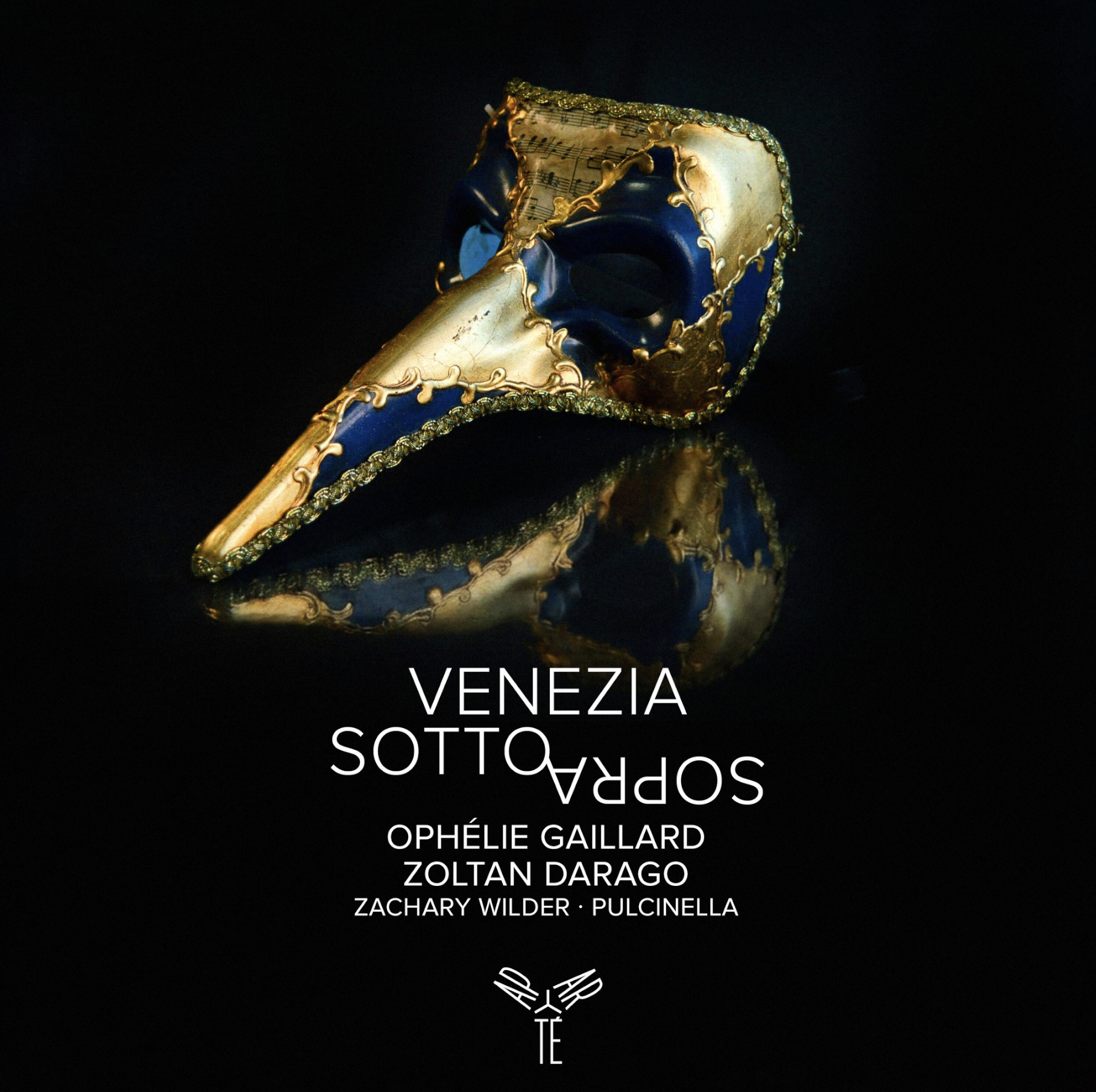
Venezia Sottosopra • Gaillard & Daragó
Venice has always been a city of contradictions, where elegance and vulgarity, sacred tradition and popular entertainment, melancholy and exuberance coexist. In Venezia Sottosopra, French cellist Ophélie Gaillard and her period-instrument ensemble Pulcinella explore the musical life of 18th-century Venice, moving beyond the familiar concert halls and churches into its streets, theaters, and canals. Antonio Vivaldi provides the musical foundation, with two cello concertos (RV 407 and RV 418), a concerto for violin and cello (RV 546), orchestral concertos, and operatic arias. These are interspersed with lively Venetian dances (balli), popular gondolier songs (canzoni da battello), and a cantata by Filippo Finazzi, a castrato who performed in Vivaldi's operas before establishing himself as a composer. Gaillard is joined by countertenor Zoltán Daragó, tenor Zachary Wilder, and violinist Pablo Valetti, among others, in a program that includes numerous world-premiere recordings and a reconstruction by Vivaldi scholar Olivier Fourés.
The booklet suggests that rather than presenting Venetian Baroque music as a succession of formal masterpieces, the album attempts to recreate the colorful, theatrical, and occasionally irreverent musical culture from which those masterpieces emerged.
The album was recorded in March 2026 at the St. Pierre Church in Paris, with Gaillard playing a 1737 Francesco Goffriller cello. I auditioned it on loudspeakers and headphones.
A word about the sound first, because it colors much of what follows. The recording is very transparent, but I'm not convinced it's an ideal one. Soloists are miked closely and sit clearly apart from the ensemble, which reads as a single mass in the background; when Pulcinella plays on its own, as in the string concerto RV 152, the distance from the microphones is a disappointment. The effect was more prominent on headphones. I'll note the exceptions as they come.
Cello Concertos
Gaillard performs two concertos from disparate periods in Vivaldi's writing for the instrument, beginning with the A minor, RV 418. The performances are good. Some recordings turn these concertos into showpieces; this one lets the music speak for itself, without artifice. The cello is right in your face, but technically strong, as we might expect, and any student approaching these works will want this recording for that up-close view. Those details matter to anyone polishing a performance.
I do love me some minor-moded concertos, and the D minor, RV 407, comes alive with the two violins positioned on either side of the ensemble. Despite a fast opening tempo, all the musicians take the challenge in stride, with good results. I'd still point listeners to Roel Dieltiens's recordings of Vivaldi's cello concertos as my favorites, but this one is artistically fulfilling.
The slow movement from the E-flat concerto, RV 408, among Vivaldi's more memorable, is also included. Here the clarity of the sound and the organ make an ideal soundscape without becoming schmaltzy. The psaltery in the continuo is nice, although it isn't called out in the instrumentarium; presumably it's played by Michèle Claude, listed as the percussionist.
String Concertos and Instrumental Numbers
The short opening track, Contradanza, features the cello and tambourine. It's an anonymous opener that helps to introduce the concerto RV 418. It's not necessary, but it plays into the album's program.
A Minuetto featuring the cello, track 5, introduces the vocal number, RV 704.
Tracks 7-9 give us one of Vivaldi's concertos for strings, in G minor, RV 152, dramatic enough to have served as a stage opener.
Percussion returns in Guerra d'amore, track 11. Like the earlier dance, it's anonymous. Two more dances featuring cello arrive on tracks 16-17. The percussion is tasteful throughout, without going to excess. I know some question its use, but to my ears it adds something of value to the flavor of these pieces.
Gaillard joins Pablo Valetti in the double concerto in A, "all'inglese," RV 546. The unison opening misses something for being so closely miked; the performances themselves, however, are again technically strong. The coordination between violin and cello is well balanced in the outer movements and the inner one alike.
Another of Vivaldi's named concertos, the "Conca," RV 163, takes up tracks 25-27. The piece has plenty of character.
Vocal Works
The album booklet does not include the vocal lyrics or translations.
Countertenor Zoltán Daragó, who has recorded an album of Bach alto arias with Les Talens Lyriques, is the soloist across the vocal works here. Track 6 is the aria Se nemico tu sei from La Candace o Siano li Veri Amici, RV 704. He has good projection and a serious case of the vibrato. I don't know about his teachers, so I can't speak to his training in early music, but his roles have featured opera. The vibrato isn't surprising, then, but it's not my favorite style with Baroque repertoire.
The next aria is Il destin che mi sovrasta from Orlando finto pazzo, RV 727. The texture is just voice and basso continuo, which I assume Gaillard is playing, as the cello part is prominent. Daragó's voice is strong.
The ensemble also presents Filippo Finazzi's Cantata No. 2 (tracks 28-30), opening with Pianger vidi appreso a'un fonte, an interesting connection to Vivaldi's operatic world. The style is most certainly Vivaldian in character, but it still works as a compositional contrast to the Red Priest.
The final track has Wilder performing as a gondola singer. I can't say the piece makes sense with basso continuo instruments behind it; nevertheless, it supplies the context of a visit to Venice.
Conclusions
This album has a distinctive point of departure. Connecting cello works with vocal ones, and then with anonymous pieces that bring another aspect of Venetian musical life into the fray, makes for a colorful palette. The musicians involved are all excellent technicians.
However, the impact on me falls short of other recordings, at least those of Vivaldi's works for solo voice and for cello. For the cello, the engineering could have done more for the balance between soloist and ensemble. For the voice, Mr. Daragó has promise, but in terms of period vocal style he's using too much vibrato for my taste.
That said, this album may be of interest for all the new music presented for the first time, much of it thanks to the wunderkind Olivier Fourés.