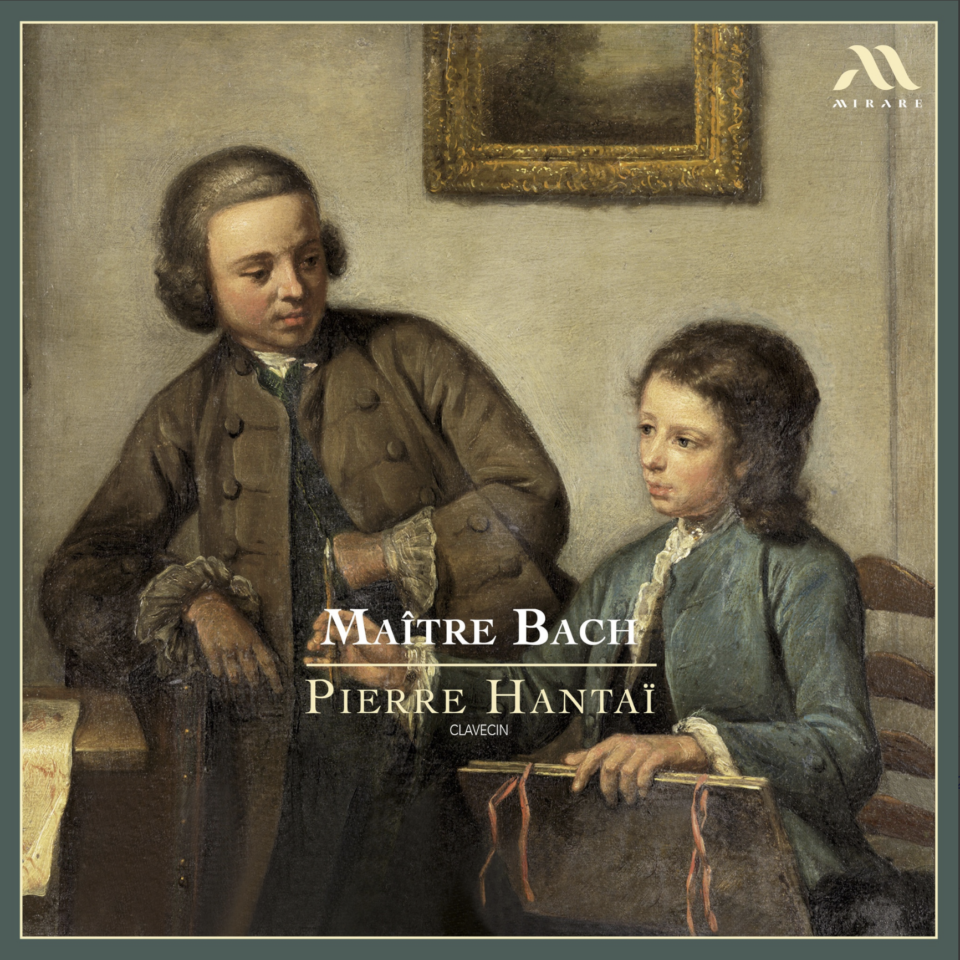
This generous recital of Bach’s music speaks directly to those of us who are, perhaps, not the most accomplished keyboard players. The recital presents a cross-section of Bach’s music, many pieces likely familiar to those who studied piano in their youth, such as the infamous Minuet in G which, sadly, has been identified as Christian Petzold’s and not Sebastian’s. I studied from the so-called Anna Magdalena Bach Notebooks, so hearing that piece alongside some of the two-part inventions was a treat. But why?
Hantaï is a master harpsichordist. His usual flair, exquisite touch, and ornamentation all come together to provide a deluxe version of these pieces, even if they carry strong pedagogical overtones.
The other distinctive aspect of this album is the instrument. The liner notes offer this description:
The harpsichord heard on this recording is an anonymous instrument, probably built in Thuringia in the mid- eighteenth century. It bears a strong resemblance to instruments produced in Gottfried Silbermann’s workshop and has two manuals, a compass of five octaves (FF–f3), two eight-foot stops, one four-foot stop, and a lute (nasal) stop. Restored in 2023 by Christopher and Catherine Jones, it is recorded here for the first time, although it has already been seen in Stanley Kubrick’s film Barry Lyndon.
They add that it resembles instruments from Gottfried Silbermann’s workshop, with two manuals, a five-octave compass (FF–f3), two eight-foot stops, a four-foot stop, and a lute stop. Christopher and Catherine Jones restored it in 2023; this is its first recording, although it has already been seen in Stanley Kubrick’s film Barry Lyndon.
For me the movie connection makes no difference, even if the movie earned four Oscars. That aside, the instrument and the way it was recorded combine to offer us something profoundly gorgeous. The instrument has a rather dark, tarnished sound, with overtones that to my ear are a bit unusual, and that novelty I think makes for a wonderful overall tone. In the upper register, that tone becomes a bit fragile, with certain notes ringing in an uncanny way. Sounds potentially dangerous, but trust me, this is an instrument that has to be heard. Kudos to Hantaï for putting this instrument on a recording.
This is an album you don’t necessarily need, but after discovering it I found myself playing it through many times in just a few short days. I don’t think it’s a stretch to say that Pierre Hantaï is among the finest living harpsichordists, and he has plenty of accolades playing Bach to substantiate such a claim. While there is certainly more robust and challenging repertoire to record, this album, for me, serves as a love letter to the amateur enthusiast who grew up with these treasures, many of them short, that paved the way for a lifelong appreciation of the period and the man who gave us so much legendary music.
The intent may have been somewhat autobiographical, as Hantaï’s entrance into the world of baroque music came by way of Bach. While Arthur Haas and Gustav Leonhardt would become his teachers, the ultimate teacher, one could say, was Master Bach.