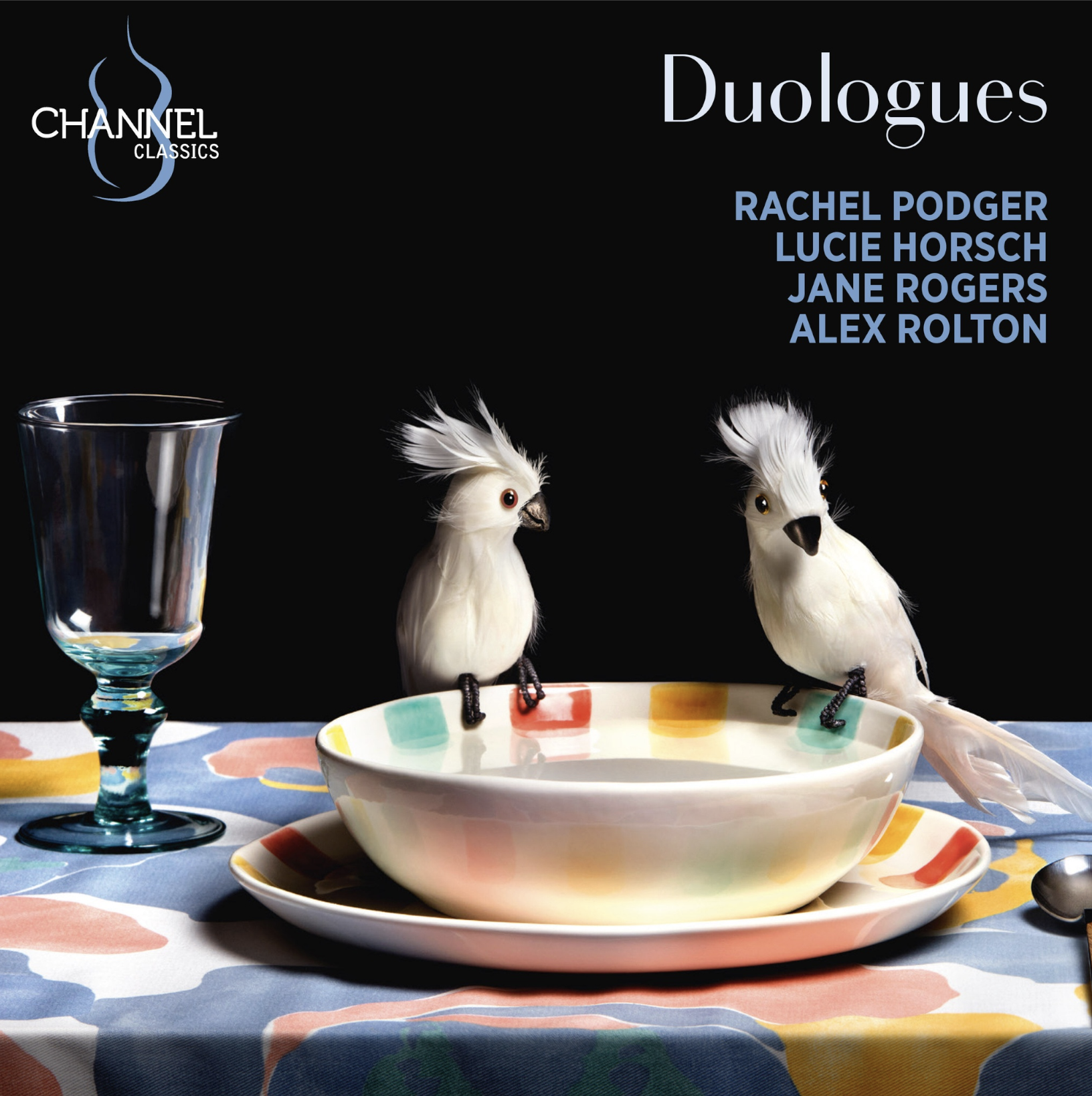
Duologues
Bach wrote the Inventions to teach his students to play cleanly in two parts at the keyboard, and the four Duettos of Clavier-Übung III are keyboard music too. Rachel Podger's Duologues (Channel Classics) builds its program from both and never lets a harpsichord into the room. Instead, Podger's violin takes one line and a partner takes the other: Jane Rogers on viola, Alex Rolton on cello, or Lucie Horsch on a small family of recorders. The fifteen two-part Inventions, arranged by Fred Thomas, form the spine of the album. They're dealt out in four blocks in their original key order, C major through B minor, so the cycle completes itself across the hour while other duets cut in between. Telemann gets two sonatas, C. P. E. Bach his Duet, Wq. 140, and Boismortier a lone Aria from his Op. 51; the Duettos go to violin and cello. Two of the three-part Sinfonias bring all three players together as trios, and the disc closes with the Badinerie from the B-minor Suite and a traditional Irish tune, "The Kid on the Mountain." Mark Seow's booklet essay frames the whole thing as correspondence: conversation rather than pedagogy, voices answering one another without the four-year wait of an eighteenth-century letter.
The sound, as ever with recent Channel Classics releases, is worth noting. Jared Sacks recorded the program in DSD256 in a Folkestone church, and the result is transparent, with each instrument's timbre caught in fine detail.
Arrangement raises its own question, and the Boismortier (track 28) is the useful control because it isn't an arrangement at all. Boismortier wrote his Op. 51 for transverse flute and violin par accords, and the violin's double stops fill out the harmony with no bass beneath. Played here on voiceflute, it works well. The Inventions are less convincing on paper. They were conceived for two hands at one keyboard, and giving each hand to a different instrument changes what they are. Yet the style of playing and the balance between instruments make the case for them as duets rather than exercises. Having toiled over them myself, I find something charming in the exchange between Podger and Rogers, and listeners who know these pieces well may enjoy hearing them anew. If you want a rhetorical reading of Bach's themes, and of the invention embedded in them, these performances both entertain and enlighten, even without two hands at a clavichord.
The Badinerie from BWV 1067 is, to my ears, as successful as the Boismortier. Podger and Horsch are well matched, and I only wish they'd done more from the suite.
The opening Telemann, TWV 40:118, is the first of his canonic sonatas, and it pits the violin against Horsch's sixth flute, a soprano recorder. It is most likely music for amateurs to enjoy at home rather than in public. For my taste, it might have worked better with a recorder an octave lower; the voiceflute Horsch plays elsewhere on the disc would have kept both voices of the canon in the same register. But the recording's clarity makes the choice hard to fault.
The C. P. E. Bach Duet (tracks 9–11) is a more advanced piece, with more nuance than anything before it. Podger and Horsch listen as they play and indulge the composer's emotional rhetoric.
This is an album of mostly modest pieces, given here to violin, viola, recorders, and cello, and each is expertly performed. Whether the music needs to exist in these forms is for the listener to decide. But take the arrangements as gestures of admiration from the performers, and each of them does their part to show these pieces in the finest light.