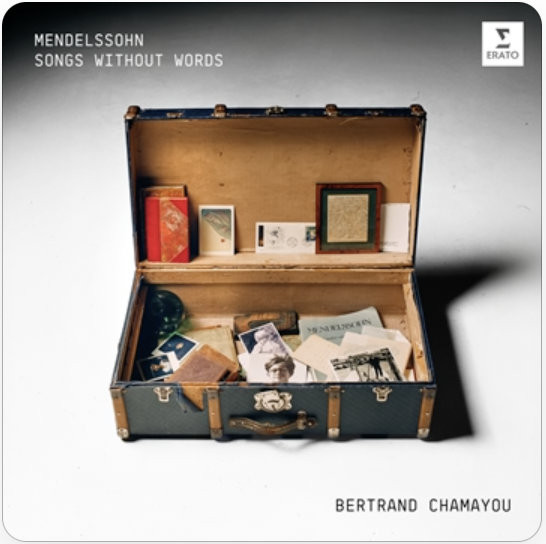
Songs without Words • Bertrand Chamayou
Felix Mendelssohn's Lieder ohne Worte hold an odd place in the repertoire. In the nineteenth century they were among the most widely played piano music in Europe, and for much of the twentieth they were among the most condescended to.
The first set appeared in London in 1832 as Original Melodies for the Pianoforte, and Simrock reissued it the following year under the German title that stuck. Five more books of six followed through 1845 (Opp. 30, 38, 53, 62, and 67; Op. 62 is dedicated to Clara Schumann). The last two books, Opp. 85 and 102, were assembled from manuscripts after Mendelssohn's death in 1847 and published in 1851 and 1868. He never chose those selections himself, which is worth remembering when weighing their uneven quality. Nor was the idea his alone: his sister Fanny was writing comparable lyric piano pieces in the same years, and the genre seems to have taken shape in the exchange between them. The phrase itself turns up in an 1828 letter of Fanny's describing a piece Felix had written into her album, though whether she coined it or was repeating his term is unclear.
The premise is simple, a singing melody over an accompaniment, often with the bass acting as a third voice. Playing it well is harder: the pianist has to sustain a vocal line on a percussive instrument while keeping the inner figuration from clotting. Mendelssohn resisted programmatic readings. Most of the evocative titles, such as "Spring Song," "Spinning Song," and the English "Bees' Wedding," came from publishers and a sentimental public. He sanctioned only a handful, chiefly three Venetian gondola songs, a Duetto, and a Volkslied. When Marc-André Souchay asked him in 1842 what such pieces meant, he answered that music expresses thoughts not too indefinite to put into words but too definite. Their ubiquity in Victorian drawing rooms is what later earned them the "salon" label. A complete traversal of all eight books raises the question of whether these miniatures can hold sustained attention as a body of work rather than as encores.
For reference I returned to Daniel Barenboim's sharp, crisp set for DG, made in my birth year. It sounds good for its age, though not every piece is interpreted the way I'd like to hear it, a judgment shaped by my long but limited acquaintance with some of these pieces, which feel today as if they've always been around. Jacopo Salvatori's set (OnClassical) is more personal and less polished than Barenboim's. That isn't an insult, just a different artistic approach: one pianist is exacting, the other more relaxed and sentimental.
Chamayou's new recording leans more toward Salvatori than Barenboim. Those who know Barenboim's set might enjoy the sharper attack of Ronald Brautigam, who plays a copy of an 1830 Pleyel. These pieces take an interesting shape on a period instrument, and Annette Seiler's 2015 set, on an 1835 Conrad Graf, offers another very different but equally interesting sound. For HIPP enthusiasts, both complete sets are worth a listen.
With Chamayou, the smoothness of the modern piano, the impact of the pedal, and the larger dynamic range are not entirely historical, but they offer something palpable and interesting. I auditioned the release on Apple Music in Dolby Atmos, which for me offered sonic benefits unavailable on the earlier recordings. For those who prefer a modern instrument, there is much to enjoy here.
In Book I's Venetian Gondola Song (MWV U 78), Chamayou gives us a piece not ruled by the metronome but felt, the way one would phrase a Schubert song. The lower register isn't as commanding as on the period pianos, but it provides the foundational support that leads us to the uncertain end.
Book II, No. 2 (MWV U 77) has some of Barenboim's percussive power without the loss of feeling that sometimes escaped the elder pianist.
The Duetto from Book III (MWV U 119) gives clear voicing to the upper and lower melodic lines. When they come together the piece reaches its climax, and Chamayou keeps everything within a limited dynamic range instead of squeezing too hard on its sentimentality.
Book IV, No. 3 (MWV U 144) again reminded me of Barenboim's precision, and here I think Barenboim is superior, even if not everything is quite as connected. Chamayou's more reverberant acoustic favors a sustained sound. Both are enjoyable, but there's something tantalizing about Barenboim's precision in this piece.
The Venetian Boat Song from Book V (MWV U 151) is well served by Chamayou's liquid touch; the movement of the boat on the water is palpable in his dynamic phrasing. It's about as dreamy as one might want.
Book VI's Spinning Song (MWV U 182) combines Chamayou's best traits, dynamic shading with the required precision. In pure texture it isn't as interesting as on a period piano, but I was very satisfied nevertheless.
The Adagio, No. 2 from the final book (MWV U 192), comes off to me as less song than chorale, augmented with romantic harmonization and repeated, emphatic, homorhythmic punctuations. It's a piece that doesn't want to give too much away, and Chamayou respects that.
Conclusions
For all their popularity, Mendelssohn's melodic piano pieces stand today as an easily digestible set of works, some within reach of intermediate pianists. I don't often find myself listening to Mendelssohn, though I can't help but admit how accessible his music is, these piano songs included. Their brevity is part of that, as are their harmonic language and their reliance on melody to grab our attention.
Professional pianists vary in their interpretations of these works, and each of those I've mentioned makes a credible case for them, including pieces Mendelssohn never published himself.
This new recording finds a middle ground between those that came before it. There are moments of exacting precision, but more than that, Chamayou is a pianist inclined to explore the feeling of these pieces, and he does so in a sympathetic acoustic.
Barenboim's sound, and I'd even say his technique, make a fine companion to this recording, though Chamayou is not the most romantic interpreter among them. If you already own a set on modern piano, I'd suggest the Seiler as a second. If these pieces aren't yet in your collection, there are many fine moments to be had in this new recording from Erato.
And finally, you may well know some of these songs but not know them as a complete set. That’s how I was introduced to them and my first listenings were arrangements, at that. Most of these pieces, to my ears, are finely written, and some are extremely short. I have a hard time considering them all a set in a comprehensive way, and with so many, it’s easy to become distracted. Instead, I’d encourage listeners to look at each published book as a set. Live with one for a week, then move on. For me, there were familiar melodies, and new ones, which seem just as well-written. Their lightness and brevity make easy entry for anyone wishing to explore romantic piano music that celebrates positive sentimentality, an assessment I’d apply even for the minor-moded offerings.