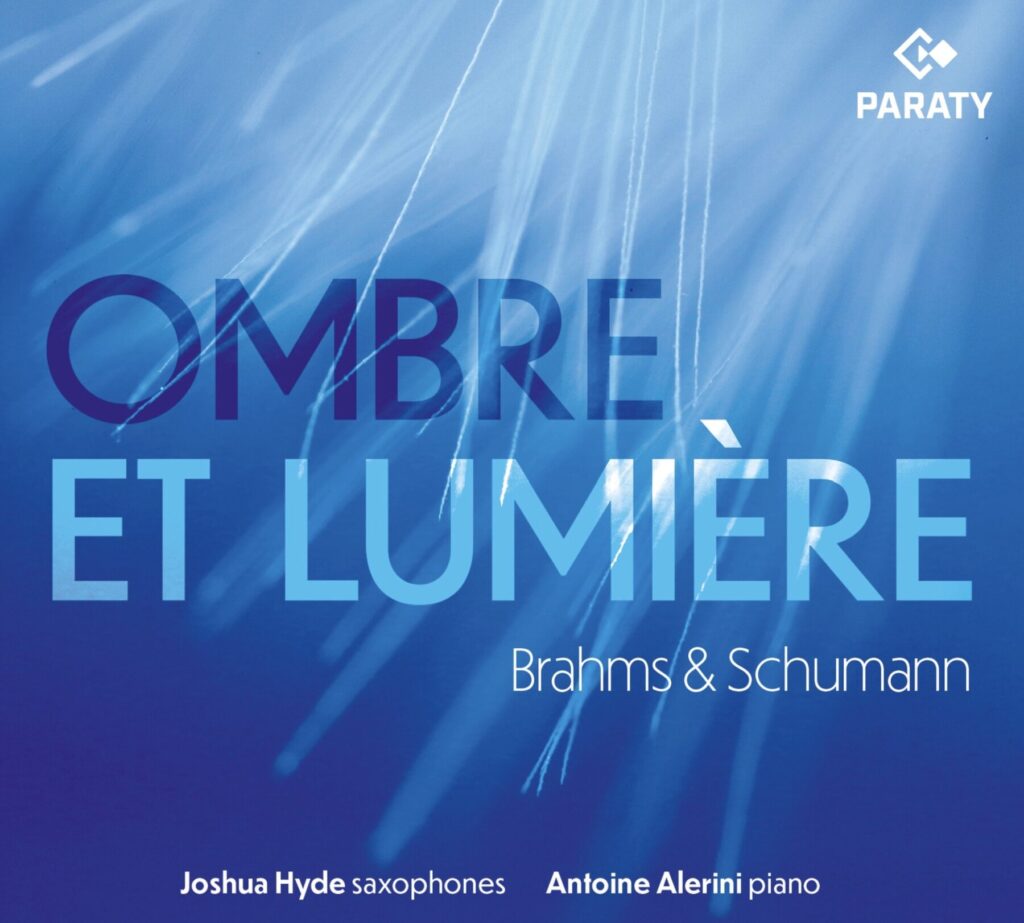
This Paraty release presents Romantic repertoire on the saxophone—not the original instrument, but one with real expressive capacity. First is Brahms’ first cello sonata, op. 38, in three movements. Second is Schumann’s Three Romances, op. 94, for oboe and piano, and third is the same composer’s Märchenbilder, op. 113, four pieces originally scored for viola and piano. The soloist, Joshua Hyde, made the arrangements.
The saxophone is an expressive family of instruments. I’ve written music for saxes but never played one; my sense of how the sound is made comes from playing the clarinet, a similar single-reed instrument. To modern ears the saxophone is probably most closely tied to jazz, and its timbre outside the jazz idiom can be striking. Joshua Hyde matches a different instrument to each work’s range, starting with the lowest of the three, the baritone, for the Brahms.
Brahms’ cello sonata is special to me for the composer’s inspiration from Bach’s Die Kunst der Fuga. The inspiration is most audible in the final movement, Allegro – Più presto, whose fugue subject recalls Contrapunctus 13. Homage to Bach aside, the longer opening movement, Allegro non troppo, offers a haunting melodic exploration by the soloist. Here Hyde’s sound is dark and in a few places nearly mimics the cello. The dialogue between saxophone and piano is nicely timed, and the balance puts the sax out front and center. For better or worse, Hyde applies a regular vibrato in this piece, and there are spots where I’d have liked to hear less of it. He does apply it strategically, though: it retreats in the opening theme of the middle movement and in sections of the Schumann. My distaste for vibrato extends beyond historical-performance boundaries, and given the original instrumentation—most cellists today would use at least this much—it’s defensible here. Give me a switch and I’d turn it down in the first movement. No doubt those who know the cello original, played in alignment with contemporary practice, will find it right at home here. One could make the case for less on historical grounds (see the writings from Robert Hausmann).
The Three Romances delighted me, thanks to Hyde’s use of what I assume is a Selmer soprano and its gorgeous sound. The balance is even better here, the sax a perfect companion to Alerini’s piano. The first movement, Nicht schnell (not fast) is haunting compared to the far more domestic-sounding second, marked Einfach, innig (simple, intimate). There’s an independence in the solo voice there that offers a comforting presence; it’s daylight to me, compared to the opening and closing movements. The final movement brings more dialogue between soloist and piano. Its short phrases seem to point to song, and Schumann sets some of them as unison statements for the piano’s right hand and the soloist. I couldn’t help but think this movement was telling us a story, walking us through scenes in a painting. What I don’t hear, in these short pieces or in the performances, is any foretelling of Schumann’s deteriorating mental health. The pieces were a Christmas gift to Clara.
Märchenbilder is supposedly a trip through the woods, with stories and creatures making themselves visible along the way. Here Hyde uses a tenor sax in place of the viola. The airy, melodic style that carries over from the Three Romances changes character in the second movement, Lebhaft, where Alerini’s piano comes out of the background with sharp articulation alongside the soloist. The third movement, Rasch (quickly), likely poses the greatest technical challenge for the saxophone, with its fast passagework. As we’ve already heard from Schumann, the moods can change quickly; those changes pose no problem for these two performers. It’s easy to accept, I think, the suggestion that the final movement relates to the story of Sleeping Beauty. Perhaps most remarkable to me is how Hyde can diminish his sound and play into the piano’s timbres.
Conclusions
Ombre et lumière is a fitting title for this album, given the sonic character of the saxophones and the Romantic style of Brahms and Schumann. Both musicians deserve commendation for a well-considered set of performances. My favorites were the Brahms sonata and the Rasch of the Märchenbilder. Nothing is lost in translating those, or any of these pieces, to the saxophone, in my opinion. Hyde is an ideal interpreter here, surprising me more than once with how he crafts his sound in service of the music. There were moments when the saxophone’s timbre against the piano sounded foreign or strange, from old associations, but I think listeners will be surprised at how sensitive and powerful a partner to the piano Adolphe Sax’s invention can be. Paraty’s sound is clear and not too close, a smart choice given the volume potential of the larger saxes. Some may have wanted to be closer to Mr. Alerini’s piano, but as noted, the balance works well.