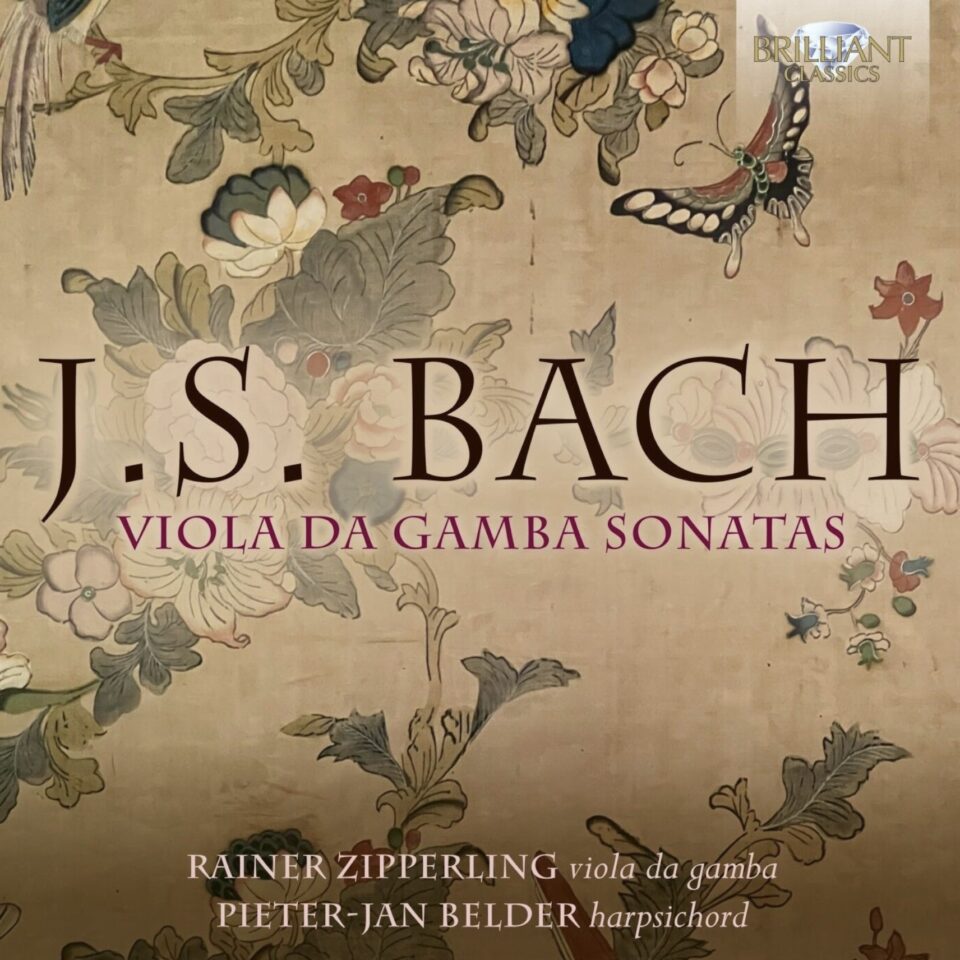
On the heels of another Bach gamba album, this one presents music both familiar and perhaps unfamiliar for the gamba. In addition to the core sonatas, BWV 1027–1029, the musicians offer the Sonata in G minor, BWV 1030b; the Sonata in D, BWV 527a; and the G major violin and keyboard sonata, BWV 1019a. The final piece is the D minor sonata, BWV 1023a.
Pieter-Jan Belder, a regular presence on Brilliant Classics, is joined by Rainer Zipperling, an established cellist and gambist who also records prolifically. No booklet came with the release as I auditioned it on Qobuz at CD resolution.
Arrangements
BWV 1030 is best known as the sonata in B minor for transverse flute and obbligato harpsichord. The G minor version here, BWV 1030b, reconstructs an earlier form of the work, and G minor presumably sits better with the gamba’s tuning and compass. This work starts the double album. On headphones, Belder is positioned left and Zipperling right, but the balance favors the harpsichord. On my system the recording really emphasizes the lowest register of the harpsichord, which makes for a rather nice keyboard sound, but Zipperling’s tone isn’t quite its match. In a movement like the closing Presto, I wanted far more drama and expression from the leaps in the gamba part. They didn’t come out in the recording, and in some cases I wondered whether Zipperling simply wasn’t taking those opportunities. That said, the piece works well for the viola da gamba.
BWV 525–530 are the six trio sonatas for organ, and many have recorded them in arrangements for gamba and keyboard. This one feels like a natural fit for harpsichord and gamba. The opening movement has long held notes for the gamba that Zipperling just, well, holds; they don’t bloom or breathe. Since the organ can’t do that, it may be apt not to add that expressive touch, but it seems like such a natural thing to add.
I felt both musicians took the middle movement a bit too slow. It wouldn’t work as well on a wind instrument, but the gamba has no such limitation. Zipperling’s approach just feels too safe to me. Yes, he infuses a bit of vibrato, but those long lines, especially at this tempo, seem to demand some improvisatory additions.
The balance seems to improve in the third movement: the gamba sounds on par with the keyboard, and Zipperling’s clean playing exposes lines I’d frankly missed in other recordings. Both artists are in lock-step on tempo. I could have entertained a faster one, but the chosen tempo is likely why Zipperling plays with such clear confidence.
Bach wrote six sonatas for violin and keyboard; the last, presented here, has always been the odd one given its five movements and the existence of earlier versions of its movements. The opening, as these two present it, makes a good case for the piece as a de facto gamba sonata. The first movement has the bounce that makes the piece infectious.
The third movement, to speak to the piece’s oddities, is for solo harpsichord. Belder’s performance is strong, leaving me nothing more to want. It’s a gutsy little piece, one I can imagine Bach used to impress the audience. It gives his companion a rest, but why this solo was inserted into the piece remains a mystery to me.
BWV 1023 was scored for violin and continuo; some believe it may have been written for Pisendel, the famous Dresden-based violinist. Zipperling’s jaunty opening struck me as odd at first. I’m more convinced by Sato’s interpretation in this video of what was likely conceived as a virtuosic toccata for the violinist to warm up.
The musicians make this one work, but it works less well as an arrangement for me, given where it falls in the gamba’s range and how much harder it is to hear the melodic material. The lower range the keyboard employs adds richness, and the Gigue is ultimately satisfying.
BWV 1027–1029
The first two sonatas, in G major and D major, are each in four movements, slow–fast–slow–fast. The third, in G minor, has the feel of a three-movement concerto.
Scholars believe Bach may have used these works at Leipzig Collegium Musicum concerts. The G major sonata has a twin version for two flutes and continuo, BWV 1039; which came first is unsettled, and both may derive from a lost trio sonata. In the gamba version, one of the flute lines moves to the keyboard’s right hand. The third movement, marked Andante, is an opportunity for some singing, if you ask me, but we don’t quite get that. The theme, shared by the right hand and the gamba, also has a clear rhetorical shape that goes underplayed, perhaps a missed opportunity.
In contrast, the first Allegro of the D major sonata pairs a great tempo with very clear playing from Zipperling. Moments of clear articulation heighten the character of the gamba part.
I’ve always felt a bit of fire in the outer movements of the G minor sonata. I’d have liked the first to go a bit faster; the third’s tempo is plenty quick, but the gamba lacks bite. It’s technically well played, but I wanted to feel more of that heat.
Some may already recognize that Zipperling recorded some of these works before with collaborator Sabine Bauer (Aeolus, 2014) on SACD. The 55 minute recording covers the three main sonatas plus BWV 1030b. In the case of BWV 1029, the zestier tempos taken were more my taste than what was offered here.
Conclusions
As ever, Belder is a good keyboardist, and there’s little to fault in his playing here. I wish I could say the same for the recording (fair, but with the balance issues discussed) and for his partner’s playing. Zipperling is a talented musician who shows no technical flaws, but his interpretations overall lacked flair for me. Brilliant Classics writes that the pair “approach the music with an intimate, unforced, and gently persuasive style that reflects Bach’s domestic and courtly chamber circles.” I think that’s fair; gentle and unforced matches my experience.
I revisited the piano-and-gamba pairing of Vittorio and Lorenzo Ghielmi (Passacaille, 2013) and found Vittorio’s playing more expressive and more to my taste, with dynamic shading; the album also offered a better balance between instruments. Another comparison is gambist Robert Smith with harpsichordist Francesco Corti (Resonus, 2021). That recording loses for me with the distance put between us and the musicians, but Smith’s playing feels lighter and more agile, with more dynamic shading.
That said, only Belder and Zipperling offer this exact program, spread over two discs, including the pieces originally conceived for flute and violin.