Vis à vis: Music by Bach, Biber, and Pachelbel • Urban Strings
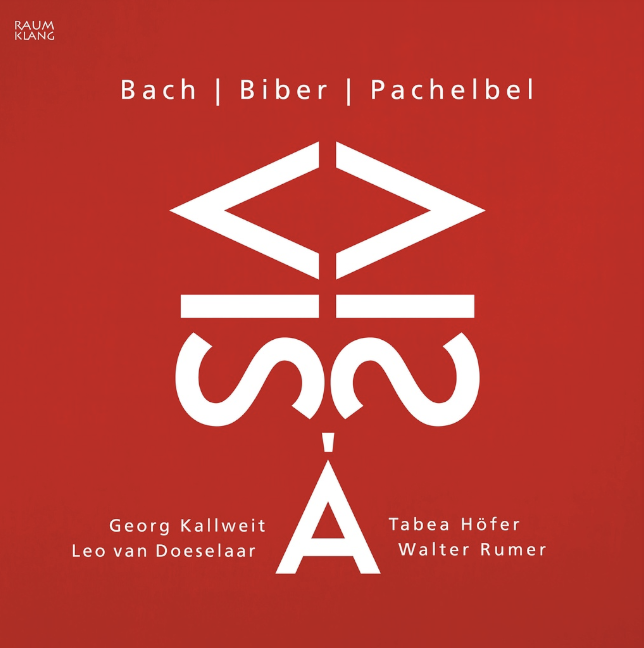
The concept of this album, which came out in 2023, is to pit one violin against another. The opening work by Biber, the sixth “Partia” from his Harmonia Artificioso-Ariosa Diversimodè accordata is played with exquisite energy from the ensemble, Georg Kallweit and Tabea Höfer on the violins. The two violinists in the Biber are positioned at the left and right sides of the stereo image, creating what I think is a smart presentation of one line against the other. A modern composer would have written this in the score, for sure, as it seems to be the whole point of the writing, to contrast these two lines with one another.
I am reminded by a YouTube performance of one of Biber’s sonatas (could have been from the same collection), led by the French violinist Patrick Bismuth. His style captured my attention; the style was presented to an almost absurd degree of bravura. These musicians are a bit more sensitive in their approach, but have a gorgeous string sound, and the depth of the bass played by Walter Rumer comes across profoundly in this recording. It’s that rare combination of really good sound reproduction, coupled with great playing.
The fourteenth track is a presentation of one of Biber’s Mystery Sonatas, the Mystery in the Temple. Organ (Leo van Doeselaar) provides the foundation of support at the start, but how does this qualify for two violins? One is positioned in the foreground and one in the back, amplifying the implication of an echo effect with Biber’s writing. The effect isn’t called for specifically in the score, but the effect in my living room is satisfying. Both violinists mimic each other’s playing well enough to pass the effect on without questioning its novelty.
Doeselaar presents two organ solos, one by Bach and one by Pachelbel. The space in which they play isn’t overly large, and it gives us an opportunity to enjoy the colorful instrument more up close than is usual in recordings featuring the organ.
The 16th track features another adaptation from Biber’s Mystery Sonatas, presenting the “Guardian Angel” passacaglia across two instruments, a viola and violin. The practice is not necessary, given that like the Bach Ciaccona from his 2nd partita, the novelty is that a multi-part composition is possible played on just four strings of a single violin. This solution, however, gives a bit more more range to the composition’s sound, and they wisely are presented close together in this performance. This composition for me is a very powerful one and I always like to hear how violinists personalize it. Things might get more complicated with two performers, but again, I think these two musicians are well-tuned to one another. I like the parts where I presume Höfer goes an octave lower on the viola.
The last piece presented is one of Pachelbel’s string partitas, from his collection Musicalische Ergötzung. I still value my recording of this collection by London Baroque. This performance has a bit more air to it, and as mentioned, the presence of the lower frequencies are really a nice component of the ensemble’s sound. I want them all. The Sarabande is particularly a special, short piece of music; the sonority achieved by these musicians amplifies its impact.
Right before the Pachelbel, the ensemble plays the violin/flute trio sonata BWV 1038, believed now to have been by his son Carl Philipp Emmanuel, a piece, for whomever wrote it (I sometimes wonder if a few of these pieces weren’t collaborations, given the style), makes me smile profoundly in the opening movement. The way both violinists phrase the lines is a lesson on how to play music from this period. It’s so well done! Hearing the continuo with organ instead of a harpsichord is a special treat. Tempos throughout are well chosen.
I am grateful for the review of this recording by Johan van Veen for helping me discover it. I am not sure the issues he mentions detract from the highly musical and engaging performances on offer here. It is easy enough for me to give this recording my highest recommendation.