Conrad Tao Plays Gershwin • Richmond Symphony
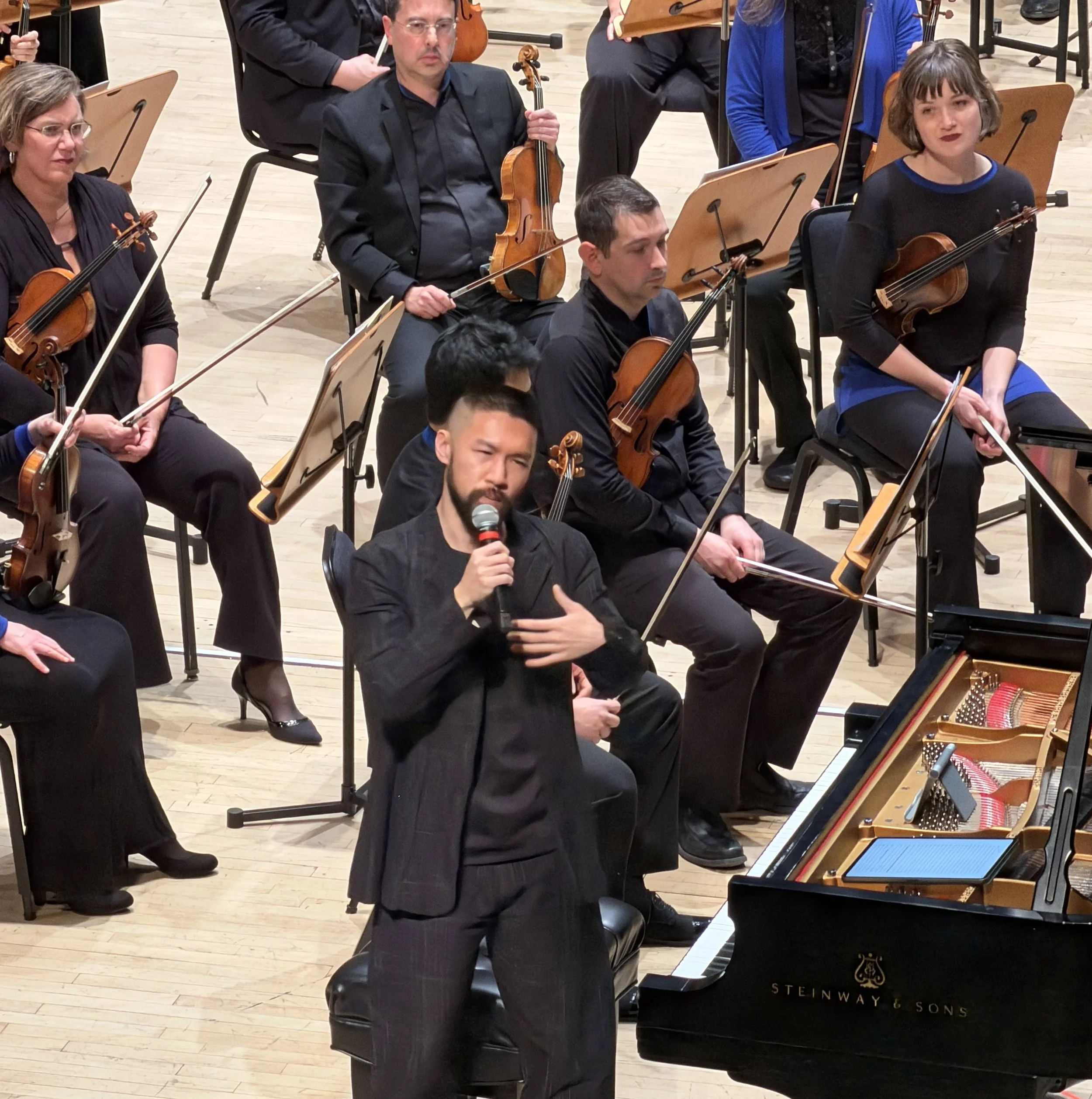
I still remember when Tao’s first album, Voyages came out on iTunes. It opens with Monk’s Railroad and it was hyped enough on the digital platform that I bought it. I can’t say why, save for the desire to give a new young artist a try. And over a decade later, he’s come perform with the Richmond Symphony, a concert featuring Gershwin’s F-major piano concerto. The concert opened with Tao’s own Flung out which he talked to the audience about, speaking of it as a companion piece to Rhapsody in Blue, dealing with dance, coming in, going out of focus. Before the intermission and Tao’s departure, he came back two multiple standing ovations to perform a version of Art Tatum’s Over the Rainbow.
When he told the audience he wanted to play something American he got a cheer from the audience; the selection was clever, played more fast and jazzy than sentimental. It reminded me of what Yo-Yo Ma played most recently on the Late Show with Stephen Colbert. Somehow the whole thing became political in a quiet way. I can’t say that everyone picked up on it that way, but he left the stage with a few people sporting tears.
The Richmond Symphony was conducted by Benjamin Manis. The Chicago-based conductor has experience with opera and in conducting Tao’s own piece, he was doing a lot of beat-keeping. The piece had sections that definitely borrowed the harmonic and stylistic language of Gershwin, but it was also constructed as a series of tableaus in different tempi and styles which required keeping things together and in sync with Tao, who played through most of it. One of the signature motifs Tao wrote was a repeated low note on the piano which got punched with one finger while he attenuated the string with his right hand inside the instrument. The composition was exciting, but had one section that had a lot of stops and starts and sagged just a bit, at least in this performance.
The Richmond Symphony’s strings were surprisingly soft sounding compared to the winds and brass. I'd like to hear them play out a bit more, maybe standing. I think the numbers of players are fine.
The Gershwin concerto felt more confident under Manis’ baton. The orchestra too felt more comfortable, it seemed, and the performance through all three movements felt well-timed and as colorful as one might expect. The piece makes many references to New York City and does well, as Gershwin did, to marry the popular style of the time into a high art idiom. Tao’s playing was nearly perfectly balanced throughout; his playing very polished. It was an impressive collaboration.
After the intermission the symphony reduced in size but kept all the violins on the left; the violas on the right. Manis put down the baton and used his hands more creatively to shape Mozart’s phrases in lieu of beating time. There were a few tricky spots where I sensed he was doing his best to keep the ensemble tight and it worked. The tempo of the finale was to my taste precisely, although the first two movements could have gone a step faster. The ensemble’s performance of the last movement might have been their favorite, at least it came off that way. Conductor Manis made a few dynamic splurges which worked well in the spirit of Mozart’s own style. The ensemble managed to squeeze out some extra volume near the end, giving Mozart’s ultimate symphony the extra juice it needs.
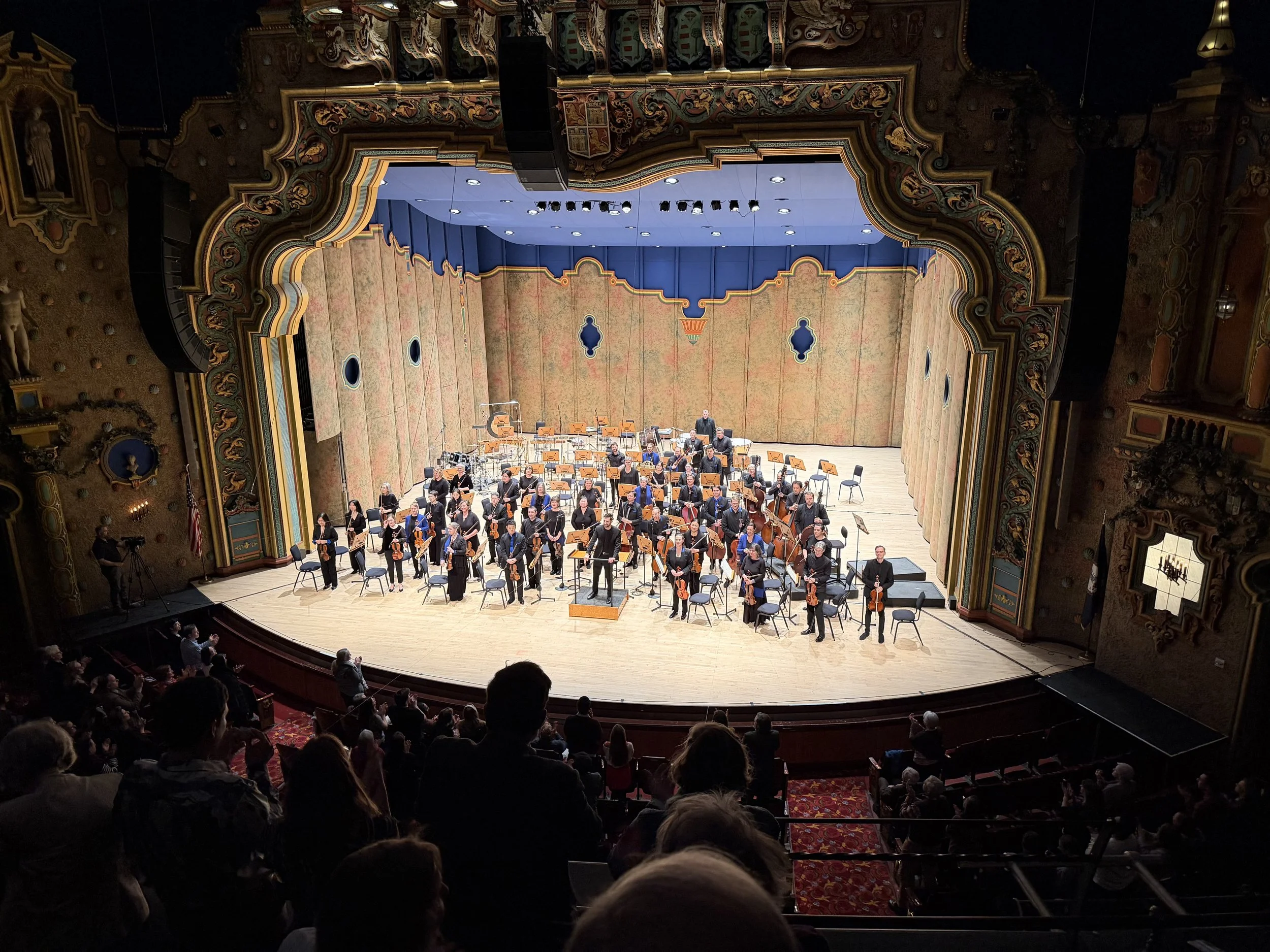
The programming was a solid bet for audiences: a special guest, something new and unfamiliar, coupled with a crowd-pleasing standard. I don’t often attend their concerts, but this production was well-done. I was glad to see the audience seemed to agree with their ebullient applause.