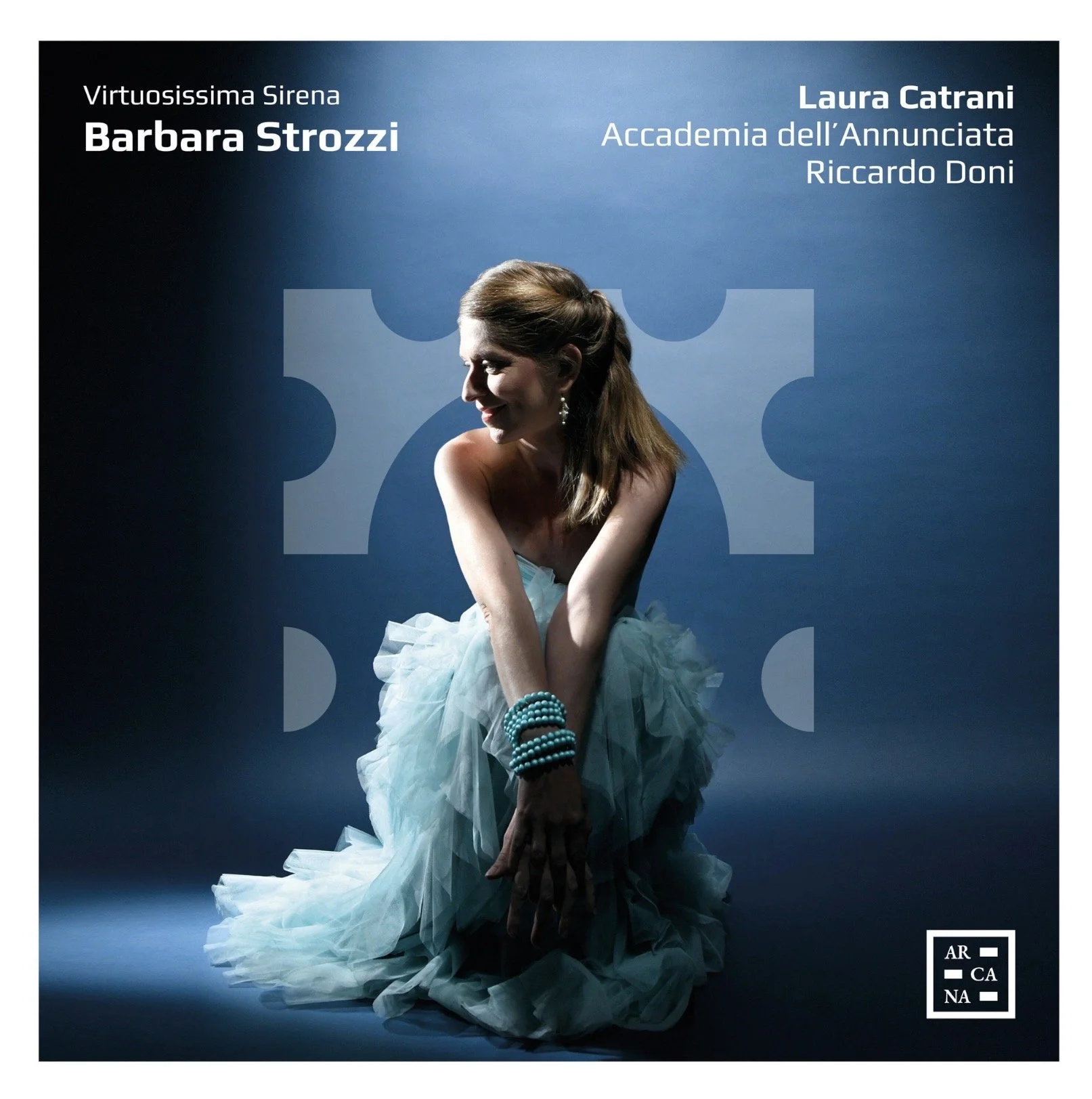
Virtuosissima Sirena - Music by Barbara Strozzi • Laura Catrani & Accademia dell’Annunciata
I just recently reviewed another album featuring the vocal music of Barbara Strozzi, a composer of quite some talent, who somehow managed to make herself well known as a musician in a period dominated by the contributions of men. The album, directed by the Italian harpsichordist Riccardo Doni, who has worked closely with Enrico Onofri and Il Giardino Armonico, here leads his own ensemble, L’Accademia dell’Annunciata. The guest singer is Laura Catrani, probably best known for her Mozart and performance of contemporary works.
The recording suffers a bit from how the music is presented across the stereo field, with Catrani’s voice appearing without a clear position left, right or center; the distribution of instruments across “the stage” sounds far more natural. It’s indicative of what I thought of the singer versus the instrumentalists, as well; Catrani’s a talented singer but I didn’t think her approach with vibrato lent itself especially to baroque repertoire. The more satisfying component for me was the continuo and instrumental support, in terms of baroque style.
The ensemble gives the singer a break with two instrumental numbers: the first is a dual violin sonata by Legrenzi; the second is Castello’s twelfth sonata from his second book. The contributions are welcome, and appropriate, since Strozzi is not believed to have written purely instrumental works. The violinists Angela Calvo and Francesco Facchini are both strong players. Maybe not up to the virtuosity of the Imaginarium Ensemble, but, not bad at all.
The opening of the lament, in track 5, carries with it all the drama of Monteverdi’s Lamento d’Arianna, potentially the model for this piece? The piece is interesting, the poetry describing an imprisoned woman; potentially as a statue? Not sure of the meaning but the writing by Strozzi is affective; the presentation by Catrani is not overly dramatic. The opening of her phrases have a particular charm to them which, after some time, wears on me, with the use of vibrato. There are turns with harmony and dissonance which the composer writes, offering great expressive power. But I felt the resulting treatment by the singer doesn’t play so much into these affective elements.
The mood in track 3’s La vendetta is a far more upbeat piece. The light style is served better here by Catrani. Her highest register has an appreciable lightness to it. The part I missed was seeing her expression; it’s the type of piece where the singer can connect with an audience with facial expressions, even going so far to act out. Given the singer’s background as an actress as well as a singer, there no doubt is a missing element with us hearing this music recorded with video.
The ninth track presents another lament, this one with a repeating descending bass. The same repeated four notes have served as the foundation of so many baroque pieces, this one includes writing for two violins which help break up the stanzas. I love this form and it bestows upon the composer a need to provide variations to the performer, inevitably setting them up to reach a climax over a familiar foundation. Much of what I’ve already said here can be applied again, save for the fact that this is one of the more impressive things by Strozzi; she breaks things up with a transition to the major mode, setting a long poem by Brunacci.
For me this album further showcases the extraordinary compositional gifts of Strozzi; it gives us a rather impressive look into Venetian society, at least the culture of the enlightened class who themselves saw fit to further develop the power of poetry with music. I am not sure Catrani is my most ideal interpreter here, but I prefer a purer voice without so much vibration. Those who are not as sensitive to this may find the vocal numbers more rewarding.