Apollo's Fire Plays the VCU Chamber Music Series
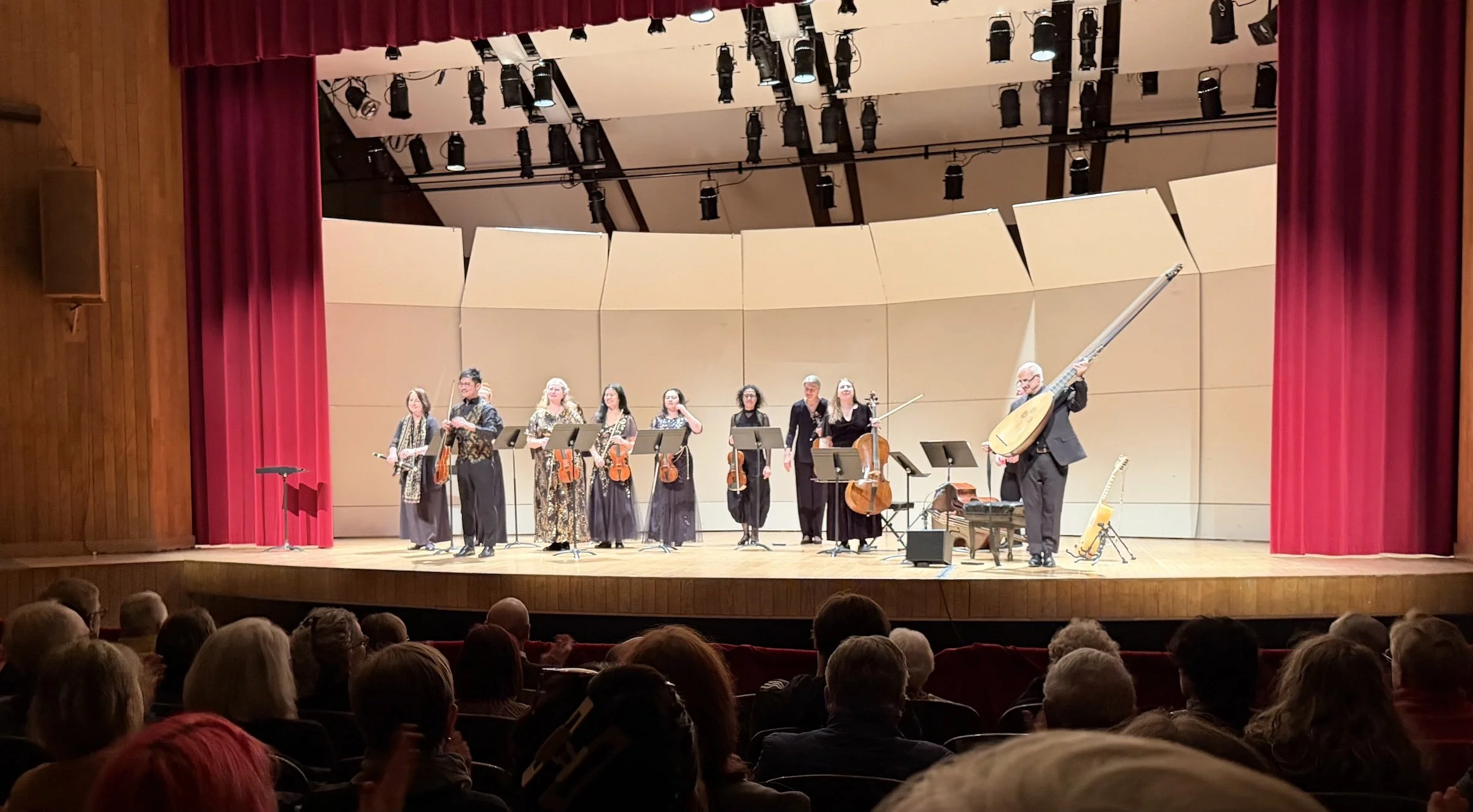
A reduced ensemble from Apollo’s Fire recently stopped in Richmond, Virginia—my hometown—on a multi-city tour. The Sunday afternoon concert took place at Virginia Commonwealth University’s Singleton Center for the Arts.
The ensemble appeared without its artistic director and founder, Jeannette Sorrell, and was instead led by concertmaster and associate artistic director Alan Choo. What follows is praise rooted firmly in what I heard and saw on stage.
Choo divides his time between Apollo’s Fire and Red Dot Baroque, and in both contexts he leads with a physical, highly invested style of musicianship. His movement as a violinist is unmistakably theatrical—but not gratuitous. While it certainly communicates tempo and ensemble cues, it goes further than that. His full-body engagement—feet, torso, bow arm—projects affect outward, making the rhetoric of the music visible as well as audible. As someone deeply interested in the expressive language of later Baroque music, I find this kind of leadership especially compelling. Choo’s gestures amplify what the ensemble is doing, sharpening the listener’s perception of articulation, energy, and emotional intent. Under his direction, the music breathes.
The program itself leaned heavily into familiar territory—a kind of Baroque “greatest hits.” It included Marin Marais’ Sonnerie de Sainte-Geneviève du Mont-de-Paris, presented in a Sorrell arrangement that expanded the string forces. The dramatic dynamic contrasts were effective, adding visual and sonic weight to a piece already rich in rhetorical pull.
Bach anchored much of the program, with the Double Violin Concerto (BWV 1043) and the B-minor Overture-Suite for flute (BWV 1067). Choo addressed the audience with context about music performed at Zimmermann’s Coffee House in Leipzig, aligning neatly with the ensemble’s earlier Bach’s Coffee House project. The second half opened outward stylistically, bringing us Telemann’s Suite in A minor (TWV 55:a2) for recorder and orchestra. Soloist Daphna Mor played with confidence and flair, delivering a virtuoso performance that was both technically assured and stylistically alert.
The concert opened with a lesser-known work from Evaristo Felice dall’Abaco’s Op. 5, featuring the full ensemble and transverse flute. In this piece, flutist Kathie Stewart was occasionally difficult to hear, a balance issue likely exacerbated by the hall’s acoustics. The ensemble did not employ a harpsichord—presumably due to logistical constraints—which left the basso continuo to theorbo, cello, and bass. William “Bill” Simms’ theorbo playing provided a pleasing texture, and from my seat, the bass line—anchored by Sue Yelanjian—came through clearly and effectively.
The program concluded with Apollo’s Fire’s signature showpiece: Sorrell’s arrangement of Vivaldi’s La Follia trio sonata (RV 63). In earlier incarnations of the ensemble, under former concertmaster Olivier Brault, this piece leaned toward full-orchestral spectacle and virtuosic excess. Under Choo’s leadership, the focus shifted toward theatrical play and ensemble interaction. With the upper strings performing from memory, the musicians leaned fully into the drama—at one point drawing the baroque guitar into a staged flirtation with the second violinist, Emi Tanabe. The antics were clearly choreographed, but the effect was infectious, bringing the audience to its feet for multiple curtain calls.
Throughout the two-hour program, Choo frequently addressed the audience, offering historical framing and musical context with ease and warmth. He acted as a kind of musical concierge, making already approachable repertoire even more accessible to a diverse crowd of seasoned concertgoers and university students alike.
Apollo’s Fire now divides its concert activity between Cleveland and Chicago, focusing largely on core repertoire rather than the more obscure byways explored by some HIPP ensembles. While the historically informed movement has done invaluable work uncovering forgotten music, it’s worth remembering that many of today’s “warhorses” once arrived as revelations themselves. Apollo’s Fire has made a deliberate choice to return to these works—and to play them convincingly.
What stood out most in this performance was how clearly the musicians claimed this familiar material as their own. Ornamentation, rubato, and bold dynamic contrasts gave even the most well-worn passages a sense of immediacy. Nowhere was this more evident than in La Follia. Free from music stands, the ensemble played with a palpable sense of interpretive freedom, shaping the work organically and heightening its affective impact.
While the acoustics of the Sonia Vlahcevic Concert Hall are not ideal for a period ensemble, the musicians’ commitment to engaging the audience was unmistakable. Beyond Choo’s visible leadership, another highlight for me was the strength of the viola section. As an amateur violist myself, I’m all too aware of how often the instrument is relegated to the background. Here, both players brought presence, energy, and clarity to their lines. Credit is due to Sorrell—despite her absence—for giving the violas meaningful material in the Vivaldi finale, and credit to the players for making it count.