L’arte della scordatura • Hirasaki
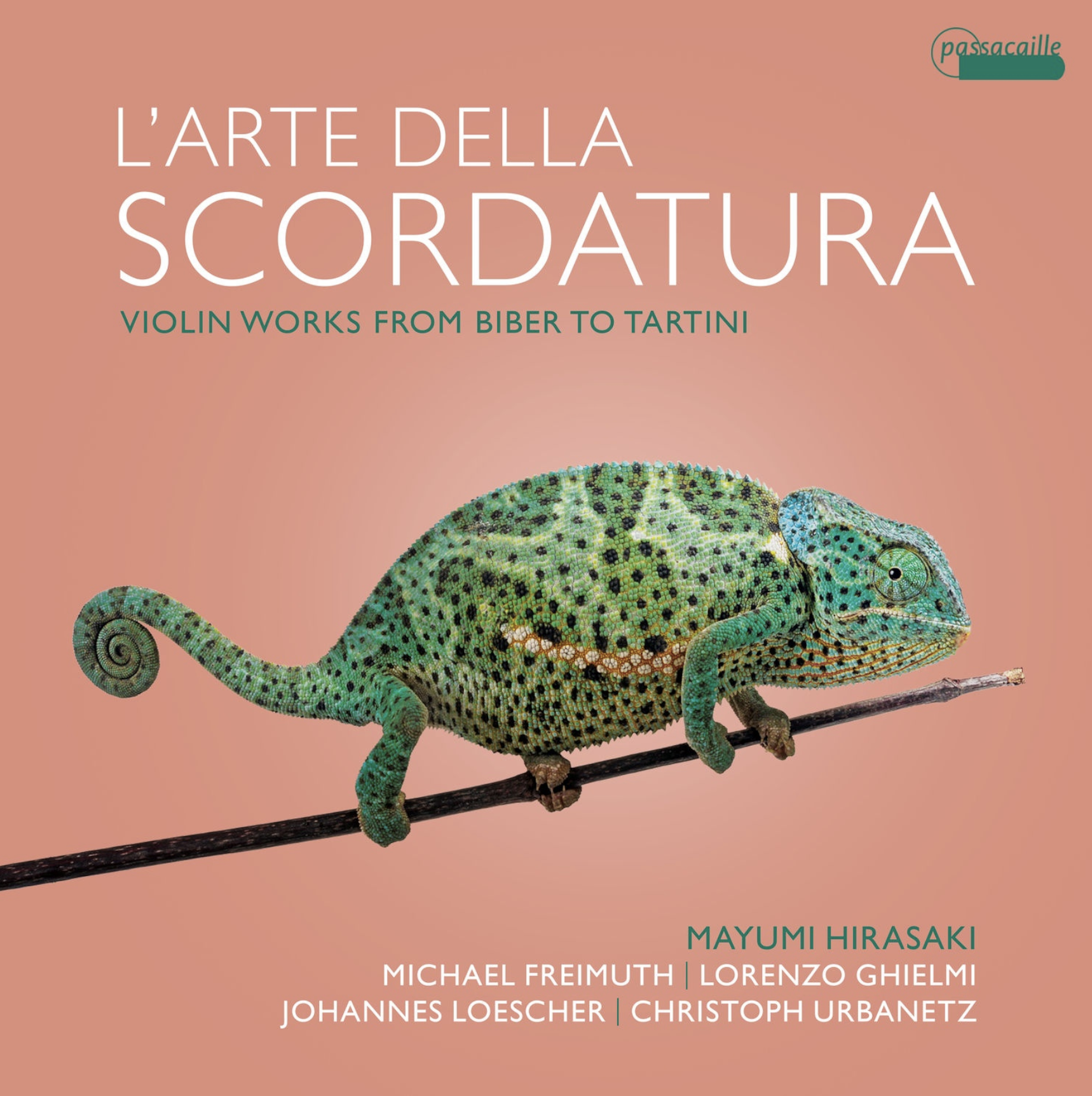
Props to Passacaille for giving us a memorable and interesting album cover. The liner notes are titled “A Chameleon of Sound,” which explains the choice. Mayumi Hirasaki on this album explores a diverse collection of baroque sonatas that explore the use of scordatura or mistuning of the instrument. A work by Biber opens the album, which seems appropriate given that Biber, above all others, exploited this technique the most comprehensively.
Hirasaki is based in Germany and performs with some well known groups from that country, including Concerto Köln and Akamus. The recording was made in the famous Deutshland radio studio in Cologne.
The liner notes document the use of violins by Hirasaki alongside the tunings used for each. She is joined in some of the works by colleagues including Christoph Urbanetz on gamba, Johannes Loescher on violone, Michael Freimuth on guitar, lute, and theorbo, and finally Lorenza Ghielmi on harpsichord. The composers include Vilsmayr, Lonati, Castrucci, Tartini, and Marini in addition to Biber and an another anonymous sonata.
The most challenging piece to my ears may well be the fifth partita for solo violin by Vilsmayr. The piece is presented across eight tracks and was published in 1715. The composer was a student of Biber and was active in Salzburg. As noted in the booklet (thankfully), Hirasaki ornaments repeats and does so to great effect.
The opening work by Biber in C minor comes from his 1681 collection and may well be familiar to readers. The opening movement is played affectively, but with a cautious tempo. The following passacaglia really exploits the chordal writing for the violin with strong dynamics. This movement has been played a bit more fancifully by other violinists, but the measured approach here is a good foil and the playing from the violinist here is especially powerful. Articulation is extremely well-done. I have little doubt that this performance would be required listening by any enterprising young violinist approaching this work.
Castrucci’s sonata, in A minor, published in 1718, is fiery piece, one no doubt intended for a showperson and not an amateur. Hirasaki’s abilities to convey the intense drama of the piece are well-done, all the while exhibiting a gorgeous violin tone. The instrument used dates from 1700. Whether we want to credit the instrument, its strings, or the bow used, I have to say this gorgeous sound that is achieved really sets Hirasaki apart as an extraordinary player.
The anonymous work is also written for a violin without basso continuo. The use of scordatura is exploited for a lot of double stopping. I think in many ways playing by yourself is a special challenge although some might find it freeing? Here the acoustic of the German radio studio works very well to provide a supportive acoustical environment for the violin to carry without the sometimes overly reverbed churches. Here she uses a Sager violin made in 2003. It sounds different from the one mentioned above used in the Castrucci sonata, but also comes with a gorgeous sound.
In addition to allowing for new chordal combinations on the violin, scordatura changes the resonance of a violin. In some ways you have to have the instrument under your chin to appreciate these differences, but a good recording can also take us there somewhat. Scordatura therefore, for me, requires careful listening. My audition of this album was done carefully. I was pleasantly surprised in each track how strong Hirasaki’s playing is: she’s got the technique but also conveys a strong sense of style which is brought to use via varied articulation, dynamics, and tonal color.
Readers may pick up on the fact that the baroque violin is my favorite instrument and I honestly have not been this impressed with a violin recording in some months. Even though this is not a new recording, having been released in November 2020, I recently re-visited it and thought it should deserve a review. An extraordinary effort from Hirasaki and her colleagues who provide good support without overpowering the star.