Æmilia • Andrea Chezzi
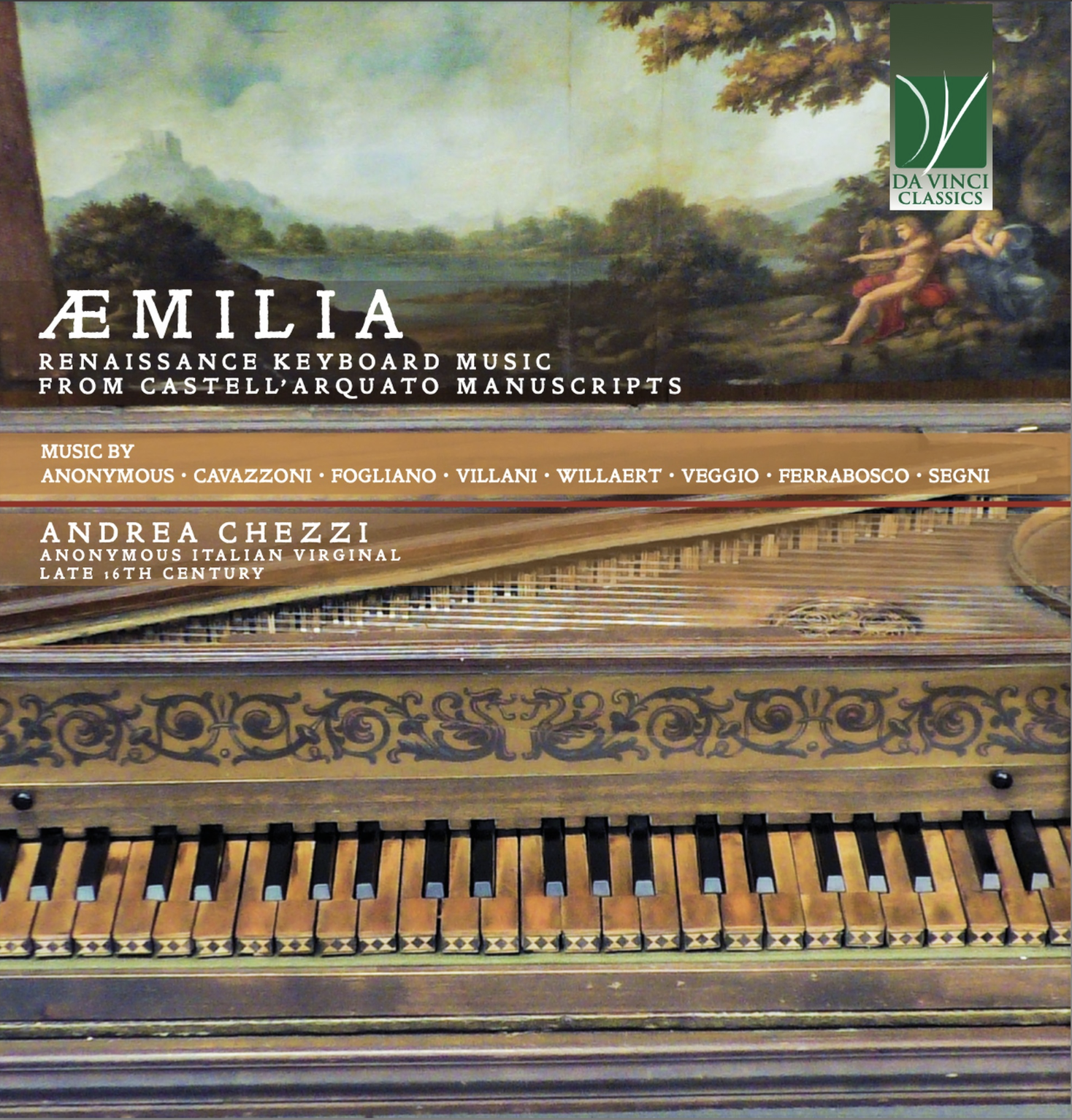
This new release from Da Vinci Classics explores a little-known corner of Renaissance keyboard repertoire, drawing from the manuscript collection of the Collegiate Church of Castell’Arquato in Emilia—a provincial archive that nevertheless preserves a vivid cross-section of sixteenth-century musical life. Performed by Andrea Chezzi on a late-sixteenth-century Italian virginal, the program brings together ricercars by figures such as Cavazzoni, Fogliano, and Segni alongside anonymous dances and keyboard arrangements of well-known vocal works. The result is less a composer-centric recital than a musical snapshot: aristocratic pavane-saltarello pairings likely connected to courtly celebrations, lively popular dances circulating in northern Italy, and exploratory ricercars that reveal the keyboard emerging as an expressive instrument in its own right. Heard together, these pieces illuminate a repertoire that feels both intimate and experimental—music rooted in local tradition yet fully engaged with the broader currents of Renaissance Italy.
I am guessing most readers won’t be familiar with the composers or even the repertoire from this era (1500s), at least from around the Po Valley.
There are three take-aways I had from auditioning this album. The first is how the style of these pieces so reminded me of works left to us from the English virginalists. I would go so far to say that the works by Bull and Byrd are a level or two far more advanced, but those familiar with the Fitzwilliam book’s dances and pieces might find something to dig into here.
The second observation is the very immediate sound. In my last review of a performance by Mr. Chezzi I noted something similar, calling out an “intimate setting.” The same thing goes here, although I feel I am either sitting adjacent to the artist or am the artist, sitting at this instrument. While I think it’s difficult to find one single solution in recording an instrument like this—wanting to not just capture the instrument but also the environment where it’s being played—recordings like this, that reveal every detail—are few and far between. I think back to the set of recordings by Gunar Letzbor of Bach’s Sonatas and Partitas where he wanted to present a “private” experience, the sound we’d hear in his practice room, I think he might have stated? The question is: is this appropriate for the repertoire?
One has to always think about the function of the music. It’s impossible for me to say, of course, but it’s very likely these pieces were intended for private or semi-private performances, given the carry of the instrument used here. The instrument used, by the way, is the one depicted on the cover, and despite its age, its timbre is enjoyable.
The third observation is that many of the pieces use a repeated left-hand, with repeated figures in harmony. Such examples include the Pavana de la batalglia (track 18) and the “Il Puliselo* (track 10). The first piece incorporates a melodic opening before some counterpoint; then the style of repeated figures… the battle theme continues, seemingly anticipating Monteverdi’s stile concitato, which used repeated figures to show to show agitation or anger. But the liner notes also mention that the music was presented in tablature. Tablature for the lute, for instance, shows finger positions instead of pitches. This repetitive style may stem from the strumming, for instance, of a guitar or lute.
When I heard the Veggio Recercada (track 27) I immediately thought of lute music, from where a lot of my familiarity with Renaissance instrumental music is derived. But it’s clearly a keyboard piece, in the way the composer has separated passages by the proximity of the two hands, exposing the compass of the instrument. We shouldn’t expect the musical style to be that different, especially given the sound of the instrument: there’s a kind of sweet roundness to he sound of this instrument in its lower register that approximates somewhat the sound of a lute.
The traces of vocal music arealso present in many of these works. It’s a stylistic element that can be heard at the end of the aforementioned ricercar, in addition to the transcriptions included of motets or madrigals. One such example is found on track 15, based on Adrian Willaert’s O gloriosa domina. The melodic material is decorated in the right hand while the left’s function is simpler, providing rhythmic and harmonic support, when it’s not filling in the other vocal parts.
The ricercars can be more elaborate pieces, and thankfully we get several examples here, which vary in style. Two are presented by Jacopo da Fogliano (tracks 5-6). These two examples are short; the first seems quite short, with elaborated concluding cadences offering as much material as the melodic theme. The second better fits into the mold of offering contrapuntal material, and here it is presented in two voices. The style leans to the past more than forward to the baroque.
The final track offers a longer ricercar, by Giulio Segni, “in sol per la via di G sol re ut.” These pieces which name the melodic content or what we might later call the “subject” by its notes make reference to the Guidonian hand, which identified hexachords. The “G” key would have been referred to as the Gesolreut (see the Wikipedia article for more). The construction of this piece is dominated by the right hand with accompanying harmony filling the texture. The theme is repetitive, demonstrating the typically more cerebral nature of pieces like this over their affect on us. (To use a more contemporary example, the piece I am guessing was written to incite the same type of wonder as the puzzle canons in Bach's Musical Offering, demonstrating the composer's art at presenting thematic material in clever ways.)
In conclusion, this is not music I may want to hear for its emotional impact; in fact I struggle to find strong emotional suggestion with a lot of music from this period. This is not to say this album lacks anything attractive to the modern listener. It does, for those interested in historical music, provide a visit to an earlier time before our more modern notions of harmony were standardized, rendered upon a surviving instrument with its own charms. Chezzi is a clean and direct performer, offering us just over an hour of pieces that highlight music in a style that may well be familiar, from names that are likely new to all of us. Chezzi utilizes early fingering style, “served to render more unified and coherent the choices relating to phrasing, articulation, and agogic shaping.” The album serves to transport us to the former musical life in and around Emilia, with music that would have been to the taste of nobles in the middle of the Renaissance.