To the World – Music for Lyra Viol • Pandolfo
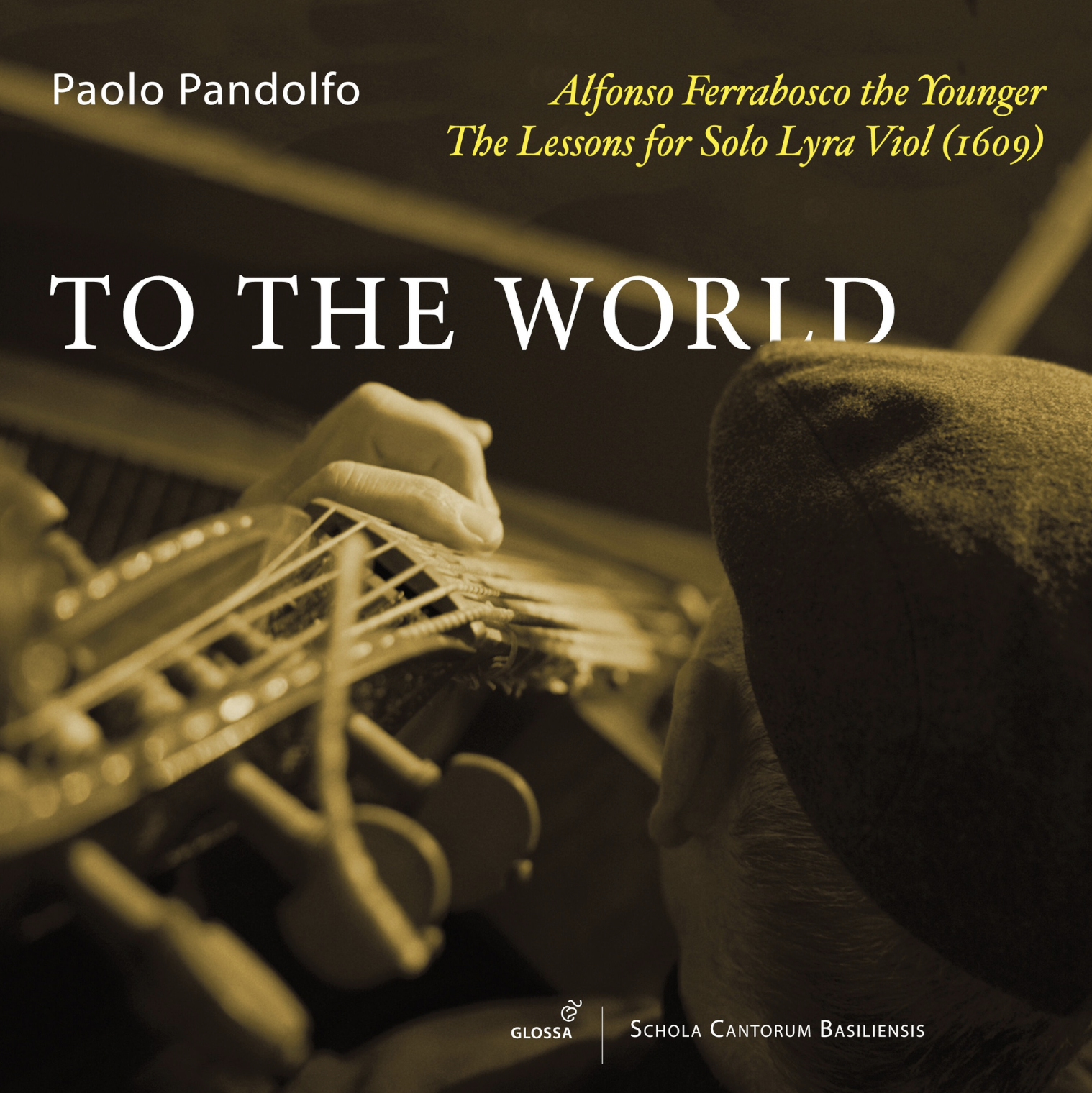
This album presents music by Alfonso Ferrabosco the Younger, sponsored by, and performed on an instrument commissioned by the Schola Cantorum Basiliensis – Hochschule für Musik Basel.
This late Renaissance book of pieces was enjoyed in the English court, created by a composer whose father had to leave England in exile, leaving him as a foster child. The instrument in question, an English cousin to the Italian viola bastarda, was designed to present multi-voiced music. Like the viola d’amore, it uses sympathetic strings to provide enhanced resonance. The excellent liner notes provide context not only around the music, but the instrument commissioned by the Schola Cantorum. And in order to realize it into sound, Pandolfo had to read from tablature, noting that “ Even among viol players, there are not many who can read these musical ‘hieroglyphics’ fluently.”
Each dance, organized across three sections, with an instrument tuning unique to each section, is followed by a Coranto. The translation is “courante” or “corrente,” so another dance, but I can’t say why there are so many, or if the pairs were envisioned to be played together as a set.
When listening with headphones I took special care to focus on the instrument used and its acoustic environment. Many of the dances are built from modest material. The gestures are attractive, as played by Pandolfo, the harmonic consonance and its amplification with the sympathetic strings coming across clearly as a feature of these compositions. When played on one of my systems that’s not quite as known for detail, the resonance of the extra strings is lost, and you may well only hear the typical sound of a viola da gamba. Like many instruments from the period, the ultimate joy in playing them comes not to the listener but the performer. (To this point, I’ve argued many times on online forums, arguing that one’s appreciation for music is enhanced when learning to play; in this case I have to first-hand knowledge, but can only speak to the sensation of having an instrument vibrate between’s one’s legs as offering a unique experience separate from listening in the confines of a concert hall.)
Most of the pieces on this album are short and of limited inventive material, as we might well expect given the time-period. As a set of lessons, we might look at these as pedagogical or as a compendium of one master’s abilities. More-so than the album just previously reviewed, Æmilia, featuring works for keyboard, these pieces come across to me with more affective impact. The Pauin or “Dovehouse Pavan” (track 25, disc 1) offers one of the longer movements, and like the pieces in that earlier album, caught up in repeating gestures, this one does the same, but the instrument or the approach here brings forth far more emotive content.
Across the entire album I was impressed with Pandolfo’s strong rhythmic pulse and the clean playing he offered, no matter how many strings he was called upon to play at once. This shouldn’t be a surprise to readers who know this artist and his high level of performance. I do wonder, however, about how these pieces were approached, and if in fact, they were enjoyed by the King? The composer’s art seems fixated, as we can see, on the polyphonic potential of his instrument. I am in no way an expert upon this instrument, but given the fact that the instrument used here had to be especially commissioned, it speaks to the unique flavor of these compositions. They may well have been performed upon a mainstream instrument, but the one here offers a real treat to the listener. Not only do we have one of the foremost interpreters behind the lyra viol, we get the benefit of his many years of experience and specifically here, the special chance to hear a bespoke instrument that seems well-equipped to maximize the impact of these dances.
There is something limiting to the pieces’ scope; their short duration speaks of the style of the day; I only wonder what the composer may have done some twenty-years later? It’s difficult to say, living in England, a location that seemed, at least to some point in time, behind the latest faire and fashion. While the music presented here is not of the highest profound level, I think enjoyment is somewhat dependent upon your attention. Therefore, choose a short number of pieces of enjoy at one sitting, taking comfort in this instrument’s timbre on the best setup you have available.