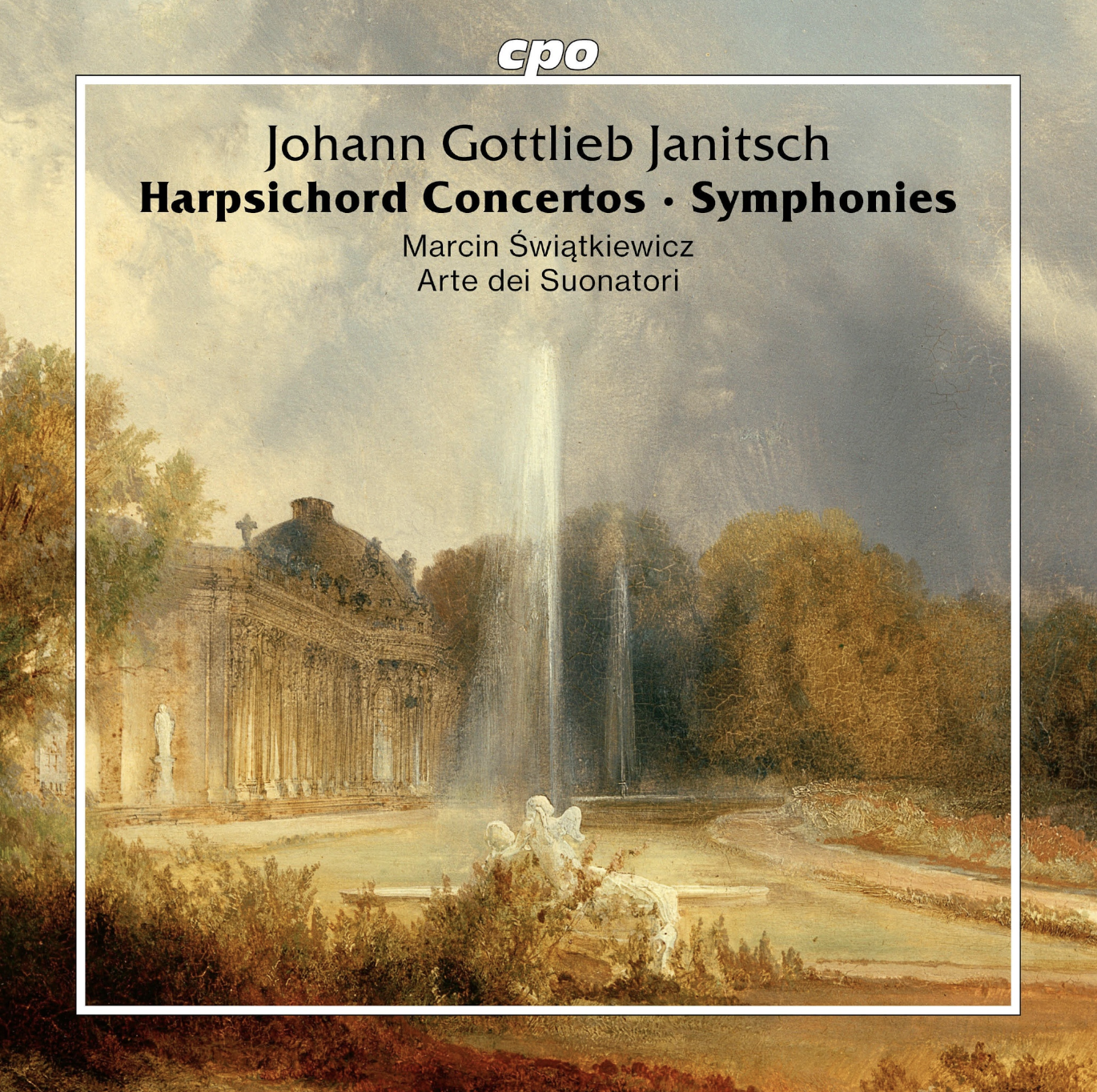
Janitsch: Concertos & Symphonies • Świątkiewicz
Johann Gottlieb Janitsch (1708–1763) was born in Schweidnitz, a prosperous Lower Silesian city that had weathered the Thirty Years' War and rebuilt itself into a significant regional center. From childhood, he absorbed the atmosphere of the city's remarkable Church of Peace — its theatrical sculptures, spectacular painted galleries, and music amplified by the building's singular acoustics — an influence that harpsichordist Marcin Świątkiewicz, who first encountered the church in the early 2000s before its renovation, believes shaped the young composer's sensibility in ways that surface throughout his music. Janitsch's early talent was noted during his Latin school years, and he later deepened his training in Breslau under members of the episcopal ensemble before taking up law studies at Frankfurt an der Oder — a typical path for aspiring musicians of the time — where he was already leading his own ensemble in performances for the royal family. He eventually entered the Berlin court of Frederick the Great, playing double bass and organizing the celebrated Freitagsakademien, the Friday concerts that became a model for musical life in the city. His output represents what the liner notes aptly call the Berlin variant of the galant style, and his quartets in particular were praised in his own time as models of formal balance and contrapuntal craft — yet most of his larger works remained inaccessible until the Sing-Akademie collection, lost during World War II, was finally recovered.
This program offers two symphonies (in F, JWV 7:F6; in E-flat, JWV 7:Es3) and two harpsichord concertos (in F, JWV 6:F1; in A-flat, JWV 6:As1). Świątkiewicz is joined by Arte dei Suonatori, a small chamber ensemble whose size works in the harpsichord's favor, allowing the solo instrument to project naturally against the strings. The choice of A-flat and E-flat as key centers is itself worth noting — not the expected territory for this repertoire.
Harpsichord Concertos
While Janitsch was employed at court as a double-bass player, his keyboard writing is anything but modest. Both concertos move with confidence across all three movements, with well-groomed melodic material throughout and Świątkiewicz's phrasing consistently attentive to the music's character. The balance between strings and soloist is exemplary. Stylistically, these pieces sit at an interesting crossroads: the Italian ritornello-solo model is clearly present, rendered in an unmistakably galant idiom. A comparison with C.P.E. Bach is tempting, though Janitsch is perhaps less given to harmonic surprise or emotional volatility. Put him next to Haydn's organ concertos and Janitsch sounds older — but there's real charm in precisely that quality. His baroqueness is a feature, not a limitation.
The A-flat concerto's opening movement offers the review's most arresting moment. The extended harpsichord solo brought to mind what it might have been like to witness J.S. Bach in the fifth Brandenburg Concerto — a virtuoso fully absorbed in an elaborate flurry of notes, the orchestra briefly reduced to a secondary partner. The use of repeated notes as a rhetorical device adds further interest; one senses a composer who understood how to hold an audience's attention.
In the slow movement, the challenge of sustain is met without resorting to formulaic patterns. The interplay between the upper strings and keyboard is genuinely engaging, and the decoration of the melodic line — ornaments, filigree — reads as a small masterclass in galant affect. What might once have been left to a performer's improvisation is here fully written out, which tells us something about how seriously Janitsch took the slow movement as a compositional act.
That said, the melodies here, appealing as they are, tend not to be fully exploited. Janitsch extends his material through harmonic progressions and counter-themes, but he stops short of the kind of developmental ambition we associate with Haydn or Mozart. This is less a criticism than a description of where he sits in musical history — and of the context in which he was writing. These were not concert works aimed at posterity; they were composed for court ensembles and the intimate Friday evenings of the Freitagsakademien. The music serves its purpose elegantly without reaching beyond it.
Symphonies
These pieces are shorter and more modest in scale than the concertos, aligning with the three-movement sinfonias of C.P.E. Bach and drawing a longer line back to Vivaldi's concertos without soloists. Świątkiewicz takes the harpsichord continuo role here, stepping back from the spotlight.
Janitsch succeeds in sustaining interest across all three movements through the quality of his melodic writing rather than harmonic surprise. The outer movements have good forward energy; the slow middle movements avoid becoming mere connective tissue by offering their own well-considered material. A modulation to the minor provides just enough contrast before the return — enough to interest, not enough to unsettle.
The third movement of the F major symphony makes the point neatly. At just over two and a half minutes, it doesn't pretend to be more than it is — melodic lines posed as question and answer, returned to often enough to feel familiar by the close. It is not developed so much as revisited. And yet there's a freshness and optimism in this music that gives a listener pause. One finds oneself wondering about the temperament of its composer — whether some of this charm reflects a genuinely happy man, at least in these moments.
Conclusions
My prior experience with Janitsch had been limited to some of his chamber music. This album opens another side of the composer, one that confirms both his strengths and his historical position. He was a skilled craftsman of melody, well-trained in the forms of the high Baroque and fluent in the galant idiom that was displacing them. The music never loses its charm, even when it declines the opportunity to push further.
Arte dei Suonatori are polished and committed throughout, and Świątkiewicz's direction serves the music with both intelligence and evident affection for a composer who deserves more than his current obscurity. If these are indeed the world premiere recordings of both harpsichord concertos, that fact alone warrants attention.