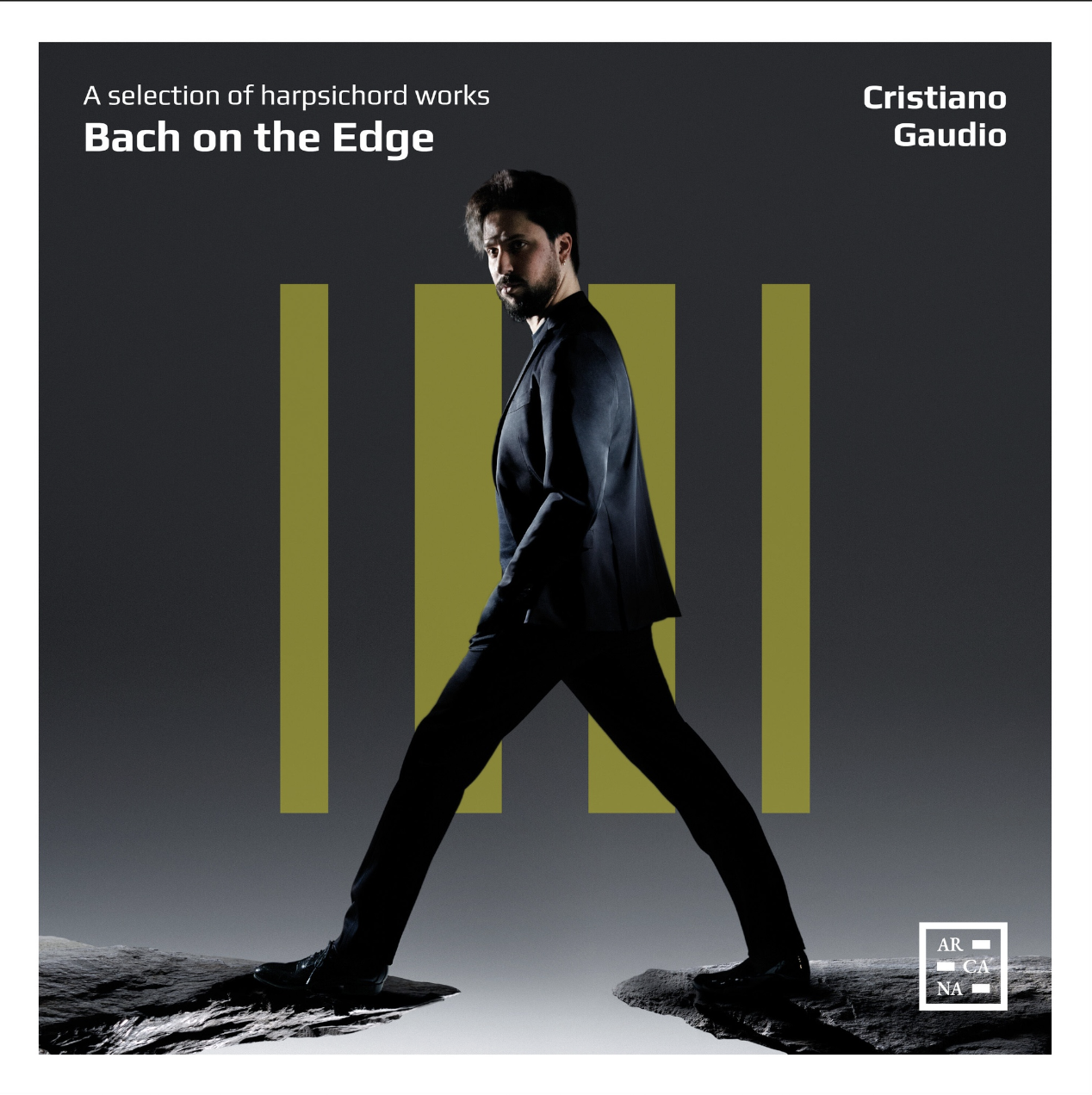
Bach on the Edge • Cristiano Gaudio
Gaudio has a great formative resume, having studied with Olivier Baumont, Blandine Rannou, Francesco Corti and Jörg-Andreas Bötticher. His earlier solo album was focused on “Händel vs. Scarlatti” and he also performed in the Rosenkranz-Sonaten album with Leila Schayegh.
This album woke me up, sounding a bit hot (fine by me, adjust the volume) helping me fight the jet lag from my recent sojourn to Japan. I just couldn’t believe what I was hearing. I decided to go to bed and start over fresh in the morning. The Andrea Restelli instrument he uses, after Christian Vater (1738) is an outstanding-sounding instrument. The recording was made at Montecastelli Pisano and the acoustic there, here captured by veteran engineer Ken Yoshida, is about as ideal as you’d want for a solo harpsichord recording.
The liner notes frame Bach as a kind of iconoclast-firebrand. The pieces chosen might lean into this characterization a bit, such as the opening BWV 903: Chromatic Fantasia and Fugue in D minor. Other pieces seem less obvious, although one can of course marvel at the mind who took the royal theme into a six-part fugue in the Ricercar à 6, BWV 1079. The younger Bach’s Toccata in D, BWV 912 might also qualify, but Erbarm dich mein, o Herre Gott (BWV 721)?
There’s little doubt that Bach was, and had to have been, one of the world’s foremost musical geniuses. For all we know about him (and we’d like, of course to know more), we don’t think he was the type with an inflated ego, or sought experiences to showcase his talents for praise by audiences. He may well have had an ego—what else describes his burst of energy in his later years to put together the Musical Offering to prove his abilities to his son’s employer?
I maintain my own belief that Bach’s place in the world was somewhat set by his background and general education and despite his talents, certain doors would always be closed to him wherein they were not for his contemporaries Telemann or Handel.
Historians have often wanted to paint Bach as old-fashioned, retreating into the past for inspiration, rather than the future. Listening to his Art of the Fugue from the late 1740s alongside the music his own sons were writing contemporaneously demonstrates this well. But I like the suggestion made in these liner notes that Bach was living on the edge through his music, and of course we have the benefit of time and history to qualify ourselves in ways that may have been difficult to establish in his own time.
All of this is irrelevant when speaking about these performances. I think instead the “Bach on the Edge” title alludes to the performer’s take on these pieces. The opening Fantasia (BWV 903) has been played a myriad different ways by both pianists and harpsichordists. This performance demands to be heard, it demands of you to sit up and take notice. Gaudio pushes us here to the edge as much as Bach. He seemingly soaks up Bach’s virtuosity without issue and breathes it out hot and colorfully. I dare say he’s met the master’s challenge here. This is the type of piece, if Bach were ever to show-off, to show-off with. It’s a highlight of finger technique, of one’s ability to tune their instrument, and then of course, the ability to work out counterpoint with a challenging theme. If Bach were ever to submit an original composition for his doctoral thesis in music composition, who might deny the conferral of his degree?
I know how I’d feel at a harpsichord competition hearing Mr. Gaudio perform this work. Readers won’t be surprised that he’s been a competition prizewinner.
BWV 964 is confusingly (by the numbers in the Schmieder catalog) the arrangement of BWV 1003 by Bach (or possibly J.G. Müthel or Bach’s son, Wilhelm Friedemann). For me the piece comes alive in the finale, in this case track 6’s Allegro. Bach doesn’t go full Busoni on us of course, but it is a very interesting piece in that we get to hear how Bach approaches the whole transcription a work for violin to the keyboard. The effect achieved by Gaudio and the arranger is to conjure a nearly different kind of sound from the harpsichord, with wipes and swipes of sound, offering a musical effect foreign to the original. Gaudio’s change in registration mid-way was a wise choice. The effect is one to leave us breathless; the simple ending is both cute and demonstrative of the personality described in the booklet’s essay.
The arrangements made by Gaudio (tracks 7, 10, and 14) are something you won’t easily find elsewhere in the catalog. His technique at presenting melodic material with accompaniment is well-measured. To note, I think, is how he articulates these pieces, both punctuating and blurring lines through articulation. These are the types of pieces that belong on the organ, one might argue, but he makes no apologies for using the harpsichord given his technique. My favorite of the three is the last, Erbarm dich mein, O Herre Gott which Chris Thile too plays on guitar in his album collaboration with Meyer and Ma. It is no less effectively played here, with Gaudio’s sensitivity to the music, the harmonic tension and resolution. The repetition here on harpsichord may not be as gentle as that strummed upon a guitar, but his phrasing is what propels this forward and ultimately allows us to ponder the rich well of emotional depths Bach possessed. It’s a bold piece to end the album with; in a concert I think this would be an encore. And how it doesn’t resolve? Makes me want the follow-up to this album already.
The opening of the Toccata BWV 912 in some ways mirrors the Fantasia, BWV 903: Gaudio isn’t intimidated by speed! One has to imagine Bach was not either, why else write music that could arrest the listener’s attention. We have to remember that much commentary of Bach’s own performances leaned into his technique over his compositional abilities. We know enough to say that listeners never questioned his technical gifts as a performer. I like an interpreter today who is willing to give us that experience. The opening of this performance is grounded in a nice, fat octave doubling in the left hand. Gotta say that was satisfying.
The next section is interesting with a change in temperature. We cool down with Gaudio as guide, as Bach leaves us some interesting rhetorical material. Bach also takes us on a bit of a chromatic ride, foreshadowing the opening work on this disc. Whichever temperament was applied to Gaudio’s instrument, it handles here very well. The writing in the ultimate third of this work is refreshing, something we often align with Bach’s youthful exploration. The contrapuntal section under Gaudio’s execution is well-managed to once again turn the temperature up. To admire is both Bach’s subject and how it’s handled, how the harpsichord, given the right acoustical environment, plays with our ears harmonically. One might suggest it takes the listener to the edge of what was possible on this instrument. I’m liking the title of this production even more.
Gaudio also presents to us the last B minor prelude and fugue from the WTC I. Readers will know it’s my favorite, BWV 869. I’ll remind you that the ultimate performance of this work, in my own view (until I discover something better), is the performance on piano by Friedrich Gulda. Mr. Gulda does two things I admire: he clearly treats the prelude as a trio sonata, giving us that punchy short articulation in the left hand, while letting the two melody lines sing on top. In the repeats, he plays freely with adding ornaments and decorates the lines.
Call me shocked here. I can’t say Gaudio was inspired by the Gulda recording, but the strengths of one came over here, onto this version on the harpsichord. The piece all together lasts nearly fourteen minutes. I don’t think I’ve held a smile upon my face for this long before. Call me impressed.
All around congratulations go to Mr. Gaudio and the team that supported this recording. While it’s not his solo debut, it's a strong recital — as strong as I expect you'll hear this year of music by Bach upon the harpsichord. The combination of strong technique and care to phrase this music in alignment to Bach’s tension and release with harmony push this recording to the front of anyone’s shelf.