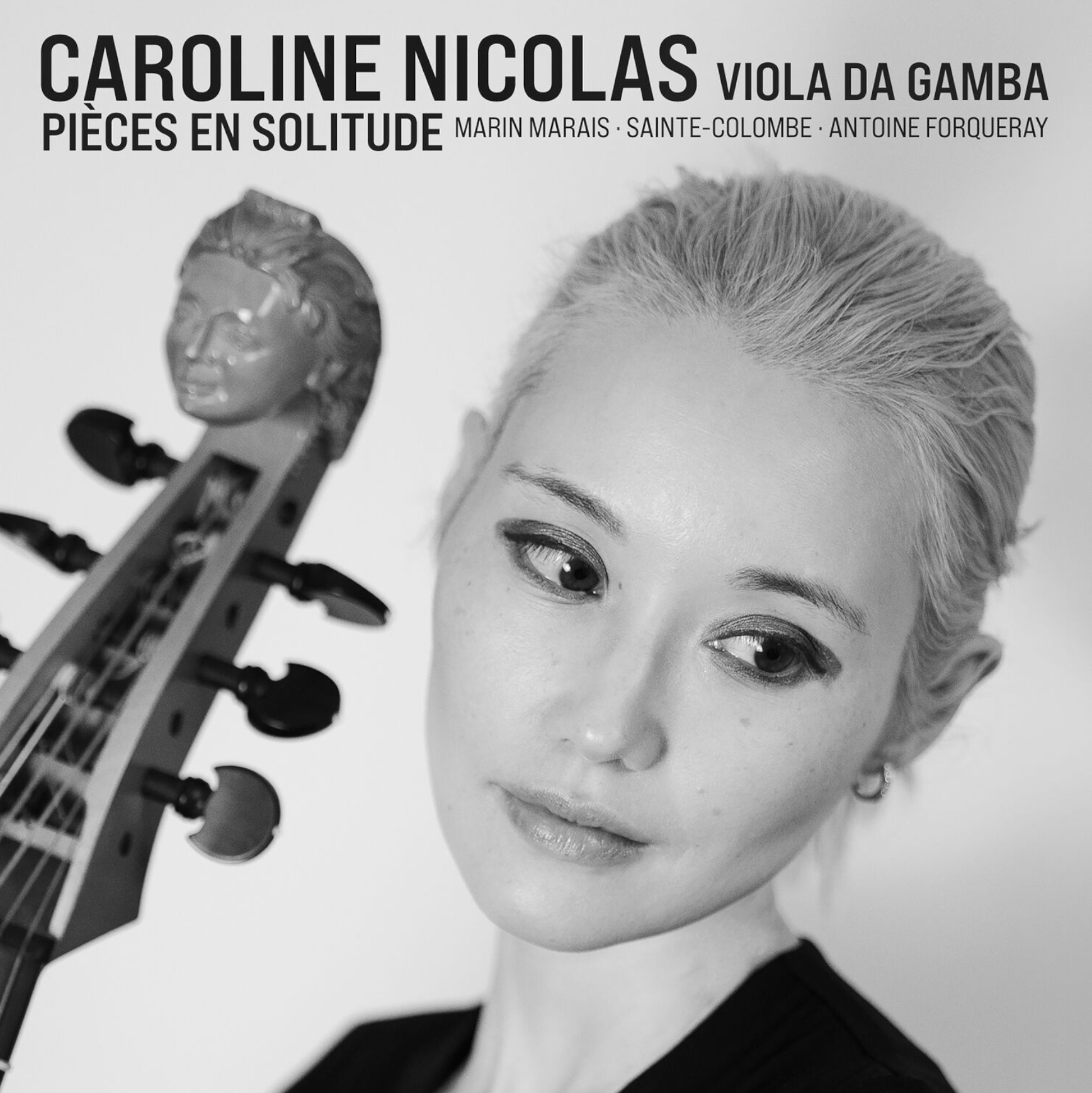
Pièces en solitude • Nicolas & Payne
North American gambist Caroline Nicolas and her husband Kevin Payne here perform French pieces for the viola da gamba, many accompanied by theorbo. Familiar names including Marais and Antoine Forqueray are featured, alongside Sainte-Colombe and Le sieur de Machy. The booklet does not discuss the music, but gives adequate biographical sketches, revealing the import of each composer.
The recorded sound is close, capturing a lot of detail, including small instrument noises that an audience might miss in a concert hall. It's not an ideal sonic picture, but given the chance, I'd rather be closer than farther away. There's nearly no signature from the space they're in.
I'll start with Sainte-Colombe's Chaconne on track 13. This is one of Nicolas' solo tracks, and the way she connects the notes, aided by the sustaining power of her instrument, is lovely. One has to admire the composer's writing, too, in how he avoided creating something too formulaic. The little cadence around the 2:30 mark is simply unexpected and attention-grabbing (in a good way). The faster material that comes later is cleanly articulated.
Perhaps one of the more famous pieces is Forqueray's La Forqueray. I felt that rising line for the gamba came off a bit weak here. For comparison, I'd invite the reader to check out Lorenz Duftschmid's reading or the much faster one by Paolo Pandolfo. This isn't so much a performance issue as one of balance, where the gamba sounds softer than the bass lute. I'm pleased she didn't attempt Pandolfo's speed, which for me felt forced. The small amount of rubato Nicolas uses suits the piece's style well.
Another well-known piece is Marais' Les voix humaines, which appears here on track 20. This piece demonstrates how well-connected the two players are, in time with each other. The use of some vibrato in the left hand, I think, works to sweeten the melodic line. This is a piece that I think benefits from the application of breath. Not literal breath from the performer, but internalizing how the music would imitate singing. Some of that effect is lost with such a close recording. I auditioned this one with headphones, as my main system is currently out of commission with some home repairs. The effect is that I'm sitting on the ground between the two players.
The balance is better in the performance of Marais' Allemande and Double on track 2. The gamba is clearly leading with volume. As Nicolas consistently does across the album, we are treated to strong articulation and a keen sense of rhythmic emphasis.
Conclusions
This is the type of album that makes for an excellent concert program; you take a linking hook, a concept or idea, and then hang from that line a number of representative works. There are enough well-known pieces here to delight those who have already bought into this period and its repertoire. The recording then serves to promote the artists, who, we're hoping, capture the audience's attention with their interpretations and technical gifts.
The technical aspect here is clear. Nicolas and Payne both have the chops required to perform this repertoire. The interpretations, aided by nuances of dynamics, rubato, and sweetness in the upper register, all enhance the music.
The close recording may have been intentional to reinforce this idea of solitude; it's a sound, however, that somewhat limits the musical effect. We can get around this by projecting this music into our own larger, hard-surfaced spaces. As much as these pieces may have originally been enjoyed by very few (one thinks of a bedroom performance for King Louis XIV), I wanted a bit more air and reflection in the sound.
But don't let that small detail keep you from experiencing the artistry on display here from this young duo.