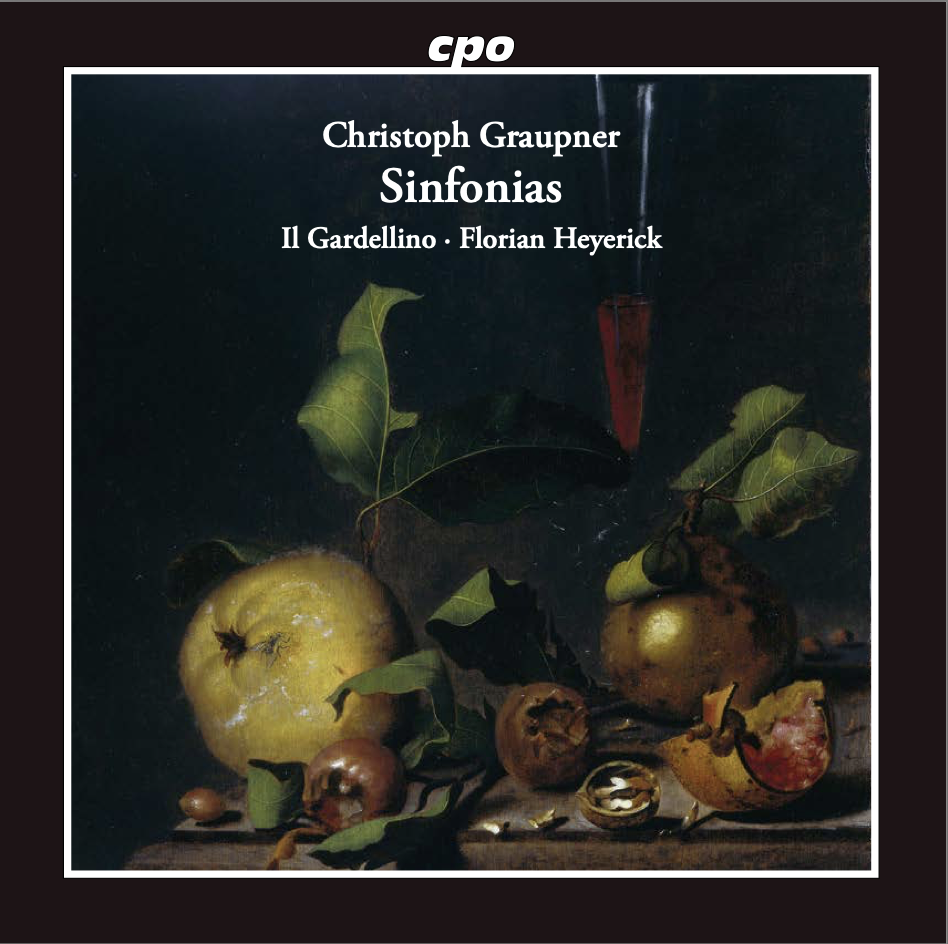
Christoph Graupner: Sinfonias • Il Gardellino et al.
Graupner isn't nearly as well known today as Telemann, Handel, and J.S. Bach, though he was a contemporary of all three high-Baroque masters. The works featured here include:
- Sinfonia GWV 528
- Sinfonia GWV 504 (excerpt)
- Sinfonia GWV 562
- Sinfonia GWV 590 (excerpt)
- Sinfonia GWV 566
- Sinfonia GWV 589
- Entrata per la Musica di Tavola GWV 453
- Sinfonia GWV 577 (excerpts)
- Sinfonia GWV 545
- Sinfonia GWV 505 (excerpt)
- Sinfonia GWV 529
- Sinfonia GWV 557 (excerpt)
- Sinfonia GWV 601
- Sinfonia GWV 597 (excerpt)
- Sinfonia GWV 604
- Overture, GWV 411
The liner notes note that GWV 577 is performed by the Cydonia Barocca Ensemble, and that GWV 411 and 453 are performed by the Ex Tempore Ensemble, both smaller forces. The conductor across the two CDs is Florian Heyerick.
According to the liner notes, the composer wrote one hundred and twelve surviving sinfonias, and this 2-CD set offers selections from sixteen. The conductor has already released two cantata recordings by the same composer on the same CPO label. These recordings were made between 2021 and 2024, offering a vivid look into the composer's compositional style, which is diverse and, to our ears, mostly unknown in the context of orchestral compositions.
Sinfonia in F, GWV 566
This work is really an orchestral suite, featuring horns and timpani. The timpani play a significant role, more so than in Bach's revisions of his own orchestral suites. The opening movement is marked Vivace, sidestepping the typical French slow-fast-slow pattern. The large recording space gives the timpani a strongly reflective stage. I'm used to hearing a drier sound for period drums, which, in this case, may have reduced their lasting effect — one I found a bit annoying. Feedback, perhaps, for the composer? Or a switch to harder sticks? Can't say.
The texture of the dances relies on melody carried by the violins; the horns punctuate with their own material, and the harpsichord is clearly audible within the orchestral texture. Graupner, though, doesn't give the bass much of a role, and what's there is hard to hear. The Bourrée is one of the dances with the most character, even if it carries a folksy charm. The Gigue, too, I believe, must have been conceived as a crowd-pleaser. It's finely written, but on the whole doesn't offer anything musically profound. In terms of musical weight, it's light — either a reflection of Graupner's compositional abilities or simply the function of the work.
Entrata, GWV 453
This work is presented as a chamber piece, offering a markedly different sound from the Sinfonia in F above. The opening movement is the longest, built in a three-part slow-fast-slow form; it's followed by a pair of menuets, a sarabande, and a gavotte en rondeau. The flavor is quite different from 566: the writing feels more adventurous — freed, perhaps, from the constraints of the horns and timpani? The absence of those booming timpani is a welcome feature of this piece.
The piece is for string ensemble, the opening relying heavily on the harmonies between the upper parts. It's easy for me to hear the composer's phrases built out of the building blocks of rhetorical gesture. The style of writing, despite the slow-fast-slow opening, feels far more Italian than French. The slow portions remind me of the writing of Alessandro Scarlatti (he would have been my guess, had I played "drop the needle"). The violins, especially the first, play affectively, but there's room, I think, for even more.
The pair of menuets offers some flavor. The composer does a good job, I think, as also witnessed in the 566 sinfonia, of offering bite-sized phrases with character that are easily recognizable on the repeats. I can hear his desire to write for his audience — to make the music approachable, and, in the case of the menuets, to give listeners the satisfaction of a strong rhythmic pulse.
The final Gavotte has plenty of country flavor: there's the pastoral aspect written into the music itself, and then the small slides offered by the violins give an unusual flavor. The whole piece encourages a smile. One could imagine clanking steins of beer in the tavern, for sure.
Sinfonia in D, GWV 529
This sinfonia, scored for trumpets and timpani with strings, is cast in a three-movement form that seems to have been a favored structure for the composer. What strikes me here is Graupner's original voice coming through; again, the phrases are not overwrought. It reminds me of the criticisms the town council gave Bach in Leipzig about the complexity of his music; they may well have been thinking along the lines of what's offered here: the music sounds just a bit simpler than anything Bach would have written. Again, I think that translates into "more accessible." There's a definite Jean-Joseph Mouret feeling, given his famous fanfare.
The slow movement gives the drums and trumpets a rest. The shorter closing movement gives more responsibility to the strings, with the drums and trumpets adding festive punctuation the piece could eliminate, giving the piece extra legs if the extra players were unavailable.
Overture in C minor, GWV 411
This is another chamber piece — or at least played as one, like GWV 453 — performed by the Ex Tempore ensemble and lasting nineteen minutes. The overture-suite is presented over eight tracks, opening with an Allegro that feels perhaps more French than Italian, though both influences are felt. The remaining movements are all marked "Air," each with a different tempo indication. The violin playing is strong; the flavor of the piece reminds me somewhat of the spurious Bach suite, BWV 1070.
The changing moods are an interesting component of this work; the sameness of the C minor key from movement to movement may get tiring, but the violin lines are consistently inventive, with some good "licks." The most harmonically adventurous movement is the final, seventh air.
Sinfonia in F, GWV 577
The scoring for this one is unusual: viola d'amore, three violas, cello, bassoon, and basso continuo! The d'amore strings lend another folksy character to the sound. The solo parts for the bassoon are welcome, since the other pieces auditioned here didn't give much to the lower register; the bassoon and viola d'amore engage in dialogue, and the effect is lovely.
I'm not sure why only three movements are provided here, but, like the piece above, they're all marked "air." I wonder what performances would have looked like in the composer's time: were these treated as "candidate" pieces, chosen at whim to fit the pragmatic needs of events that may not have had a fixed slot for musical entertainment?
Either way, the bassoon part sticks out, and it's well tackled by Lisa Goldberg.
Conclusions
If the name Graupner sticks out to you as a Bach fan, yes, that's why you know him: he was to become the next cantor in Leipzig, but his employer would not release him. And then Bach got invited to audition. These "sinfonias" offer a great look into the composer's ability with non-religious music, though it's conceivable that some of these may have been performed in the same space. The use of horns and trumpets suggests he was called on to provide festive music for ceremonial occasions.
This recording, as noted, brings together three different ensembles under the common thread of conductor/harpsichordist Florian Heyerick, who has come to specialize in the study of Graupner's music. The strong sense of rhythmic drive and the composer's choice of interesting instrumental colors are hallmarks of this 2-CD set.
Sound-wise, the smaller Ex Tempore and Cydonia Barocca recordings are strong, though the volume is lower than the bright, transparent recordings made at the Mariekerke.
What these recordings reveal is a consistent voice from the composer, a mind that offered easily accessible and attractive music to his employer, whether by design or limitation. If we compare these works to those by Telemann, Handel, or Bach, they differ because of this composer's unique voice, but also because those three composers, who enjoy a far wider following today, tend to spin music in longer stretches, ultimately creating more complex structures. Yet Graupner knows how to move us rhetorically, as his writing for the first violin makes clear.
I shall enjoy returning to this recording, and I look forward to hearing more from this composer.