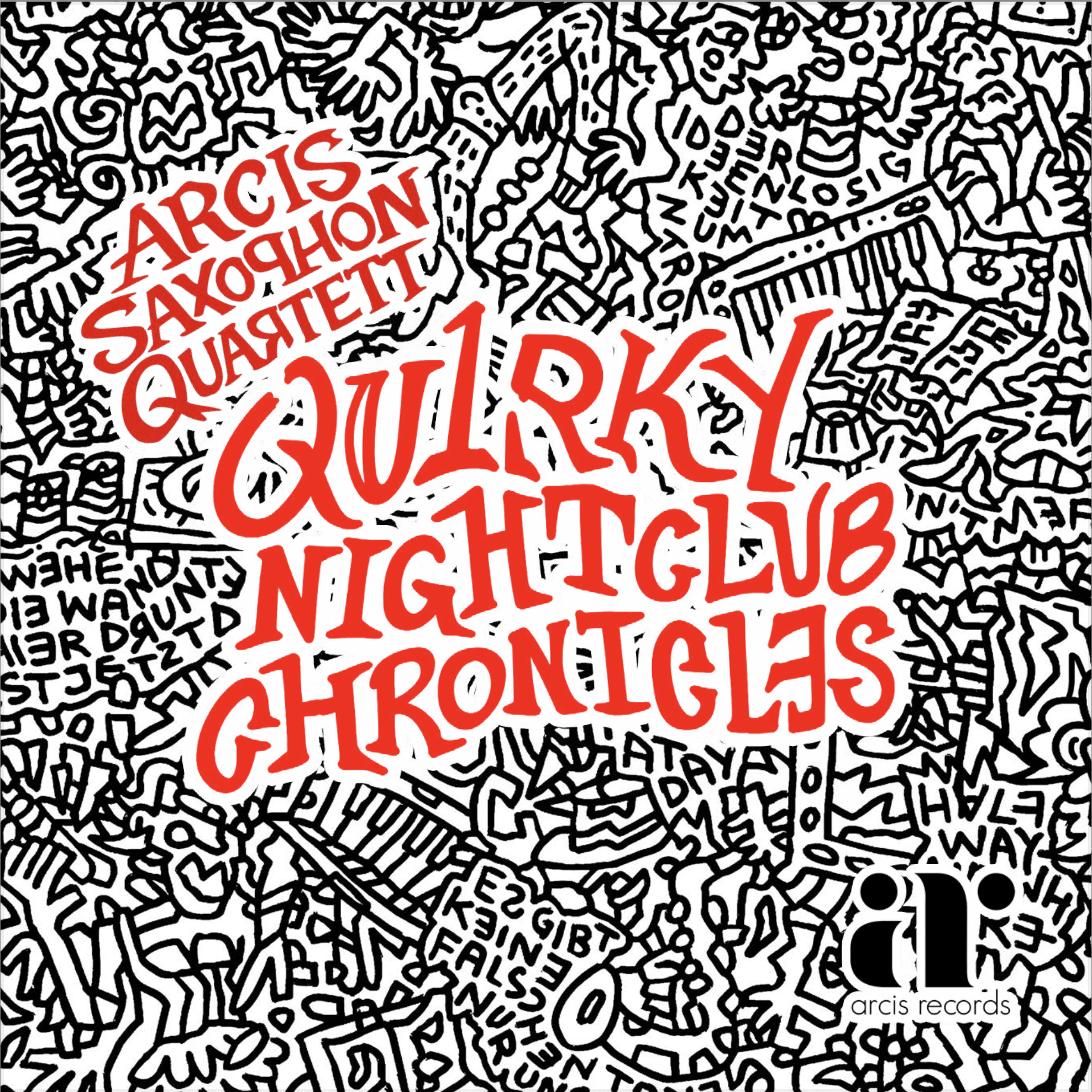
Quirky Nightclub Chronicles • Arcis Saxophone Quartet
Claus Hierluksch (soprano), Ricarda Fuss (alto), Anne-Marie Schäfer (tenor), and Jure Knez (bari) form this quartet with a release featuring works by Shuteen Erdenebaatar, Marc Mellits, Emma O’Halloran, and Astor Piazzolla. Needless to say, this is not baroque music, but much of it, the nuevo tango composer aside, is written by living composers. The recording was made at the Blaibach concert house and the recording, auditioned primarily on headphones, uses this concert space to capture a lot of the reflection of the instruments, rather than miking them directly. The recording is dynamic but I’d have preferred to gotten closer to the instruments themselves. For those who don’t naturally gravitate to the sound of saxophone, or more specifically a sax quartet, don’t let the associations one may have with jazz turn you off. The format—each player with their own appropriately-sized instrument—I think has a wonderful, integrated sound when done well.
It’s what you’ll find here.
I started with the familiar: five short tangos by Piazzolla, arranged obviously. A piece like Libertango offers plenty of challenges for several of the players, but there are not any technical deficits to be heard. Not everyone may like the imitation of the violin by the soprano in Escualo, but it’s a nod in the right direction, I think, to give credit to the style of the original. What’s lost, of course, is the color and texture from a mixture of different instruments. But what’s gained is an inner-clarity with the composer’s art. And in their own way, they let the piece earn its due with effect. I think it’s a great balance in adopting an arrangement that is most certainly well-known by the audience.
Marc Mellits (b. 1966) piece is Tapas, composed in eight movements. It’s another arrangement. I don’t know what the original concept was, beyond the idea of providing the musical equivalent to Spanish-style tapas cuisine in sound. The result isn’t Spanish music, per se, but the idea of small musical bites, each with their own “flavor.” The style is contemporary, some may find affinity in style to minimalism. Tapas Two leans there most heavily; but thankfully the composer has more than one stylistic reference up his sleeve. The reverberant space almost isn’t enough to carry Tapas Four, and I’d love to hear it in an open public space. As I have many times heard a solo sax player in the Paris Métro underground, I’d like to hear some of this “meal” in music in a similar space. Not a knock on the performance, but having written music for such a space myself, I’m just super curious to how this composer’s style would relate.
The center of the composition’s arc is the fifth Tapas, which lasts over four minutes. The energy, which is still present, even though the composer slows the frenzy of the other movements, achieves a delicate and expressive plateau. Tapas Six uses the composer’s familiarity with the saxophone to mimic the sound of an electric guitar. The piece ends again with the mood presented in Tapas Five. But the movement is gone, what remains are straight chords to anchor us. The movement ends with a division of melody and harmony, but stripped to essentials.
Emma O’Halloran’s (b. 1985) composition Night Music was inspired by her time in Miami after leaving her native Ireland. She writes that the piece is an attempt to capture the “colours, the heat, the rhythms, the club nights, and also the quiet of the ocean at night.” I felt the composer does well at taking strong musical ideas and squeezing out the juice, not letting a good idea die after one expression. Extraordinary breathing is required to make this work, and the use of extended techniques convey the memory of the ocean. It’s a perfect piece at seven minutes to exploit the character of a saxophone quartet. I might have never guessed “Miami,” but then again, I did not share the composer’s own experiences. But the result is a cohesive work that I found enjoyable.
Erdenebaatar’s (b. 1998) Echoes of Life opens the album. It’s a five-movement tonal composition, designed to capture the “shared human experiences that quietly connect us.” The movement last between one and a half to three minutes in length, echoing the tapas concept again for me. The opening “Awakening” is beautiful, not only for the composer’s harmonies, but the execution by the ensemble. Smooth is the operative word.
The technique used in Reflection, the piece’s third movement, puts the players in lock-step, articulating the same rhythm before solo parts emerge. As a compositional technique, I liked the effect, and the way the ensemble stays super-focused with the same articulation. The finale, entitled Sparkle starts with a kind of call and response; perhaps the cacophony of birds? It gives way to a repeated pattern in the bass which gives different players the spot light as the harmonies change like colors.
The composition for me is approachable and the quartet present it lovingly.
Conclusions
Despite never playing the saxophone, I’ve always been drawn to its use in contemporary western art music. (I’m also a big fan of Chris Potter, the jazz sax player.) And yeah, the saxophone part in Dave Brubeck’s Blue Rondo a la Turk? Great stuff.
This recording does well to present the strong gifts of the individuals who come together here as a cohesive, single voice as a quartet. The title is the only thing I’d flag as questionable; it doesn’t for me, at least, sell the music as well as it should. Quirky, yes, that word applies to the music, not the performers; would you hear this in a nightclub? Not the ones I imagine, but then again, I’ve yet to travel to Munich.
For those who like the sound of the saxophone and want to support new music, I can’t think there is any drawback with investing your time with this album which will debut on July 17 worldwide.