J.S. Bach: Cello Suites, arr. for viola • Sabbah
One might understand how a violist could feel slighted for not getting their own sonatas or suites when Bach’s music for the violin and cello is so monumental. The truth, however, is that during the Baroque period the viola rarely occupied a solo role. Musicians such as Marc Sabbah will be quick to point out (as he does in the liner notes) that Bach clearly enjoyed the instrument, or at least leading from it, in ensemble playing. He also notes that while Bach left us no viola concerto as Telemann did, he did place the instrument in a leading role in the Sixth Brandenburg Concerto.
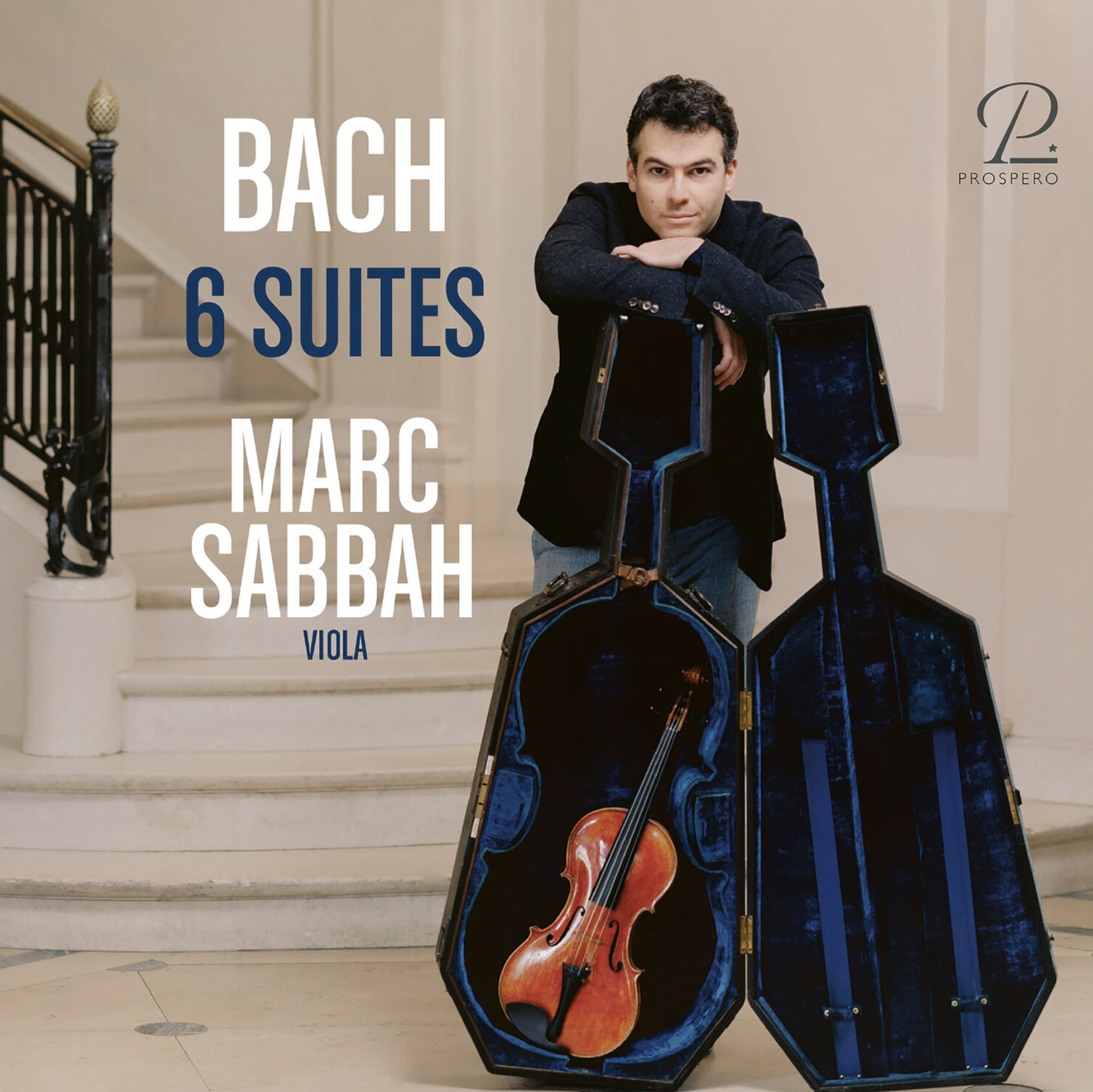
The viola is tuned like the cello, only an octave higher, making the cello suites surprisingly accessible to the violist, at least on the surface. The cover of this CD features a viola inside a cello case—a clever visual conceit, I must admit. Sabbah, who performs on a modern setup, nevertheless approaches these works with historical curiosity, returning to Anna Magdalena Bach’s fair copy and even preserving readings that later editors regarded as “mistakes.” His bowing fits Bach’s music naturally, and he largely abstains from vibrato. I’d call this a historically informed approach, though along the HIPP continuum he stops short of going all the way with gut strings or a period bow.
There are a few moments where I felt Bach’s idiomatic writing for the cello loses something in translation. The opening of the G-major Suite is beautifully played, yet some of its full-bodied resonance inevitably gives way on the viola. The pair of Gavottes from the Sixth Suite presents a more complicated case. In some respects, the dances suit the viola even better than the cello. Yet much of the tension I associate with these movements disappears. What I have always heard as one of Bach’s saddest inspirations, despite its major mode, here simply sounds happy. Many cellists may disagree with me, but Sabbah performs both dances beautifully. They’re simply different on the viola.
Another revealing example comes in the Courante from the E-flat major Suite, BWV 1010. Here the viola’s shorter resonance encourages a lighter, swifter approach, allowing Sabbah’s crisp articulation to shine in the rapid passages. The lively Gigue is equally successful. This suite seems particularly well suited to the viola’s range, spending much of its time in the instrument’s middle register while still exploring both its upper and lower extremes. The opening Prelude, too, works wonderfully on the viola, with Sabbah’s instrument singing sweetly in its upper register.
Sabbah’s historically informed approach is perhaps most evident in the Second Suite, BWV 1008, and his studies with Anner Bylsma were likely foundational to that musical outlook. In the opening Prelude, however, I found myself wishing he would relax the tempo just a bit. There is certainly room for interpretive flexibility, but Sabbah seems committed to pressing the movement forward. For me, this suite contains several moments worth savoring. Some listeners may prefer a more romantic approach, but Sabbah consciously avoids that path.
The mood shifts in the following Allemande, where touches of rubato gently illuminate the phrasing without tipping into romanticism. The Courante receives an even looser treatment, with greater rhythmic freedom. In the Sarabande, the restrained rubato and tasteful ornamentation are expertly judged. If I were to change anything, it would be to hear vibrato used a bit more freely as an ornament. Sabbah employs it, but somewhat timidly.
Sabbah’s phrasing, emphasized through crisp articulation in the Menuets and Gigue from the same suite, offers something a bit different from many cello recordings. These choices are not viola-specific; rather, they reflect how Sabbah wants us to hear these dances. The result is refreshing.
I admittedly missed the satisfying low opening note of the C-minor Suite, BWV 1011, but Sabbah’s handling of the opening Prélude is tastefully rendered. The other great Sarabande of the set appears here, with Bach’s almost meandering melodic material, leading us where? For my taste, Sabbah loses a little by moving through it this quickly, guiding us along Bach’s winding path. The remaining dances unfold at ideal tempi, and I especially appreciated the buoyancy of the Gigue. Throughout the recording, I should emphasize, Sabbah’s tone borders on gorgeous.
Conclusions
It wasn’t that long ago that I heard baroque violinist Rachel Podger record these suites on the violin. She is a marvelous artist, but many of the dances simply felt different to me—through no fault of her own. My ears have simply been conditioned by hearing these works on the cello for so many years.
I did not have that same universal reaction to Marc Sabbah’s recording. The viola is very much its own instrument, and whether that stems from its middle register, its slightly more nasal timbre, or some combination of both, I suspect the greater difference lies in Sabbah’s interpretations. He has no interest in simply imitating a cello. Instead, he approaches these works as music worthy of the viola on its own terms.
The recorded sound is excellent, offering an ideal balance between instrument and acoustic. My affection for these suites on the cello may ultimately keep those performances as my personal preference, but Sabbah’s readings are intelligent, thoughtful, and deeply musical.
Listeners seeking an overtly personalized—or, some might say, romantic—interpretation may not find it here. Sabbah mentions in the liner notes that he hopes to record these suites again someday. I hope he does—not because these performances are lacking, but because I would be fascinated to hear what additional layers of musical personality emerge after he has lived with these works even longer.
For violists exploring Bach’s cello suites, this album deserves to become a standard point of reference—and even devoted cello listeners may find themselves hearing familiar music from a rewarding new perspective.