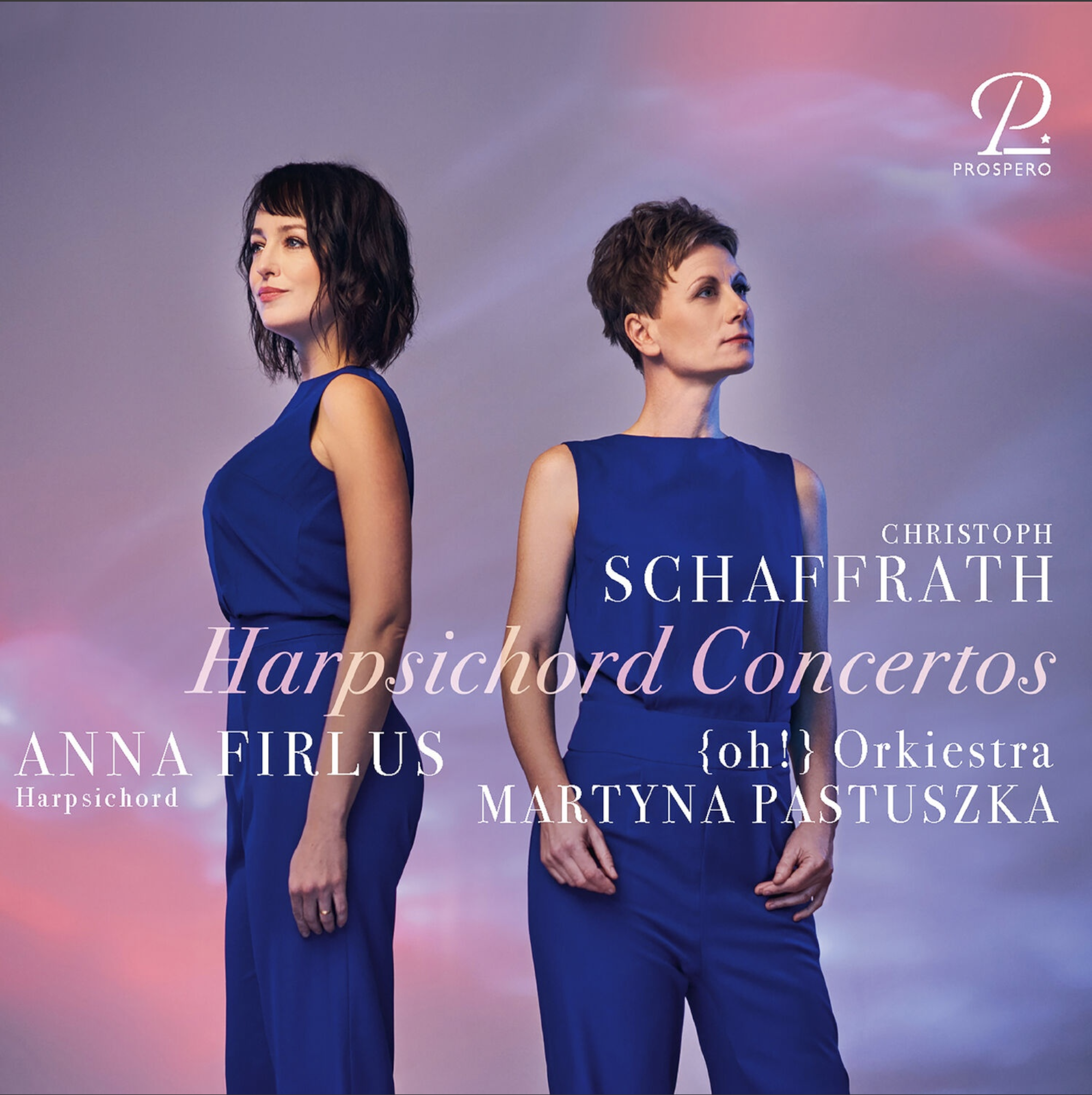
Schaffrath: Harpsichord Concertos • Anna Firlus
Christoph Schaffrath (1709–1763) served as a harpsichordist and composer alongside Carl Philipp Emanuel Bach at the court of Frederick the Great. The liner notes to this new album — harpsichordist Anna Firlus backed by the {oh!} Orkiestra, directed by violinist Martyna Pastuszka — include a fine essay on the period and note that Schaffrath wrote over a hundred concertos for his instrument. Just three appear here, all world-premiere recordings: the Concerto in G (CSWV:C:41), the Concerto in C minor (CSWV:C:11), and the Concerto in A minor (CSWV:C:53). Firlus teaches historical performance at the Music Academy in Katowice.
Schaffrath's style won't surprise anyone familiar with the music that came out of Potsdam in this period — though you'd never mistake his concertos for those of Bach's son. The first, in G, reflects the galant style throughout; it's a highly polished work. The second, in C minor, may catch you off guard: it opens with a fugue. That backward-looking gesture then morphs, somehow, into the galant aesthetic, and the finale settles into something we recognize stylistically — though in C minor it hints at some stormy stress before its frequent turns into the major. By the A minor concerto we've begun to recognize Schaffrath's signatures. He knows how to elaborate a ritornello through modulation, he favors rising chromatic figures, and he clearly enjoys dialogue between soloist and orchestra — themes passed back and forth like a ball moving up a soccer pitch.
The sound, and the ensemble's polish, are standouts. The recording was made at the Music School in Jastrzębie-Zdrój, with what I'd call a "concert-hall" acoustic — most noticeable when the full string body is playing. Even so, the harpsichord stays clear, giving an ideal sonic picture for this repertoire.
One thing these concertos make plain — and listening only confirms it — is that they were written by a keyboard player. It's easy to assume Schaffrath performed them himself, and that the writing reflects not just his style but his abilities as a harpsichordist. I say that because the keyboard parts are genuinely inventive: they go far beyond re-hashing the opening ritornello.
Take the finale of the G major concerto, which I listened to closely (without a score), doing my best to make sense of it. The keyboard writing struck me as fairly dense — dense enough to work as a solo sonata; it reminded me of a Platti sonata I once studied. But Schaffrath keeps pulling us back from all those fast notes in two ways: by handing attention to the orchestra for a statement of its own (or letting it interrupt the keyboard), and by offering shorter phrases that give the keyboardist complete control of the affect, here shaded with a little rubato. It's another instance of his care for balance — and, I think, for holding the audience's attention.
I can't fully explain the fugal opening of the C minor concerto, except to note that composers after 1750 seemed drawn to counterpoint as a kind of backward glance. What's unusual here is how Schaffrath takes the subject and spins it out for harpsichord and strings as thematic material outside the structure, if you will, of a proper fugue — not the way Haydn or Mozart handled contrapuntal movements. The writing is, I'll be honest, both odd and clever.
Schaffrath is also willing to try interesting things beyond the keyboard part itself. In the middle movement of the A minor concerto he hands the opening to the strings, then slowly pulls a thread — a ribbon of fabric, I keep picturing — away from the violin until it settles on the case of the harpsichord; the keyboard begins in a continuo role, and only at the end does the light catch its strings. That tension, if we can call it that, between strings and keyboard makes for a real structural idea in the slow movement. It's handled with a freedom that never feels formulaic. Around 6:10, violins and keyboard join in unison. Fascinating writing — I'd have loved to know what Emanuel's father would have made of it, and of how it works on an audience.
The concerto's closing movement is dramatic and stylish in equal measure, and {oh!} play it with exactly the confidence it needs — the effect is perfect. It's the kind of writing that pulls you in. The lute in the continuo is a lovely touch; I can't say whether it reflects court practice, but the texture is wonderful. Here the strong theme keeps returning to the full ensemble, leaving the keyboard in a secondary, texture-filling role. Even so, the writing reminded me of J.S. Bach's transcriptions of the Italian concertos he studied — Schaffrath shows that the keyboard could play "everything" if we asked it to…
Conclusions
Anna Firlus is a fine keyboard player. She makes this music sound easy — but listen to the little left-hand runs in the continuo of the opening track (the G major concerto) and you hear just how assured the playing is. The ensemble, keyboard included, is as tight as anyone could want.
If I'd been asking for this album for Christmas, I might have wished to hear one of these concertos on an early piano; I'm curious how the balance would work with a slightly louder instrument. Nothing is lost with the harpsichord, as I said — but I'm curious all the same.
The real show here, for me, wasn't the harpsichord — and I don't mean that as a knock on Ms. Firlus. It's that Schaffrath's writing wowed me. On the evidence of these three works, he was a genuinely gifted composer. His melodic material, which dominates the outer movements of all three concertos, is very good, and he orchestrates well, using limited forces in interesting ways — writing a short phrase for, say, basses and violins before drawing in the whole ensemble, a terraced effect that makes you notice the dynamics. And he refused to work by formula. Sure, he drops in descending-fifth sequences as readily as Vivaldi, but they're never the point. The construction of the A minor slow movement I described above? That's real artistry. The independence of the bass line at the opening of the same concerto? Yes — the ritornello could have wrapped up quickly, but he tacks on a "coda" of new material. The dialogues between strings and keyboard? He never settles on one method; he keeps looking for new ways to integrate the parts — all of it, given that opening ritornello, already there waiting to be exploited.