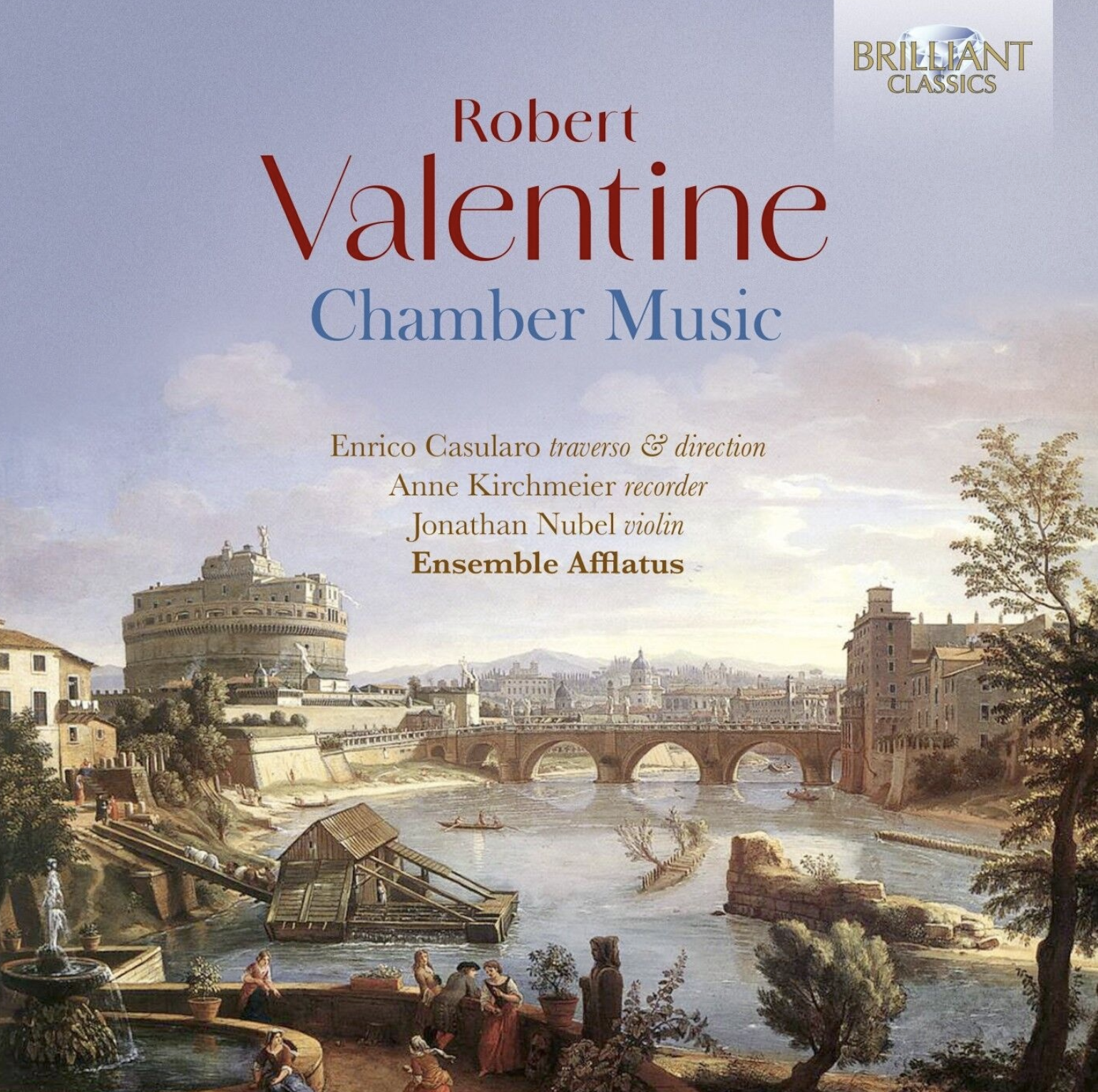
Robert Valentine: Chamber Music • Ensemble Afflatus
Robert Valentine is remembered as a recorder virtuoso who also played violin and oboe. The oboe sits this program out; the other two instruments are well represented across a cross-section of the British composer's chamber music, released last year by Ensemble Afflatus.
Valentine was born in Leicester and spent his adult life in the Papal States, where he was sometimes known by an Italianized form of his name. His style spans a long career, from an imitation of Corelli to a more galant idiom.
I'll say up front that the recording was made in Sierre's town hall — built as a chateau, later run as a hotel — and its acoustic does Valentine few favors. Soloists arrive forward with a reasonable halo, but the players behind them dissolve into reflection. In the opening traverso concerto the flute is clear and present at the expense of the strings; in the two violins and viola, the string sound is nearly all reflection, as if the players stood on a level above the soloist, looking down. I don't find it attractive, and there's no way around it but to accept it and taste Valentine's music through the distortion.
In the Sonata in D for violin and continuo, led by Jonathan Nubel, Valentine writes three movements marked fast–slow–fast. The violin's fat opening chords share a thread with Tartini to my ears. Nubel seems to play from the same deep position he held in the concerto; the reflected sound follows him, and we're left either in the worst seats in the hall or eavesdropping on a rehearsal from the corridor.
The A minor sonata for two recorders, "La Villeggiatura," gives us Anne Kirchmeier and Caroline Emery alone, without continuo — and here the room turns generous. When Valentine asks the two to play in unison, the air in the space enhances the blend rather than smearing it.
The B-flat concerto that closes the disc unfolds in four movements, slow–fast–slow–fast. Its style is appreciably older than the opening concerto's — it comes from a 1725 Naples collection — and Kirchmeier plays it on recorder, probably the intended instrument. It recalls the Neapolitan chamber pieces Il Giardino Armonico recorded in the 1990s (Musica da Camera di Napoli, 1994), and the comparison locates Afflatus: accomplished players, but not on the bleeding edge Antonini's group occupied. Allflatus' tempos are well judged, though the recorded sound blurs much of the violin writing in the faster movements. Kirchmeier's ornaments, on the other hand, are inventive and land well.
At the center of the program is a traverso sonata in E minor from Valentine's Op. 13, and here flute and continuo sit close enough together to hear the piece plainly. The five-movement design closes with a Minuetto that, like the opening Adagio, retreats from the Corellian manner; the fourth movement's dotted rhythms suggest a Gigue but reach for something more cosmopolitan, at least in the continuo, while the second-movement Allegro comes off as squarely Italian. What I most enjoy is Valentine's continuo writing — it carries far more variety than the solo line strictly requires.
Solo discs devoted to Valentine are not numerous which makes Afflatus's choice worth applauding. For comparison, a 2022 recording by Tommaso Rossi and Barocco di Napoli collects a number of the flute sonatas, drawn largely from Op. 12, with a natural continuo-to-flute balance and a far more direct sound than we get here.
The program is the disc's real achievement: a duet for two recorders, a violin sonata, a flute sonata, and two chamber concerti, chosen to show Valentine's range across his composing life. It's an excellent introduction to him. What stands between the listener and full enjoyment is the recording itself, which needed more comprehensive miking or a different room. The playing and the program deserve better.