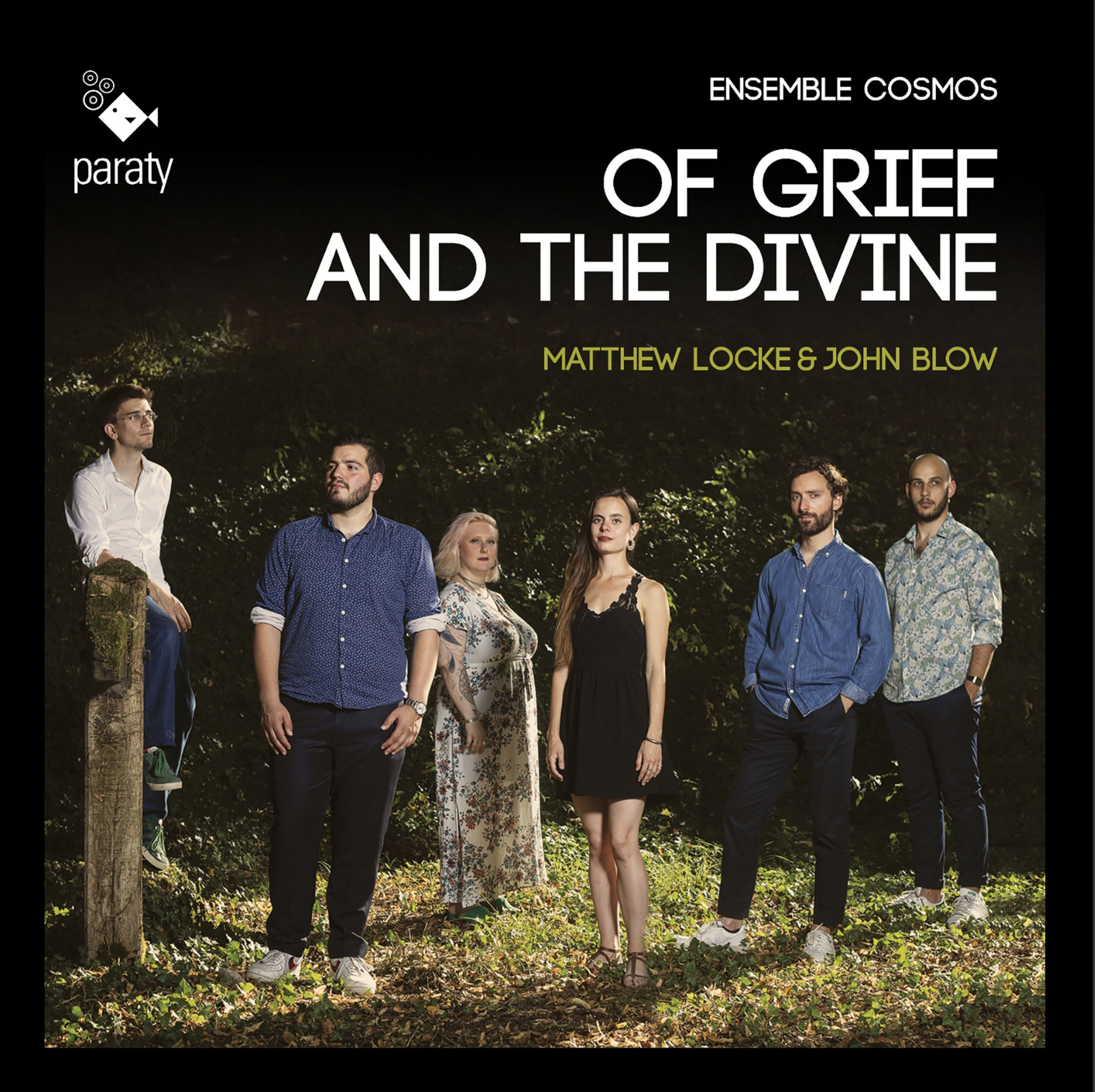
Of grief and the divine • Ensemble Cosmos
The verse anthem was England's answer to a problem the Reformation had created: how to make music that served an English liturgy without the Latin polyphony that had carried the old one. Elizabethan composers — Byrd chief among them — found it in alternation, letting one or a few solo voices declaim the text over organ before handing it back to the full choir. The form was flexible, driven by words rather than by counterpoint, and it was still developing when the Civil War stopped it. Under the Commonwealth the cathedral choirs were disbanded and church music contracted to whatever a household could sing around a continuo. When Charles II returned in 1660, the anthem repertory had to be rebuilt out of surviving part-books and the memories of the men who had sung it. Matthew Locke and John Blow are what that rebuilding sounds like from either end — Locke trained before the collapse, Blow recruited as a boy into the reconstituted Chapel Royal — writing a form that would shortly acquire strings, ritornellos, and Purcell.
Ensemble Cosmos take the verse anthem and bend it to their own concept: a one-per-part virtuosic vocal chamber group over continuo. These are not the forces the music was written for, but I found this solution to nevertheless offer a deeply affective experience.
Recorded at Saint-Pierre de Montmartre in November 2020 and released on Paraty, this is an audiophile's album — the voices arrive with a directness that is a feast for the ears, and the credit belongs to the singers and the engineering in roughly equal measure. I will not belabor the point again; assume it holds for everything below.
Purity of voice dominates the second track, Locke's Lord, let me know mine end. The independence of the lines, and the way the organ centers the blend beneath them, is catnip.
In Blow's Jesus, seeing the multitudes (track 8), the texture is dominated by countertenor Damien Ferrante — soloist set against a larger group. Even at one-per-part the balance holds and the leading voice is easily discerned. The tempo works for me, too, keeping the harmonic rhythm from going stagnant.
Both composers are represented by settings of How doth the city sit solitary (tracks 3 and 5), and hearing the same Lamentations text twice, in two hands, is the program's best idea. They have distinct flavors. Locke's is the more theatrical in its handling of the text's storytelling. Loris Barrucand supports the ensemble on keyboards, and in the Locke he switches between organ and virginal for a luxurious point of contrast. There is a soprano solo in the last third of it that simply commands your attention. Outstanding.
Two tracks belong to the instrumentalists, both Locke: a Pavan in C Minor at track six and an Almain at track nine, the latter on virginal.
The final piece, Let the righteous be glad and rejoice by Blow falls into Purcellian style. Four of the ten pieces are by Blow, and I found I preferred the Locke, maybe the final track offering its own unique impression. Either way, I kept imagining how these might sound as consort music for viols. The harmonic language would carry; what would be lost is the dramatic and rhetorical weight that only voices deliver.
Conclusions
Ensemble Cosmos woke me up. The continuo support — keyboard and viola da gamba — opens up a dynamic range that commands the listening room, and the singing is presented with a blend and balance I have rarely heard in this repertoire.
To be honest, this is the best album of English music from this period I have heard. One could make the obvious joke about the Restoration's church music arriving by way of a French ensemble on a French label; it doesn't interest me. This is repertoire that in lesser hands becomes background music to something more interesting, and Cosmos make it the main event.
I can think of no better evening than a dark room with nothing but these musicians emanating from the loudspeakers. It reframed Locke and Blow for me.