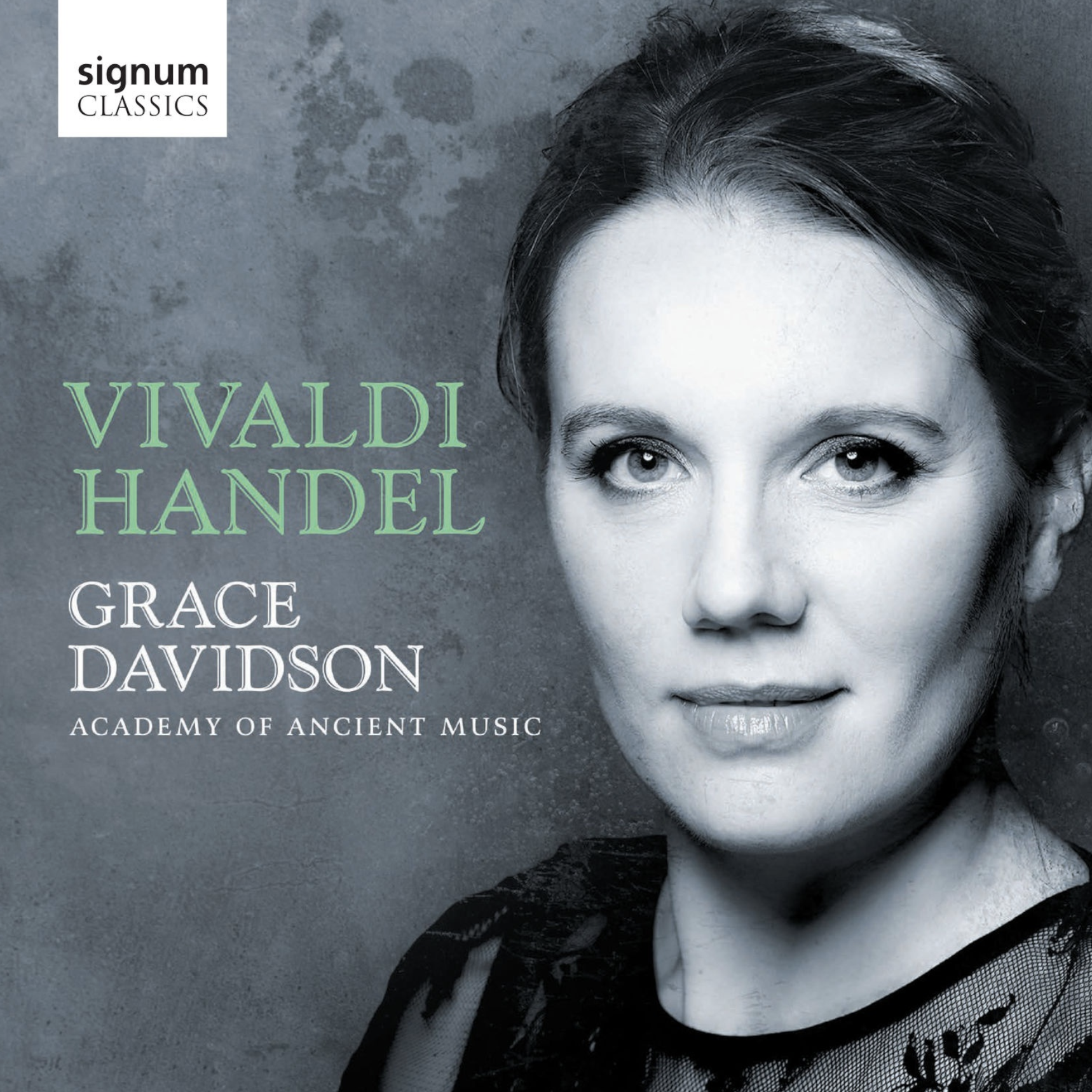
Handel & Vivaldi: Sacred Works • Grace Davidson
I'm not going to pretend I know what has happened to England's two great period-instrument ensembles — maybe nothing has — but their presence in the world recording market has changed considerably since the heyday of the 80s and 90s, when Baroque discs were dominated by the English Concert and the Academy of Ancient Music. This may well reflect what there is to be made from recordings at all in the current day.
This 2018 release on Signum Classics features cellist Joseph Crouch leading (artistically) the AAM, with Bojan Čičić as leader and soprano Grace Davidson as soloist. The liner notes indicate the recording was made under the Egarr directorship, although he was not part of this production. The sessions were held at All Hallows, Gospel Oak, in April 2015 and January 2017.
The pieces represented include:
- Silete venti, HWV 242
- Gloria, HWV deest — ascribed to Handel, but never assigned an HWV number
- Salve Regina, HWV 241
- Nulla in mundo pax sincera, RV 630
As I auditioned this album, which I'd not encountered before, I was struck several times by being fooled into thinking Davidson's voice was Emma Kirkby's. Under closer scrutiny it's easy enough to say they are not one and the same, but I share the reflection as a way of placing her voice against a well-known archetype — and Kirkby recorded the Vivaldi motet with this same ensemble under Hogwood. Davidson uses more vibrato across the board as part of her technique. It's a fast one, and not overly wide. While I'm sensitive to vibrato, especially outside operatic content, her technique maintains clear diction.
That clarity is at least partly an artifact of how the recording was made, and here is the one real problem with the disc: Davidson is placed too far forward in the balance. In my room she appears above the orchestra, up front and slightly to the right, and the image suggests she is bigger than the ensemble behind her. The clarity is a genuine benefit; the scale is wrong, and it costs the AAM.
The pieces selected make a good program. The Salve Regina, the third work here, dates from 1707 and carries an innocence for the singer that Davidson conveys well; the same character is present in the Vivaldi, although the mode changes to major. That motet was written for the orphanage that served as Vivaldi's workplace for so many years — most sources put it around 1735, though Michael Talbot argues for a considerably earlier date. Its opening two movements ask nothing difficult of the instruments, but they require a gifted singer. It's in the third movement that Vivaldi turns up the technical demands on both voice and orchestra. The finale, an Alleluia, again puts minimal challenges on the orchestra but seems designed to showcase a gifted singer.
All of the works on this disc are in Latin. The first, by Handel, opens with a French-styled instrumental Sinfonia, and the style is solidly Handelian with the oboes embedded into the ensemble. The opening is a great assessment of the ensemble by itself, and the AAM sound quite good — right up until the voice enters a good deal louder than the players and ruins the effect. This is where the balance problem does its worst damage.
The work's poetry is focused on hushing the winds, for the singer's soul is resting in sweetness. The theme of nature continues as the singer praises love in Jesus. The liner notes indicate it was written in London in the 1720s.
The Allegro in the penultimate track for this work is the most fun of the movements: quick, mimicking a wild wind storm. The playing and energy from orchestra and soloist are tight and well-synced.
The six-movement Gloria is written for far smaller forces: continuo and two violins with voice, and the violins do not play throughout. To my ears this piece takes on a far more profound character, the Italian-leaning style clearly intended for use in a church service. In that context Davidson's vibrato sounds a touch more out of place, and it leaves me imagining the work was first sung by a male voice.
Conclusions
Davidson has a significant resume focused on early music. She's got a beautiful voice that comes across clearly in this recording. There were spots where I'd have liked her to leave the vibrato off entirely, but her interpretive style is very consistently applied across the works here.
As I write this, I'm listening to the final track of the aforementioned Gloria, the Quoniam tu solus sanctus, which offers about the most challenging content on the recording. Davidson's voice never shies from a strong confidence.
The recording's sound is otherwise clear, with an appropriate sense of atmosphere. The balance between voice and instrumentalists is the one thing holding the recital back.
That said, I'd recommend this recording for myself, to add to my collection of Handel's solo vocal music.