Telemann: Französischer Jahrgang 1714/1715
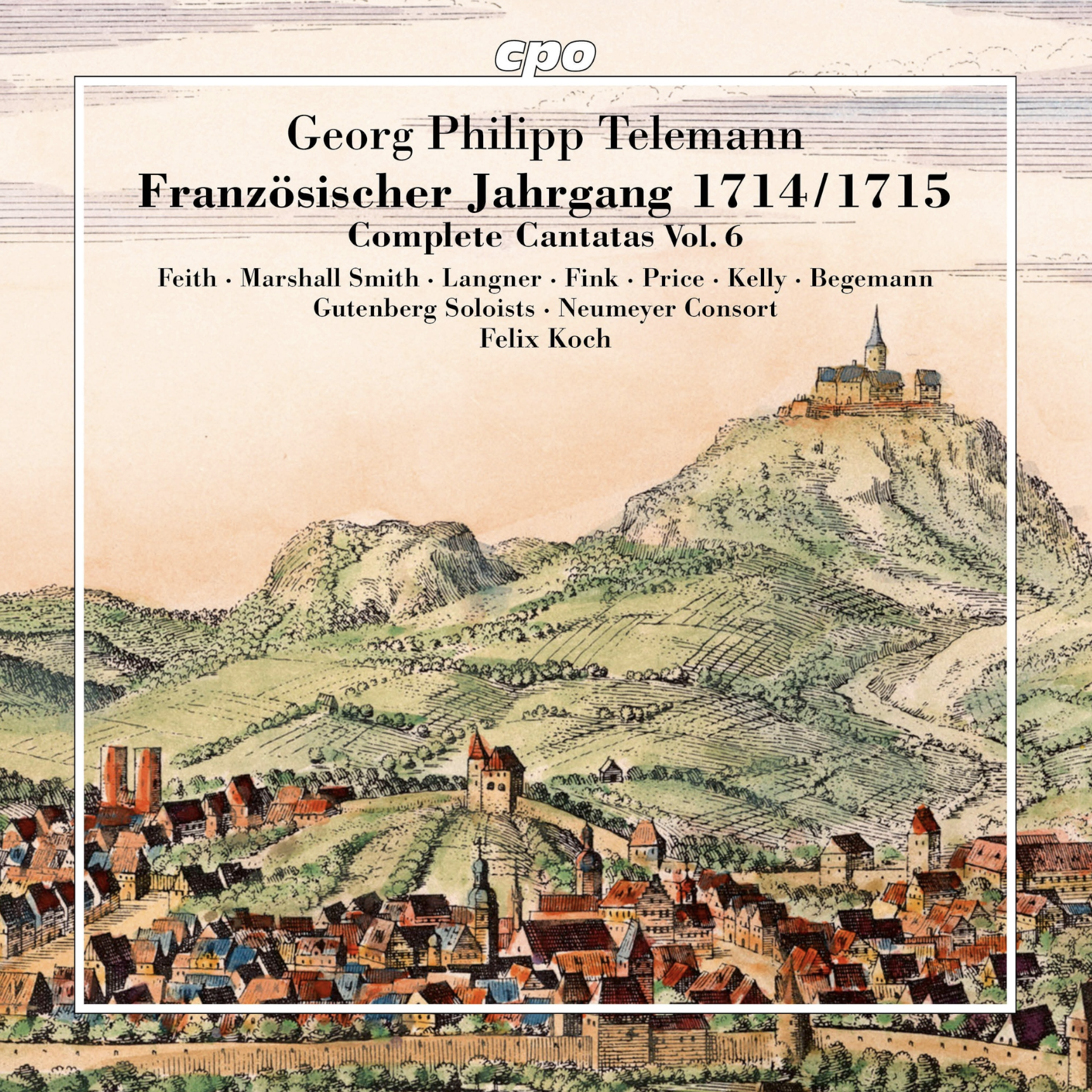
This is volume 6 of Felix Koch's series of Telemann's cantatas; the title refers to the composer's choice of producing a series of cantatas in a French operatic style. Telemann set texts by Erdmann Neumeister in Frankfurt. CD 1 gathers the three days of Christmas (In dulci jubilo, Ein Kindelein so löbelich, Lobt Gott, ihr Christen allzugleich), the Sunday after Christmas (Gott Lob! Nun geht das Jahr zu Ende — the same Neumeister text Bach set twelve years later in Leipzig, inviting direct comparison), and the Feast of the Visitation of Mary (Lobe den Herrn, meine Seele). CD 2 moves through the third to sixth Sundays after Epiphany (Kommt alle, die ihr traurig seid, Herr Jesu Christ, groß ist die Not, Der höchste Gott ist rein, Jesu, meine Freude) and closes with the Feast of the Purification of Mary (O wie herrlich wird's im Himmel) — ten cantatas in all, sung by the Gutenberg Soloists and accompanied by the period-instrument Neumeyer Consort.
Many of us may think of high baroque cantatas through the lens of Johann Sebastian Bach. The other major touchpoint would be the style of George Frideric Handel, although he left us large form oratorios over cantatas. To many ears, I think Telemann is going to hit differently.
Handel had significant training through his travels in Italy for writing vocal music; Bach looked backwards to past masters. Both men of course were influenced by the music being made around them; in Telemann's case, I often get the sense that he was pragmatic, having written music that was fresh. Each composer pulled inspiration from particular musical styles, and here Telemann is overt in applying a French operatic idiom onto the traditional German cantata skeleton of chorale, biblical dictum, recitative, and aria — the first solo of Herr Jesu Christ, groß ist die Not carries the gravity of a French overture, a chaconne-like aria sets the Isaiah dictum in O wie herrlich wird's im Himmel, and courante, gigue, and hemiola rhythms recur across arias that would otherwise read as straightforward Italian da capo forms.
The playtime for each cantata tends to be shorter than the ones left to us by Bach, as a general rule. Just over two hours of music, ten cantatas across the production.
With the emphasis on French style, you won't think for a minute that what you're listening to is French when you hear the German text. However in the opening of TVWV 1:1066, the inclusion of trumpet and timpani toggles the mind for Charpentier. The same piece has an awesome fourth movement "Amen" chorus.
The booklet provides the German text with English translation. The notes provided give commentary across each cantata. The voices are presented clearly across the production, with an immediate presence; the acoustic suggests a large church but not a cathedral. That setting works in service to the music; the orchestral forces sit behind the vocalists and their impact is far less forward.
TVWV 1:967 sets Jesu, meine Freude as a six movement cantata. Those familiar with Bach's motet will recognize the tune but the similarity ends there. The dance-like duet for alto and tenor follows an opening chorale. The blend of voices is ideal, the balance with orchestra also well done, their sound led on top by oboe. A similar pattern emerges in the soprano aria, although set in the minor mode. Telemann's treatment for the voice, against a moving background, is hauntingly beautiful. In the second section, the solo voice takes on the busier theme introduced by the instruments. The combination and connection in style to the earlier duet showcase Telemann's compositional gifts.
TVWV 1:1003, which opens the second CD, begins in minor, with a text that starts "Come all who are full of sorrow" with a bass aria. The punctuated figure with the oboe seems to arrest our attention. Telemann doesn't fully develop the piece, but instead moves on to a chorale, setting a prayer to the almighty. Cleverly, the opening aria continues in the third movement with a solo for soprano. The continuation of music from the start through different musical forms is clever. I can only imagine the economy used by the composer helped keep the audience's attention. The next aria, for alto, again seems to be built for the sense of continuity. Again, different music, but close enough in harmonic language and style to feel like an evolution of what started the piece minutes before. The chorus closes the work with affirmation, promising the believer that
Here may my heart rest.
with irresistible energy.
Many will recognize the music in TVWV 1:939, In dulci jubilo, a seven-part work. The inclusion of horn gives the work a celebratory flavor. The longest aria goes to the bass, O heilige Nacht. The piece takes on plenty of energy with running figures for the violins, repeated figures for horn. A shorter tenor aria follows, a thanksgiving offered at the manger. As the cantata for the first day of Christmas, the work serves to provide storytelling alongside the devotional outpouring. The rising figures in the final movement from the full ensemble work as an affective device.
Conclusions
The production from these musicians is high. They are vocal works and the soloists are each easy to hear and are fine singers. Vibrato is used, but in an effective way without coming off as operatic. The tempos across the board are well chosen, and winds and percussion add punch and color to an otherwise subdued string section. I got the sense, rightfully or not, that this presentation is what I might have expected to have heard back in Frankfurt.
Putting this set on and just letting it wash over you is not how you should approach the music; Telemann's style, combined with the efficient use of time, makes it easy to miss the details that make the writing interesting. For our contemporary short attention spans, taking these cantatas one at a time — with the text in front of us (apologies to those who don't read German or English) — is a good first step toward understanding Telemann's art. I found the pieces across the board to be highly accessible. For instance, Telemann will take a musical idea and it doesn't have to be clever, per se, but then he'll repeat it again. Making something new more familiar. In hindsight, it's exactly what is missing from many of the cantatas written by Bach. I almost feel these pieces do well to project the text in a stylish way. But the reliance upon counterpoint that dominates Bach's own style is gone.
Telemann does not possess here the talents of Handel in his writing of arias. The parts for instruments don't seem to require virtuosos to play alongside the singer, something often found in both Handel and Bach's writing.
In all, I found this set to be full of small surprises and found myself in higher admiration for Telemann's writing. His music never hits me in the same way Bach's does with the Leipzig cantor's profound control of harmony and counterpoint, but in many ways living in Telemann's church is like eating a lighter diet. You'll spend time with one and likely have room for the dessert for a second.