Berlin Viola Concertos • Ensemble Diderot
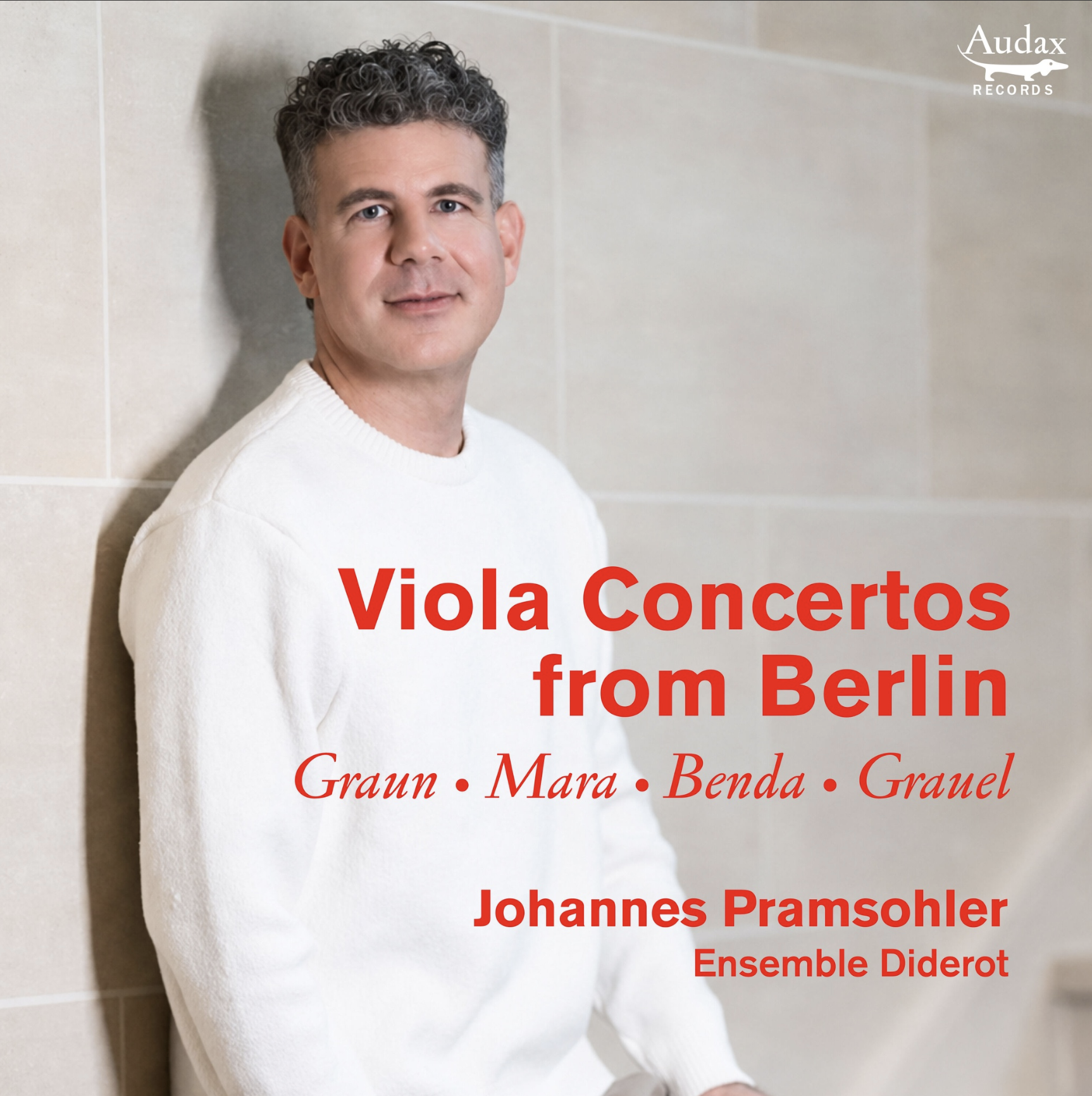
When we think of the hundreds of concertos Vivaldi wrote, the violin is the star — though he was never opposed to offering us other colors. From the baroque proper, it's Telemann who ventured a concerto for concertato viola, and almost no one else. The viola's role then was what it largely remained: filling in harmony. Its voice sat lower, and perhaps its timbre couldn't cut through orchestral texture the way a violin's could. Although you could say the same of Vivaldi’s viola d’amore and yet he hadn’t held back from writing solos for that Frankenstein instrument. The liner notes to this release take up the question, in a program of solo viola concertos from the Berlin court of Frederick the Great.
Johann Joachim Quantz, in his 1752 Berlin flute treatise, opens his section on the violist bluntly:
The viola is commonly regarded as of little importance in the musical establishment.
His explanation is unsparing: the instrument falls to beginners, or to players who couldn't distinguish themselves on the violin, and it offers too little advantage to be worth a skilled musician's time.
Phillip Schmidt's notes for this Audax production are again very well researched, though the answer to my question — why viola concertos at all — isn't conclusively given. The provenance is the interesting part. These works come from the music archive of the Sing-Akademie zu Berlin, lost since the Second World War, rediscovered in Kyiv in 1999, and returned to Berlin in 2001. The collection has drawn attention chiefly for its Bach materials; alongside them sat these unknown concertos from Frederick's court.
Diderot perform one-per-part as a chamber ensemble. Those who question the practice might look into the function of this music as the notes describe it — heard at court, in noble houses, and in the semi-public music societies where professionals and amateurs played side by side. That doesn't directly settle the number of performers, but the clarity of this recording and the technical command of the players assembled robs the music of nothing. Director Johannes Pramsohler leads as soloist on a viola by Leopold Widhalm, Nürnberg 1782, lent to him by Reinhard Goebel.
The album opens with the concerto in E-flat by Johann Gottlieb Graun (1702/03–1771). Of the composers represented he's likely the most familiar, and the one with a foot firmly in the baroque sound world. He presided over the Prussian court orchestra as concertmaster, and it's his instrumental music — the solo and double violin concertos above all — that made his name. The concerto here is finely wrought, leaning more into melody than contrapuntal structure, as the emerging galant style did. To my ears it may well have been written for the delight of the performers, at least as much for the solo part, which Pramsohler plays flawlessly.
The concerto in C is by Markus Heinrich Grauel (1720–1799). The opening Allegretto carries a simplicity in the solo part that suggests to me it may have been written for a less experienced player, though the ornaments offer something to decorate it, and under Pramsohler's bow they never feel trite. By this point I have to mention the sound of the Widhalm instrument: boy, does it have a gorgeous voice. Against Grauel's orchestral accompaniment it cuts nicely on its own terms. The upper range loses a bit of the instrument's soul in a way a violin's E string does not, but the middle and lower register is as much a star of this album as the music. The Adagio has some nice moments of harmonic tension and release. Like the Graun, melody is king. I know nothing of Grauel as a composer, but I note that the repeated-note theme from the first movement's solo part returns as a connective device in the third, which suggests a clever mind at work. And in contrast to the first movement, the third hands the simpler construction to the orchestral tutti while the solo part takes the more interesting and demanding role. Perhaps it wasn't for an amateur after all.
Grauel's other concerto, in E-flat, closes the album. There are nice moments of dialogue between soloist and orchestra in the outer movements, though the development of themes never goes deep and some passages come off as formulaic. A shift to the minor in the first movement might serve as its climactic high; on the surface it's a mechanism to stretch the material. The melodic writing isn't especially memorable, but it does pull attention to the soloist and the series of light acrobatics required. The Larghetto reeks of the sentimental style made famous by C.P.E. Bach, and the repeated material between phrases grows long in the tooth to my taste. It would be easy to discredit Grauel for not being more inventive; I'm betting the restraint is purposeful, quality musical entertainment for players who weren't professionals. Diderot and their leader never betray their own standard of technical and sensitive playing. The opening solo is an unusual compositional touch — the notes single it out as well — and Pramsohler takes it at a clip that a less confident player would have had to draw out. This Italian gesture lets the soloist stand apart from his musical peers.
The E-flat concerto by Ignaz Mara (1709–1783) is a smaller piece in length, but like the others adopts a three-movement design. Mara was a Bohemian cellist who came to Berlin in 1742, and is thought to be the player for whom C.P.E. Bach wrote his three cello concertos. There's a lot of repetition in the viola part of the opening movement, which suggests to me a technique for helping a less experienced performer maximize practice time. The Largo — muted orchestral parts giving it a particular atmosphere — speaks to a more classical idiom. The repeated figures in the finale work two ways: they plant a melodic cell that violins and soloist pass between them until it earns a place in the listener's mind, and they keep handing the soloist familiar material. I may be reading too much into a composer's attempt to write for less advanced musicians, since it doesn't come across in the writing itself. Mara proves a capable composer, and despite the shorter length his themes are well chosen.
Benda is next — in this case Carl Heinrich Hermann Benda (1748–1836), with a concerto in F. The younger son of Franz Benda, he joined the Prussian court orchestra as a violinist at fifteen and studied composition with Kirnberger; until now none of his concertos were known, and only two violin sonatas from 1785 survive besides. His writing differs from the other composers here in asking more of the soloist. His textural solutions are melodically driven like theirs, but less simple. Some of the passage work wants to light the soloist as a virtuoso outright. It's clear in the first movement, where he exploits both the lower and higher ranges of the viola, and he even leaves a hook for a cadenza. Pramsohler's time alone is another chance to hear the borrowed instrument in its glory, though the cadenza itself — composed for this recording by Philippe Grisvard — doesn't lean into the virtuosic role as much as I'd have liked in how it’s performed. The Adagio in B-flat minor has quite a formal setup before the viola enters, taken a bit brisker than expected, and I think the tempo works. The finale is all I need to say that Carl Benda was perhaps the most talented musician represented here. Its opening feels brilliantly assembled; the viola part is written so comprehensively that the orchestral support could nearly disappear without loss, and the writing throughout is more robust than anything else on the disc. I wouldn't be surprised to see this concerto gain the currency among HIP ensembles that the Telemann has. Props to Ensemble Diderot for giving us its world premiere, along with every concerto here but the Graun.
Conclusions
These pre-classical pieces — call them Rococo-inspired — are remarkable artifacts of the musical culture King Frederick II built around himself. The style his musicians cultivated lacks the high contrapuntal intellect celebrated by J.S. Bach, and to some extent by Emmanuel, who was in Frederick's employ. All of these concertos register that change in style, despite the omnipresent basso continuo. You might call it more approachable: melodies and passages that re-purpose melodic fragments through harmonic transformation. Written by four different hands, the music still exudes an almost singular emotional character of hope and pleasantry. I'll be honest — the galant style doesn't feed me the way the preceding one did. I hear it as entertainment, and I wouldn't say that about Bach's cantatas or his concertos. It was the high classical and romantic composers who found a way to infuse that deep emotional pull into a melody-forward approach to composition.
The question I kept asking through these concertos was who played them, and the notes supply a better answer than I expected. Several of these manuscripts passed to Carl Friedrich Zelter, later the Sing-Akademie's second director and, by his own account, a viola virtuoso who liked to play concertos on it. A cadenza in his hand survives in the Grauel C major; the solo part of the Benda is in his handwriting too. So the "written for amateurs" instinct I kept reaching for may have it backwards — these were the property of an accomplished player, in a musical culture where professionals and amateurs sat in the same room. Which also explains the one real outlier: the Carl Benda concerto is a significant work, and it demands multiple listens from a connoisseur's perspective. You'll enjoy the others, but that one is the find.
One of the founding aims of Musica Antiqua Köln founded in 1973 was not only to play baroque music but to perform music that hadn't yet entered the canon. Diderot are hardly the only ensemble championing unfamiliar repertoire, but I applaud their energy in bringing these works to light, and they do it with a high level of musical attention. Doing so carries risk. If the viola is the second-rate instrument Quantz called it, how marketable is a set of viola concertos by composers the public has never heard of? The answer MAK arrived at was to record both the unknown and the familiar, and Pramsohler and his colleagues are managing to make that formula work. I can't say exactly what makes the Widhalm viola special, but its tone is nearly as distinctive as the Rogeri violin Pramsohler acquired from MAK's founder. It offers a dark, chocolate sound, and it elevates the solo voice in every one of these concertos. I can imagine that instrument spending most of its life in the interior, supporting role of orchestral repertoire; its voice is absolutely a great one out front.
For those of us with a strong interest in the historical role of music, an album like this is catnip. For anyone who likes or plays the viola, it's an easy win. Whatever fault there is comes from the style itself and not the performances. Ensemble Diderot again prove to be musicians of high integrity, bringing art back to light with care and strong technical ability, continuing a short but needed tradition of unearthing what was lost and giving it new life.