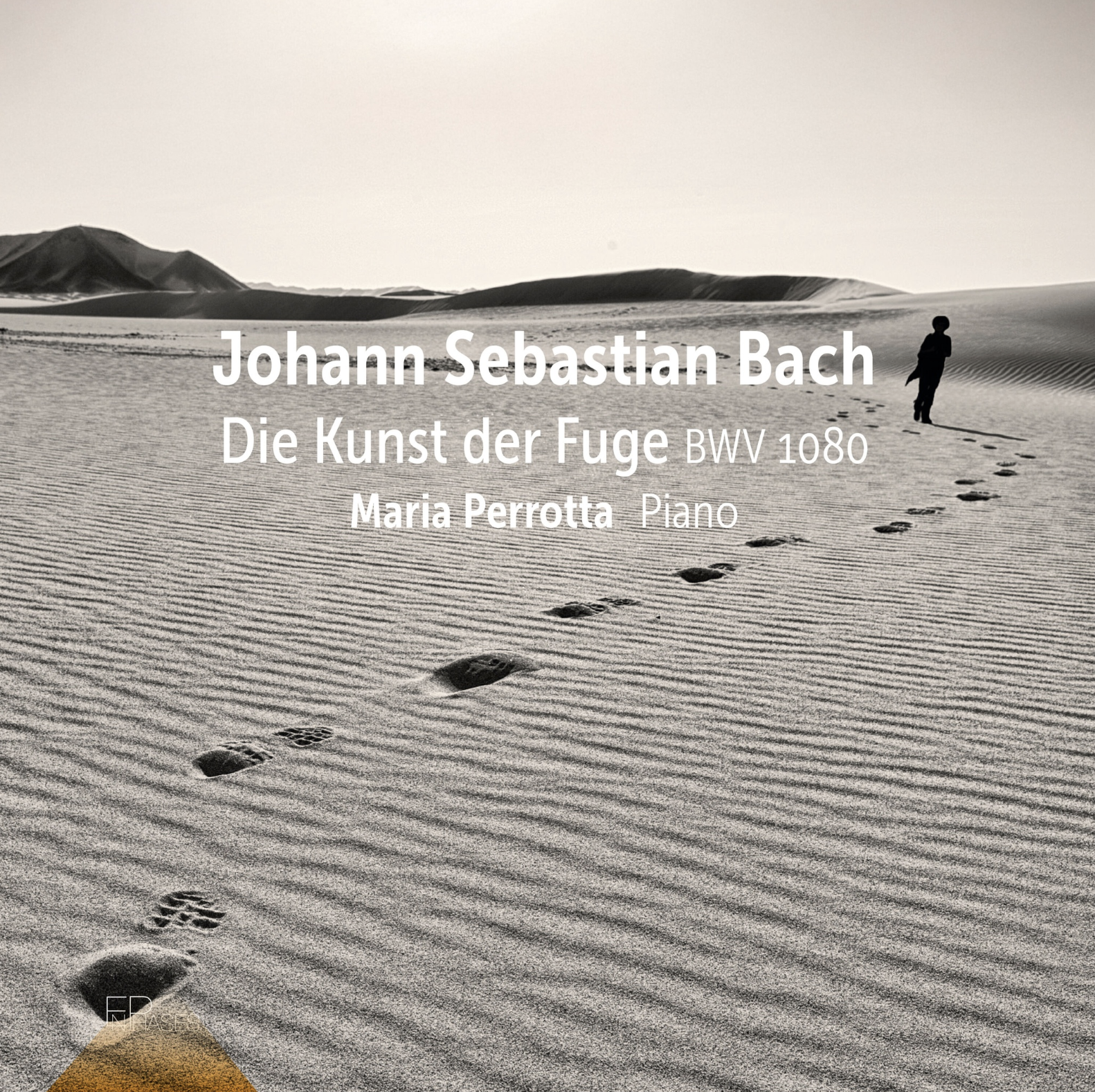
Bach: Die Kunst der Fuga • Maria Perrotta
The Italian pianist Maria Perrotta was a name I was unfamiliar with. Her bio reveals some details that you may be interested in. She won at competitions in 2004 and 2008, and has been praised for her “crystal clear sound.”
Maria Perrotta studied at the Conservatoire of Cosenza, her native city, and she graduated with distinction from the Milan Conservatoire under Edda Ponti. She subsequently graduated in chamber music from the École Normale de Musique in Paris. She also studied in Imola with Franco Scala and Boris Petrushansky and in Germany with Walter Blankenheim. In 2007 she graduated with distinction from the Academy of St Cecilia in Rome in the class of Sergio Perticaroli.
I’ll soon enough discuss her performance but one of the details that audiophile-leaning listeners will want to know about this production is that the artist has recorded upon a grand piano by Stephen Paulello. A detail of the construction of his pianos is to use all parallel strings (they don’t cross, presumably reducing resonance of one string upon another), strings he manufactures himself. The recording, too, was made in his own studio, one designed to advance the sound of the music with its design around acoustic projection. The resulting sound is warm, and the projection of each note, it is as if each note sounds with a protective forcefield around it, which is a quizzical way for me to say that the piano offers enormous transparency. For those who like the sound of a piano? This album presents it. What a gorgeous sound.
I’ve written enough reviews of this work to talk about the fact that it’s written in open score, that an instrument or instruments are not specified. Much ink has been used to discuss these issues and I’ll just say succinctly here that I believe we should treat this work as a treatise. Bach was surrounded by musicians in his day who wrote about music, Rameau being a great example. Quantz is another. I don’t think Bach was in any way aligned to writing an quasi-academic book about music. He was a musician first and foremost. And this was his attempt at sharing what he knew about counterpoint, a central tool and process for the way he composed music. It’s impossible to say if this is how Bach himself thought of the work, or if there was any plan on introducing text to accompany the evolution of complexity that takes over the work in time. Leonhardt of course points to other open-scored works that ultimately were just keyboard pieces, but these questions and thinking about the work and its ultimate function, while interesting, never help us truly get to how we might listen to it.
I’d encourage you to sample from it. The material is rich enough to allow you to luxuriate in one movement at a time. It’s therefore not important to me when musicians discuss how it should be performed or in what order. If it’s complete or incomplete. It’s obviously incomplete.
Finally, I’ll say the piano is among the worst instruments to use to perform it and maybe, too, one of the best? There’s a certain clarity that comes from performing each voice on its own instrument for those who really want to hear the piece as lines instead of what I think is easier for us to hear, which is a series of harmonic progressions. Then again, the piano, while all one instrument, offers the benefit of dynamics to allow a single keyboard player to tease out those voices and their independence from one another. Not all pianists do this equally well, of course.
Perhaps a great place to start would be Contrapunctus 6, in stylo Francese, track 6. Perrotta is very cognizant of applying different dynamics across the left and right hand, helping us to hear separately, aided by the piano’s own natural transparency, the independent voices. Dynamics in terms of phrasing, especially as she approaches the pause before the final statement? Without pedal or any particular romantic style, she presents the music with intelligent phrasing using dynamics to heighten the movement’s design. I think it’s an approach that should appeal to many. And it’s done without drawing too much attention to the performer.
Contrapunctus 8, for me, is one of the more interesting of the fugues Bach gives us. Here Perrotta varies the touch, offering some shorter, punctuated treatment in how she realizes the subject. It’s tricky to do this, technically, but I very much like the result, which for me helps to highlight the complexity of this piece, given the very characterful subject Bach uses before a second and then third is combined. That punctuated technique, especially as rhythm becomes a very important component of the contrapuntal material, works well here. Playing this all legato would be to ignore the very interesting flavor of material Bach gave us.
My favorite fugue is the 9th contrapunctus, “the fast one,” here conveniently positioned on track 9. There is a comfortable, easy-going feel to the way she performs this, not going for batshit intense. There’s a real deliberate feel to the first jump in the subject that gives the material a human rather than mechanical feel. Perrotta’s performance both feels commanding and approachable. When the lower portion of the keyboard’s gamut is activated, it’s once again remarkable how the lower notes of the piano comes at an equal weight, without overcompensating bloom and dominance. It makes me think a Paulello instrument is ideal for Bach and baroque repertoire, if a piano is your thing.
Of course some may want me to point out that the harpsichord or even the organ is not as adept at allowing the performer to highlight the differences between short and longer notes, given how they are touched and released. This distinction is what separates a good pianist from a professional. Contrapunctus 10 is ripe material to showcase the contrast here in touch between the opening’s short note treatment to later, more connected playing. I know I struggle to vary touch like this myself at the keyboard; I also know the better pianos I have played have made it easier. What I lack is the ability to keep those variances of touch continually clean and it is why I so admire the approach here. The effect comes off as simple, but I know the technical journey it took to achieve these differences in touch. It’s impressive. There is another pianist I’ve reviewed who applies a very consistent touch throughout their playing of Bach; this is what’s interesting, Perrotta is applying two approaches to bring clarity to the writing in this track, number 10.
Before she ends, as nearly everyone does with the so-called “Contrapunctus 14,” Perrotta offers the four canons, which always feel like lighter pieces. The tempos chosen for the Contrapunctus 12 and 13 movements were a bit slow, but I can understand the choice, given the overall effect that’s achieved. I was more comfortable with the tempos for the canons.
For those interested in getting into what makes these canons so interesting from a compositional point of view, I’d point to you to this resource from the pianist Evan Shinners.
The most interesting single track to use to compare recordings of the Kunst der Fuga is the the last. For one, some pianists of late have attempted to “complete” the fugue, and others perform it as written, trailing off, leaving us many times feeling the weight of profoundness in the acknowledgement that the composer left things undone.
Some performers, I feel, just play the music, not injecting any emotional weight into the piece, but what I detect here from Perrotta at the slow, mezzo-piano start is respect. The adopted tempo slows down the harmonic rhythm a bit, offering a slow and calmness that’s felt above the performance of other movements. It’s the kind of approach that works well with stringed instruments, as they have the awesome ability to sustain the notes strung together in each voice. Here again, the pianist’s touch is responsible for allowing us to hear this horizontal connectedness.
Some performers speed things up in the second part (just before 6 minutes in), but here the pulse is maintained. The tempo would allow for some ornamentation to be included, although sadly, she doesn’t turn all Koopman on us, as much as I might have liked that. Instead of using speed, however, she taps into the restrained dynamics and turns up the dynamic heat, right before the start of the third section (9:15). The choice here to literally slow things and vary touch is not shocking, but it commands our attention. Of course the reason is that we hear the composer’s musical signature.
The effect is a projection of fragility in my view. It tells me the relationship between us, and the music, has changed. I can’t speak to her intention specifically, but I feel it’s more of what I sensed at the beginning of the recording, that she’s projecting her own respect for the music and the composer. The work many times fits on one CD, but she took her time, offering us nearly an hour and a half. It’s not a romantic interpretation, it’s not attempting to portray the composer falling dead at a particular point in the music, nothing like that. But it is, I feel, an interpretation that takes into account the special nature of this last piece, its place in musical history, or our ability to point to this one thing, representing the tragedy of human death, or of unfinished art. She achieves this through restraint. It most definitely communicates something to me, but I’m not sure this restraint ultimately well-suites the music across the entire movement. In many ways, however, I like this over a performance that feels like we are winding up and then all of a sudden it ends? Like a surprise?
It’s a big deal on how artists handle the ending. Through multiple recordings we end up getting multiple viable solutions. I just wanted to document here how Perrotta approaches it in her recording.
In conclusion, this is a recording of special interest to pianists and piano lovers: it showcases extraordinary control with regards to touch and again, the sound of the piano and the recording together is an extraordinary treat. Many of these performances feel natural, furthest from being “mannered.” And there’s something attractive about that, how it comes off as very accessible music to the listener.
For me, this joins a number of other remarkable recordings and I shall enjoy returning to it. It has introduced me to the talent of Ms. Perrotta, who has thankfully already released a number of other recordings I aim to explore. Whether or not you are already familiar with her and her achievements at the piano, this recording I think should be one you’ll want to audition, even if you’re an HIPP purist.