J.S. Bach: Komm!
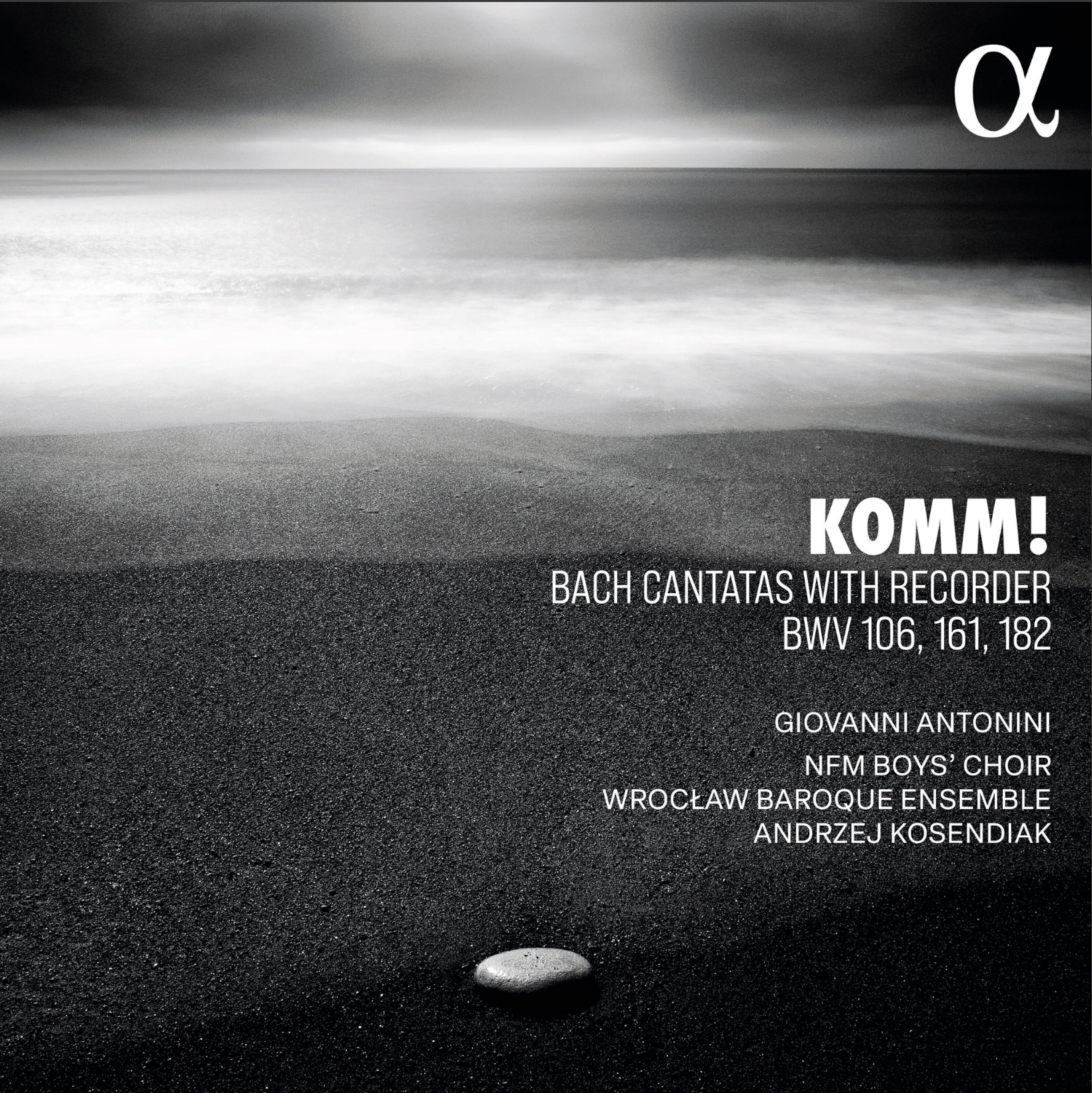
The recorder occupies a distinctive place in Johann Sebastian Bach's sacred music, its gentle, breath-driven sound frequently associated with mortality, consolation, and the promise of eternal life. Bach invests other colors in his instrumentarium with associated meanings: gambas, oboe da caccia, transverse flute, and, more rarely, trumpet and cornetto. The recorder's associations provide the unifying theme for Komm!, a collection of three early Bach cantatas performed by the Wrocław Baroque Ensemble and NFM Boys' Choir under Andrzej Kosendiak, with celebrated Italian recorder virtuoso Giovanni Antonini. Sheng-Fang Chiu also performs in the tracks requiring a second recorder.
The earliest work, Gottes Zeit ist die allerbeste Zeit (BWV 106), commonly known as the Actus tragicus, is a funeral cantata dating from around 1707, whose intimate scoring for two recorders, two violas da gamba, and continuo accompanies a meditation on death and Christian salvation.
Komm, du süße Todesstunde (BWV 161), composed during Bach's Weimar years, also contemplates death, but as a welcome release from earthly suffering, with recorders lending a particularly tender quality to its opening alto aria.
By contrast, Himmelskönig, sei willkommen (BWV 182), written for Palm Sunday in 1714, celebrates Christ's entry into Jerusalem, combining festive choruses with more introspective passages that anticipate the Passion. Here the recorder takes a prominent solo role, particularly in the expressive alto aria.
The program concludes with the devotional song Komm, süßer Tod, komm, selge Ruh! (BWV 478), published in 1736, in an arrangement that adds a recorder part. Kosendiak and his musicians approach these works through historically informed performance practice, employing period instruments, a small vocal ensemble combining boys' voices with adult male singers, and instrumental textures that emphasize the recorder's expressive and symbolic importance throughout the program. For me, the recording brings to mind the essay I just published on historical performance practice, prompted by an interview with philosopher Rebecca Lowe, precisely because these are HIPP musicians—especially in their use of boys for the upper vocal parts.
BWV 182
The cantata opens with a Sonata in which recorder and violin share a jaunty little tune. Its dance-like feel may strike some as an odd fit for its purpose, but for Palm Sunday it may very well have suited Bach's plan for something uplifting. For me the tempo of this short movement (track 15) was tame, but the spirit of celebration is nevertheless present.
The opening chorus (track 16) continues the collaboration between the two treble instruments, now with a small chorus. Instruments and singers are well balanced (the recorder is buried at times, which is natural), and there's no mistaking that we're listening to boys in the top part. The bass aria (track 18) features a well-polished violin solo, played by what I assume is a second player borrowed from Il Giardino Armonico, Stefano Barneschi. Bass Jaromír Nosek is no less emphatic.
The alto aria that follows (track 19) pairs Antonini's recorder with countertenor Piotr Olech. The effect is less successful for me: Olech applies an uneven vibrato in places. When an instrument doesn't vibrate and a voice does—outside an ornamental context—it's always an awkward match. Olech simply isn't the vocal virtuoso that Antonini is on the recorder, whose performance is far more rhetorical.
Krystian Adam Krzeszowiak is the far stronger soloist in the tenor aria (track 20), with its fast-moving bass line. The final chorus (track 22) brings recorder and violin back again. The balance again favors the singers, but the basso continuo remains a strong foundation, and the two soloists fight to be heard—which is not a criticism. The recorder is easily buried, and I prefer this authenticity to artificially projecting the "star" of the album.
BWV 106
This famous work opens with a pastoral Sonatina for recorders and gambas. Kosendiak again takes it slower than I'd like, but at least he is consistent. The opening chorus (track 2) is kept light by the smaller forces. The tenor arioso (track 3) is among Bach's most famous solos; here the soloist is Maciej Gocman. His vocal style is perfect for me, without the vibrato we got from Olech. The tempo is again on the slower side, though very serviceable.
Es ist der alte Bund (track 5) sets the solo soprano against the lower choral parts, and I'm used to hearing it sung by a professional female soprano. By comparison, a child's voice here is angelic. Of course, Bach's choral forces at St. Thomas included boy sopranos. Stanisław Adamus's performance is commendable, if not as deft as some of the female sopranos I've heard. That said, there's something about this historical voice type that speaks to me.
The alto aria (track 6) is sung by countertenor Daniel Elgersma. To my ears his style and confidence are superior to Olech's, although some vibrato does sneak in; since the accompaniment here is organ, the clash I mentioned above is less apparent. The ensemble uses a chest organ rather than a full church organ, so the voices are clearly heard above the accompaniment with good balance.
BWV 161
There's no instrumental introduction here; the cantata opens directly with the alto aria and its pair of recorders (track 9). Elgersma sings the aria while Olech carries the chorale melody, Herzlich tut mich verlangen—sung here, following Bach's Leipzig revision, rather than played as in the Weimar version. The timbre of their voices is a good match, but I still don't feel they're on equal footing in terms of confidence. Credit to the engineering team—Andrzej Sasin, Aleksandra Nagórko, and Antoni Grzymała of CD Accord—for how they place the two singers apart; the stereo separation between them is a delight.
The tenor aria (track 11) is sung by Krzeszowiak, whose vibrato here is a bit annoying. I'd rather the soloists had made a collective decision to vibrate or not than vary from aria to aria. The text is personal and calls for expression:
My longing Is to embrace the Saviour And soon to be with Christ. Though as mortal ashes and earth I will be crushed by death, My soul's pure gleam Will shine like the angels' glory.
Still, nothing in it demands quite so operatic a voice. What Krzeszowiak does well is command the aria with strong dynamics. The closing chorale (track 14), which begins
Though the body laid in earth Will be consumed by worms…
brings the recorders back into the fold with the chorus.
Conclusions
This album is curious for more than one reason, though that may not register at all with a casual browser holding the disc in a store. The name Giovanni Antonini may spark interest, but his contributions, while strong, aren't the real story of this recording.
The engineering, made in the ORLEN Main Hall of Wrocław's National Forum of Music, is something special. There's reverb, but we're nice and close to the music and the musicians making it. The balance is natural, and the dynamic range lets the soloists come out above the texture. We'd be so lucky if all of Bach's cantata recordings sounded this good.
Less praiseworthy for me are Kosendiak's interpretations. My chief complaint is his tempos—not a strong complaint, but had a few movements been pushed a bit, I'd have been happier. Less consistent, too, were the strength and vocal styles of the soloists. All of them were good enough, but only some rose to a stature worth repeated listening and further study.
Finally, this album returns to the approach Harnoncourt and Leonhardt took in their groundbreaking Bach cantata cycle: boy sopranos. Here we get them both in the chorus and in the solo for the Actus tragicus. I'll be the first to confess that I've heard stronger all-around choral performances with professional women, and I understand why ensembles use them. Women singers weren't foreign to Bach, but they were not permitted in the church music he directed in Leipzig. Whether Bach would have preferred that solo in track 5 sung by a trained singer like his second wife, Anna Magdalena, or by a boy is something we'll likely never know. But there's something to be said for the sound, which is appreciably different.
Which brings us back to the meaning and intention behind musicians who adopt historical performance practices. The essay I linked above goes into enough detail to get us thinking about what HIPP is, or why it exists at all. I'd maintain that if we're bold enough to use gut strings, old string instruments or copies, and recorders (over modern metal flutes) in this repertoire—not to mention particular vocal styles—then exploring the sound of boys over female sopranos is a worthy pursuit.
What I don't do in the essay, however, is define HIPP with any definitive guideposts or creed. I'm not sure a single creed exists, although many words have been spent defending (and objecting to) the idea of resurrecting old instruments and vocal styles, not to mention pitches, temperaments, and tempos. For me—without getting too detailed—it's an effort to slide along a performance continuum toward the way music was played in a former time. In doing so, we're better able to understand that music's context as a medium of communication, religion, and art meant to move its audience. I don't hold it as a perfect art, nor as the only option for a contemporary musician.
In this case specifically, my strongest recommendation—especially if you already own recordings of these works (though you likely won't have BWV 478 in this arrangement, nicely performed here too)—is to listen, for the excellent sound quality and the participation of young male singers. This is closer to the world in which Bach worked, and if we're to understand his art and who he was, it's worth our time to hear his music this way.
Set the historical concerns aside, and I'm happy to report it survives as affective music.