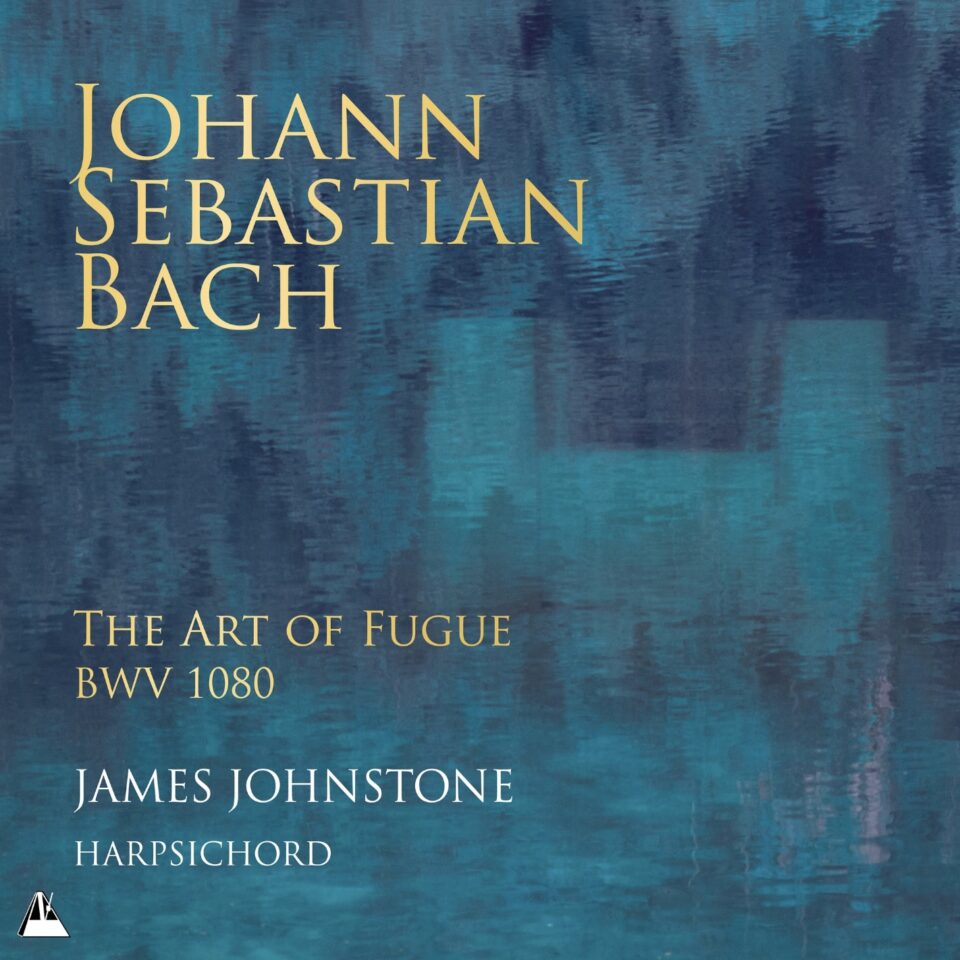
When I think about harpsichord versions of Bach’s Die Kunst der Fuga, the recordings by Robert Hill, Christian Rieger, and Ton Koopman come to mind. James Johnstone would certainly ask us to also consider Gustav Leonhardt‘s groundbreaking 1953 recording. At least he mentions Leonhardt’s essay in the liner notes, in his “personal note,” where he shares that his own introduction to the work came through Lionel Rogg‘s 1969 organ recording. We might expect that Hill and Koopman were both inspired by Leonhardt’s advocacy for the work as an ideal for the harpsichord, since both studied with him. There’s still a Leonhardt connection for Rieger, who studied with Andreas Staier, and Staier studied with both Koopman and Leonhardt. Johnstone, as we’ll find, also studied with Leonhardt’s student Ton Koopman.
I also recognize that Christophe Rousset made a recording of the work, mostly solo; he studied with Bob van Asperen, another Leonhardt disciple.
Many recordings of the work are tailored to fit onto one CD. Johnstone is a bit more leisurely with his tempos and takes two discs, including, as the last track, the chorale Wenn wir in höchsten Nöten sein, on organ. The 1751 edition, seen through the press by C.P.E. Bach, appended this “deathbed chorale” to the set of fugues, some may think as a concession to the final fugue being left unfinished.
Do we return to Leonhardt?
Leonhardt’s recording, reissued on CD in 1993 after appearing in the Musical Heritage Society’s catalog in the 1970s, is not an ideal recording. It’s interesting for judging tempos and the like, but the sound is piercing and difficult to appreciate.
Robert Hill’s recording, issued in 1998-99, is, like Johnstone’s, on two discs, and I own the set. The tracks don’t exactly align with Johnstone’s, given the work’s multiple versions and the choices artists make about performance edition. Hill’s reading is good, and the sound of this newer recording is a big improvement on Leonhardt’s. Hill plays upon two instruments made by his brother, Keith Hill, which sound excellent, although the recording over-emphasizes the bass register a bit.
Rieger’s recording comes in at 78:21. I own this CD too; it was made in the German radio recording studio in Köln and issued by AVI-Music. The instrument was built in 1990 by David Sutherland after a Zell original from 1728. Of all the musicians named so far, I find Rieger’s performances the most virtuosic in character, with some swift tempos. The sound is also excellent.
The Erato recording from 1994
Predating Hill and coming just after the Leonhardt reissue, we have Ton Koopman, joined by his wife, Tini Mathot. I saw this recording when it came out but, not understanding what the work was, avoided it; it was only maybe a decade ago that I finally picked up the CD, used. It runs 1 hour 16 minutes and features the unmistakable sound of Koopman’s favored builder Willem Kroesbergen, who has made copies of Ruckers instruments. I love the sound of these instruments too, but beyond that, the album is unique for the artists’ application of an extreme number of ornaments. Koopman’s playing, especially in this recording, draws criticism for his eccentric ornamentation. For the performance especially, though, this is my favorite Die Kunst der Fuga in a harpsichord version.
Johnstone’s Entry into the Canon
When you start this recording, it’s uncanny how alone you feel. I began listening on headphones and could really only hear the instrument; with speakers some atmosphere is audible, but the sound is still somewhat isolating. I wouldn’t call that a negative; the sound is simply focused on the instrument. The opening tempo is a bit stoic.
Johnstone plays an instrument by Stephan Geiger, a copy of a 1792 German harpsichord. On several tracks he is joined by Carole Cerasi, who plays a John Phillips copy of an original from 1722. As mentioned, the recording is very close, picking up the exquisite details of both instruments.
David Stancliffe’s review is how I learned about this recording, and he was very impressed with Johnstone’s performance. I was less so, at least where tempo is concerned. I have my own sense of taste, but there’s also a practical matter: the themes Bach employs include longer-held notes that are not affected by a slower tempo when played by strings or on the organ with its sustain. Played on harpsichord at this tempo, they hold the engagement back. Contrapunctus 4 is a track I found annoyingly slow. Yet there’s the texture of his instrument and his careful articulation, and then I start to hear the familiar in a new light. The slow tempo gives way to a pace that allows the articulation to really highlight the artifice of the fugue. It’s still not my favorite performance, but, yes: I can respect the invitation to hear the music this way. I think you should as well.
Contrapunctus 7, too, is too slow for me, whereas I found no. 8 quite ideal. I won’t go into much detail, but there’s a whole world of exploration to be had in this track, with the profound nature of the music. And when you don’t expect it, Johnstone inserts an ornament. He’s not going all Koopman on us, but the little addition here and there is nice. Maybe a nod to his teacher?
Like Koopman, he invites a second musician to work through later portions of the work, such as tracks 1-2 on CD 2, Contrapunctus 12. The two instruments are synergistic, I’d say, but tempo is again what holds me back from getting excited about the collaboration. For comparison, Johnstone and Cerasi clock in at 2:43 for the inversus, while Koopman and Mathot clock in at 2:20. It’s not a remarkable difference, but Koopman’s recording benefits from the performers’ drive on the downbeat and those florid ornaments.
Many may obsess over the “last contrapunctus,” sometimes labeled no. 14, which Bach left unfinished. Koopman plays through it in under seven minutes, Rieger in 9:34, Hill in 8:12. Johnstone is no speed demon, but he closes it in just over eight minutes, without playing the final, trailing-off passage, so I’d wager his pacing is on track with Hill’s. Comparing the two, Johnstone’s recording is much clearer, and the way the harpsichord was captured, without bloat in any one area of the frequency range, makes his recording, for me, superior to Hill’s. But why would you not play the entire piece, with the trailing-off phrase with which we’re now so familiar?
Reinhard Goebel closes in a similar way in his 1984 recording, using strings and harpsichords, with both Hill and Staier participating. So the practice isn’t unheard of, and maybe it’s more respectful, given the desire to make music. Of course, some musicians have attempted to finish the fugue, which for me would have been ultimately more satisfying.
Conclusions
I always welcome a new recording of Bach’s Die Kunst der Fuga. The one recording I haven’t discussed yet is Rousset’s, made in 2020. His recording offers more atmosphere than Johnstone’s, but his program of tracks is even more unusual, not including the final fugue at all. He also adopts the most piquant tuning among the recordings. His recording ultimately didn’t stun me speechless. His technical abilities were on full display and left much to admire, but there was a lack of the feeling I think this music can’t do without.
Johnstone does offer some of that, though not to the degree of my favorite performances, which use more instruments than a single harpsichord (or two). Rousset may be the perfect companion to Johnstone’s recording, I think, not only for his choice in tempos, but for his sense of time and the recorded sound.
I am disappointed I don’t have the same level of superlatives to offer Johnstone’s recording as Mr. Stancliffe. The recording is, above all else, honest and clean, and it gives us an easy opportunity to hear the totality of Bach’s masterwork, at least the 1751 published version.
For me this work deserves more study and listening, and in taking that adventure seriously, I’ve heard within it so many beguiling phrases, harmonizations, and moments that deserve an interpretation that pulls on them in a way that arrests our attention. This performance stopped short of that for me.
What it does offer is excellent sound and a presentation without artifice or fancification. Rieger offers more energy; Koopman, more flair. Hill’s disposition isn’t too far from Johnstone’s, and in the few cases where I favored Hill’s tempos, Johnstone’s recording offered that superior sound.