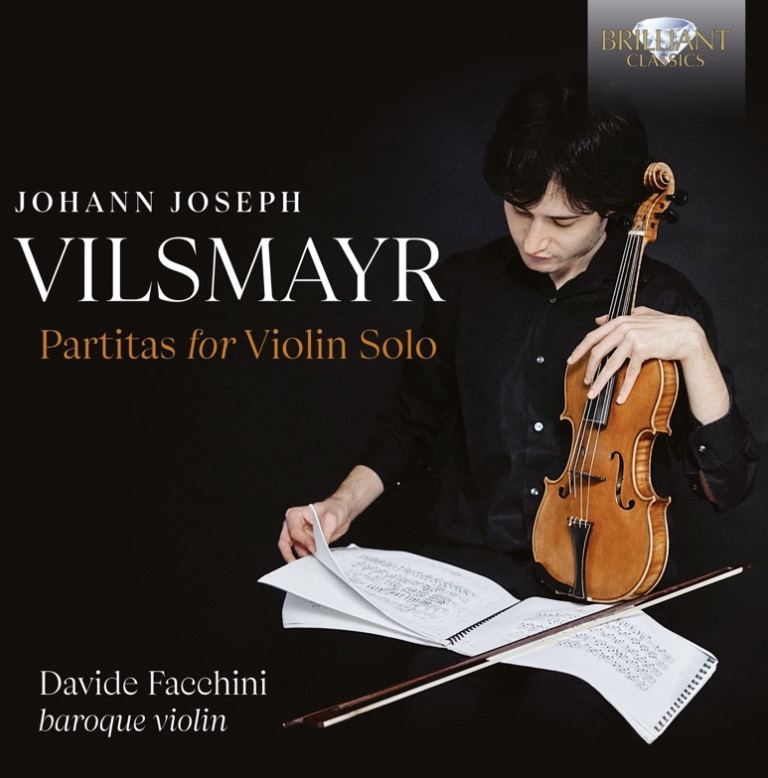
Published in Salzburg in 1715, Johann Joseph Vilsmayr’s six partitas for unaccompanied violin, Artificiosus Concentus pro Camera, belong to the tradition of solo string writing that flourished before Bach’s sonatas and partitas. Vilsmayr (1663–1722) joined the Salzburg court’s chapel in 1689, placing him within the orbit of Heinrich Ignaz Franz Biber, his probable teacher.
These compact sequences of dances and arias display his talent for melodic grace and harmonic richness. Four of the partitas employ scordatura to extend the violin’s resonance and color. Their blend of elegance, ingenuity, and instrumental daring offers a vivid glimpse of the musical world of Baroque Salzburg. The use of mis-tuned strings means a musician was not going to perform these in sequence; further evidence that these collections wouldn’t have been heard as we might hear them now, as an album.
Each partita opens with a Prelude and proceeds through dances and arias, and some of the titles may be unfamiliar to listeners, such as the Rigodon (track 42) and the Retirada (track 46), both from the G minor partita. The spellings are not all Frenchified either: the movement titles there include Guiqß for the gigue and Boure for the bourrée. I’d argue the style isn’t necessarily French, either. These pieces carry a virtuosic flair that Facchini is technically prepared to meet, but what they convey is something I’d call more Germanic, which is to say a style that finds itself by borrowing from other origins. The Retirada is a fair example: Biber closes a suite in his Mensa sonora with one too, and Vilsmayr uses it to end the G minor partita.
The sound on this recording is close, with plenty of reverb. It’s always a fine balance, especially with a solo instrument. Here I think the balance is well managed, but a tad wet for my ultimate taste. The performer steps away from the mikes in a few cases for effect, giving us an even more vivid sense of the space in which he’s performing. He plays his baroque instrument without much vibrato and with a good declarative style, essentially leaning into the composer’s rhetorical phrasing. What the reverb offers, honestly, is a nod to the composer, using the room to build harmony through arpeggiated chords and the like. Listen to track 20, the Ciaconna that closes the B-flat partita’s ten movements. The reverb is perfect for this type of piece.
I’d refer listeners to Telemann’s solo Fantasias, which, though the title differs, fit the model used here.
What’s missing from this set, and what Biber’s writing gives us, is development. The short movements suggest the stylus phantasticus, but there’s a certain rigidity in the delineation from one dance to the next, where with Biber one idea dovetails neatly into the next. Unclear to me is whether the performance tradition in Salzburg would have entertained the performer adding doubles to a movement, increasing the original’s complexity. We see evidence of the tradition in Bach’s first partita, but it’s a question I alone cannot answer. Vilsmayr does write out some variations himself, as in the Aria – Variatio and the Aria variata in the closing A major partita, so the impulse was at least present on the page. It’s that last movement (track 57) that maybe best mimics the form used by Biber of a theme and variations. Not going to complain that it’s the longest movement on the recording.
The real talent of any composer writing solo music lies in conceptually divorcing the instrument from the basso continuo. The violin or cello offers relief through access to multiple strings, and Vilsmayr leans into touching on bass notes, essentially splitting the texture into two voices (as in the G minor Saraband, track 41) or using double-stopping. The title page of the 1715 print announces exactly this ambition: à Violino Solo Con Basso bellè imitante. The partitas move through A major, B-flat major, C minor, D major, G minor, and A major. The two A major partitas use the normal G-D-A-E tuning, and scordatura is applied in the four between them: the B-flat partita lowers the top string to D, for example, and the D major partita is tuned A-E-A-D. It may be in the G minor that I noted the strongest change in Facchini’s instrumental timbre, but none for the worse, just different.
Readers may already know Gunar Letzbor’s complete recording on Arcana. The two violinists enjoy a similar sonic picture across their recordings, although this new one has a bit improved resolution for the closeness to the violin we get. There are moments where Letzbor comes off as a showier performer, but it’s not just speed. He can push his instrument harder, which I might call an overly masculine approach to interpretation, more aligned with Goebel’s style. The energy is appreciated, but I am not sure that approach is warranted by the character of these dances. If that recital put off listeners, I think this reading by Facchini will be better appreciated.
There were a few moments where I wished Facchini had leaned into vibrato for affect. The perfect candidate might be the opening Prelude of the B-flat major partita, track 11, the first of the set to call for retuning. There is some vibrato, but I’m talking about the longer notes, where a couple of beats of movement would have given us just a little color. He does lean in, if only a bit, in the Aria Lamentevole (track 27).
While most of these short movements sound straightforward, they challenge the player and need a skilled artist. The C minor partita is a good place to hear the range, and its nine movements are laid out in contrasts. They would also have served as a pedagogical tool for the advanced player.
For us, they serve as fascinating exemplars of the violin’s evolution from a lower-class fiddle to an instrument capable of imitating the voice and ensnaring the attention of the listener without the accompaniment of peer musicians. Davide Facchini is unfamiliar to me, but he has proven through this production to be a formidable player with good taste. Born in Rome in 2000, he studied with Enrico Onofri, Lorenzo Ghielmi, and Enrico Casazza, and this is his first album. I can’t wait for the next. Formidable!