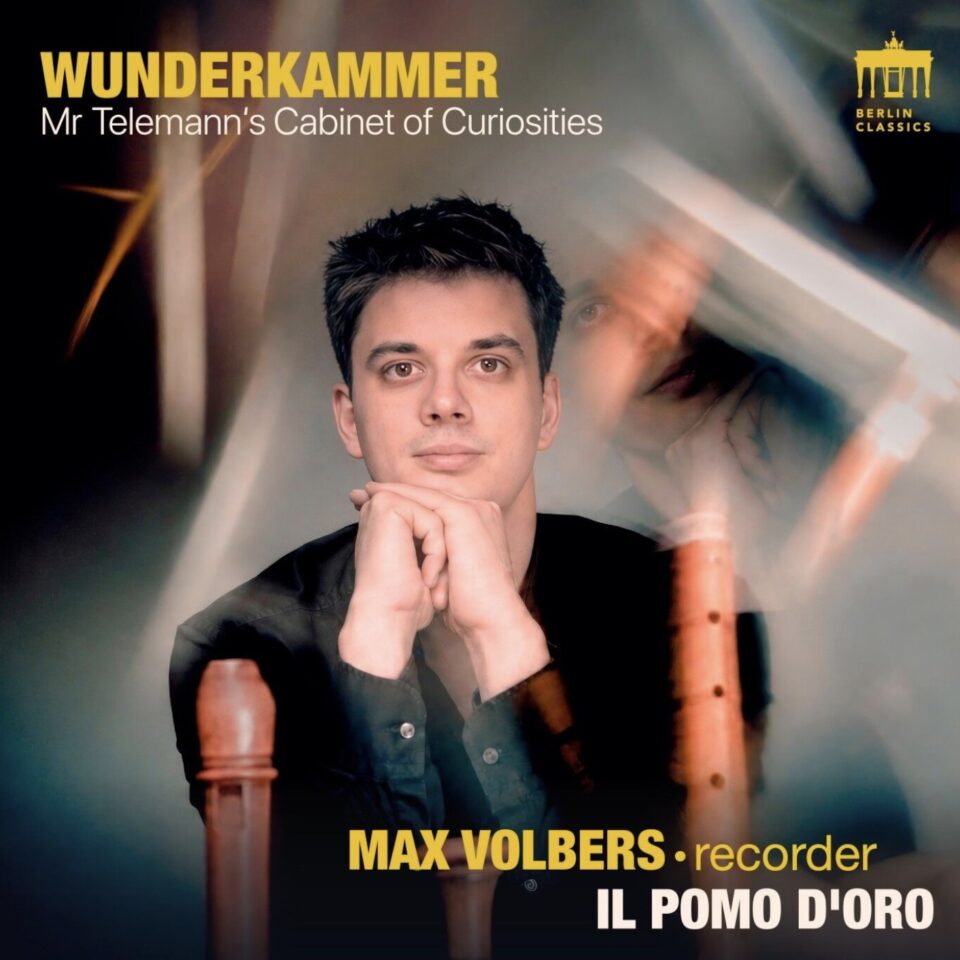
The novelty of this album is that it presents a composer’s works through a new lens of sorts. A kaleidoscope might be the better analogy. I’ve enjoyed recordings with Max Volbers before, and this time he’s joined by Il Pomo d’Oro in a small configuration with single strings on each part. As you’d expect, the album includes the famous Overture-Suite for recorder in A minor, TWV 55:a2. The other straightforward piece is the F minor sonata, TWV 41:f1, originally scored for bassoon and continuo (the 1728 print allows recorder). The rest is arrangements, and the opportunity is to hear familiar Telemann in a new light.
The opening overture-suite in G is a pastiche built from movements borrowed across Telemann’s overture-suites. Of them all, I found track 4’s L’Hypocondre the most affective, with its changing moods. The Harlequinade on the next track also impresses, with its fast tempo and Volbers’ clean, technical playing. These highly colorful pieces work well together as arranged, and the final Chaconne from Die Satyren in Arcadien, TWV 21:8, is a fitting closer. The flourish at the end? Now he’s showing off. But why not?
The album was made at my favorite recording location, the German radio Kammermusiksaal in Köln, made famous in my eyes as the site of MAK’s Brandenburg Concertos, and it’s nicely balanced with reverb. My one persistent reservation is placement. Volbers is up front, clear, and stage right, but the ensemble is pushed back and thin in spots, without any especially deep transparency. The continuo suffers most. Jonathan Álvarez’s bass is present in the texture, but I wanted more from it, and I’d fault the microphone distance, maybe, rather than the player. That is the condition of the whole disc, so I’ll only flag where it lifts or bites hardest.
Perhaps the most transparent piece here is the F minor sonata, where the soloist is nearly wholly responsible for moving us through the performance. I’ve heard so many sonatas like this one, played more or less cleanly, as written, without any extroverted attempt to move us. Under Max Volbers, our delight seems to be front of mind. He has many tricks up his sleeve: bending pitch, adding vibrato, adding clean ornaments, and using rubato to give us more than just the notes on the page. His continuo partners are synchronized with his agenda. What’s harder, and what he attempts in the final Vivace, is to make all those fast notes sound both intense and relaxed. The opening phrase has sharp articulation, and in the next he adds microseconds more time to the notes, shifting the mood to something less intense. He’s a virtuoso. I’d take a whole box of his Telemann sonatas.
The foreign (Polish) styles introduced in the opening pastiche return in violinist Alfia Bakieva’s arrangement of dances 26 and 29 from TWV 45, featuring violin. The ensemble leans hard into the folksy idiom. It’s impossible to say whether Telemann would have recognized the style as presented, but I enjoyed the attempt, which isn’t the first by HIP ensembles.
Another ensemble piece without recorder is the E minor Passacaille, TWV 55:e4. The performance is good, but with no soloist to anchor the picture, this is where the recessed sound disappoints. I wanted the same spotlight on the first violin that Volbers enjoys elsewhere. The playing was excellent, so get us closer to the action, please, with transparency.
Fuga 14 from Telemann’s Zwanzig kleine Fugen, TWV 30:14, was also included on Nevermind’s Telemann recording, where it’s one of my favorite tracks. It’s short at just 2:22 and simple in texture, but Telemann packs some very affective music into those few bars. Dynamics lead here, as they do with Nevermind, but I’ll admit Il Pomo d’Oro don’t get nearly as close to nirvana as Nevermind did. It does serve as an interesting introduction to the A minor suite.
I’ve heard this work live and across many, many recordings. What first gets my attention is not the recorder player but the energy and gusto of the small band. That energy in the slow opening of the Ouverture sets the stage for what is to come. The clean, articulate playing of Volbers in the faster sections is infectious. You can’t get enough of it.
In Les Plaisirs there’s a trap, in my view, of going too slow. The tempo here seems ideally chosen, and the recording captures Volbers’ solo playing above the ensemble with good balance. It’s the spotlight I mentioned earlier.
There’s also a risk with the Air à l’Italien, which here clocks in at 7:29. Many recordings run in the six-minute range. The key to going slower is making the solo part pull us inward without growing boring. Volbers does pull a few tricks, as does violinist Alfia Bakieva. The movement has a faster middle section, and the musicians here take it faster than normal. In total, I felt the slow tempo, with improvisatory gestures from the violin and Volbers’ tone and ability to ornament, made for an engaging hot summer’s stroll through the garden.
Neo Gundermann’s guitar in the Réjouissance is entirely too loud and feisty. I couldn’t get enough. The piece’s virtuosity isn’t limited to Volbers, who delivers, but spreads across the entire ensemble. The pair of Passepieds might have been a tad quick for my taste, but the final dance, the noble Polonoise, is exquisitely led, again by Bakieva. The balance when the recorder enters is perfect. Volbers again attracts attention with his varying articulation, which I thought was exactly right.
Conclusions
I expected this album to be good, but that expectation rested firmly on Volbers’ reputation. What I hadn’t expected was the close collaboration between recorder player and band. Using fewer strings has its advantage, and here the entire cast gets to frolic in the virtuosic waters.
I think the musicians did well to expose the Wunderkammer of Telemann. I honestly question whether Telemann enjoyed performances this crisp, engaging, and colorful in his own time. My speculation serves no purpose other than to lend these musicians very high praise. This album sets a new high bar.