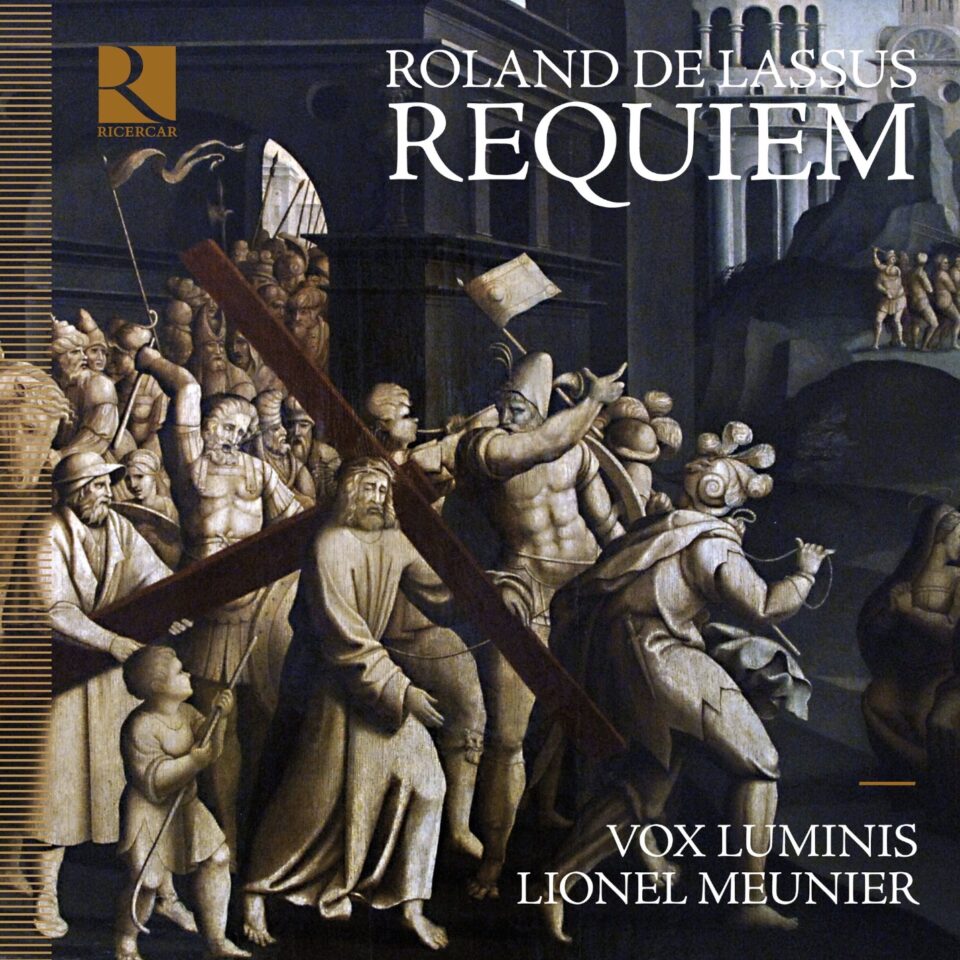
On the heels of my review of the Alchemist recording comes this new album by Vox Luminis, an ensemble I’ve had the pleasure of hearing live more than once. Lassus was prolific, with more than eighty masses to his name, and only two of them are funeral masses. Both are here: the Missa pro defunctis à 5, H. vi/135 (LV 963), and the Missa pro defunctis à 4, H. iv/95 (LV 624).
For those looking for a Lassus album with exquisite sound, this may be the one. The recording was made in October 2025 at the Église Saint-Rémi in Franc-Waret, Belgium, and the presentation via headphones is surreal: I heard the extent of voices well beyond the boundaries of my two ears. I auditioned the Qobuz 96kHz version, with no Atmos trickery. The ensemble’s relaxed demeanor fits the bill, and the album achieves a perfect balance of church atmosphere and vocal transparency.
Another album I own and with which I’m familiar is the one by the Hilliard Ensemble (ECM New Series) which includes the 4-part requiem mass. While I admire the Hilliard sound and aesthetic, the recording here is offered transposed down and provides and comparative version at lower pitch.If I could only have one recording, this new one by Vox Luminis, I think, steps ahead.
The two works on this disc differ in vocal character. The five-part mass is scored for cantus, altus, two tenors, and bassus, with the cantus parts sung here by women. The four-part mass lies at an altogether lower tessitura: tenor, baritone, bass, and deep bass, voices for men alone. The liner notes point out that this low scoring is a rare feature in the repertoire, and it survives in an Augsburg manuscript dated 1575 that transposes the music down a fifth. The sonic character is darker, and the timbre of those low voices is unusual but ultimately very interesting. Combined with this timbre is a series of harmonic shifts that don’t follow later, recognized harmonic tonality. The modal approach offers contemporary listeners something otherworldly, although that association is purely created by our lack of familiarity with the sounds of Lassus’ time.
The two masses also have different histories, which is worth knowing when you listen. The four-part setting was printed in Paris in 1577 by Le Roy and Ballard; the five-part setting is later, published in Munich in 1589 as the last of the six five-part masses in the Patrocinium musices. The track order on the disc is therefore not the order of composition. The liner notes find no evidence tying either mass to a particular funeral, including that of Duke Albrecht V of Bavaria, who died in 1579.
Lassus has a quality in his writing to use harmony to grab the listener’s attention, even if the formal arrival of these harmonies is dictated by individual lines. He doesn’t seem to be using purely polyphonic writing; rather, he writes homophonically within the movements that define the mass. Plainchant is never far away. In the four-part setting, nearly every section opens with a chant intonation from the deep basses, and the Dies irae alternates chant and polyphony, with a verse not found in the Paris print. Both masses also reduce the texture to two or three voices for individual verses, an old practice going back to Dufay’s generation.
Funeral music, as a genre, may not appeal to many of us, and Renaissance music may not speak to us as directly as music from later periods. However, Lassus’ music is not often performed this well. Whether you approach this repertoire as a religious experience, a historical one, or simply for its ability to transport us someplace pleasing yet unfamiliar, this album offers us a strong stamp for our passports.
For students of this music, the album also succeeds in presenting the only two examples of the composer’s funeral music, and I like that they differ in both scoring and form. The five-part mass offers a Tractus; the four-part mass adds a Graduale and, in place of the Tractus, a Sequenz of unusual scale. Both end with a Communio, but the musical material between them is different.
For me this is not every day repertoire, but as far as my appreciation of Lassus grows over time, this recording contributes to that appreciation.